Event: 12-13 April, MIT campus, Forum on Future Cities

Technologies

Forum on Future Cities hosted by the MIT SENSEable City Lab and the Rockefeller Foundation 12-13th April 2011 | MIT Campus, Cambridge, Massachusetts.

The Forum on Future Cities will bring together leading thinkers in academia, industry and government from around the world to discuss the most pressing issues of urbanization, and explore how they are being impacted by a wave of new distributed technologies.

Confirmed participants:
Adele Santos, Dean of the School of Architecture and Planning, MIT, Anthony Townsend, Technology Forecaster and Strategist, Institute for the Future, Antoine Picon, Harvard Graduate School of Design, Department of Architecture, Harvard, Beatriz Lara, Director of Strategy and Innovation, BBVA, Dennis Frenchman, Department of Urban Studies and Planning, MIT, Frank Jensen, Lord Mayor, Copenhagen, Irving Wladawsky- Berger, Strategic Advisor, Citigroup, Joe Paradiso, Director of Responsive Environments Group, MIT, Jonathan Rose, Founder & President, Jonathan Rose Companies, Mark Spelman, Global Head of Strategy, Accenture, Martin Fleming, Vice President, Corporate Strategy, IBM, Nancy Odendaal, Snr. Lecturer in City and Regional Planning, University of Cape Town, Nicholas Negroponte, Founder & Chairman, OLPC, Nicola Villa, Global Director of Connected Urban Development Group, Cisco, Peter Ong, Head of the Civil Service, Singapore, Simon Giles, Partner, Accenture, Stefan Köhler, Mayor of Friedrichshafen, Thomas Menino, Mayor of Boston

Thriving on Chaos–Brings out the “Right Stuff”

Collective Intelligence
Seth Godin Home

Making a straighter ruler

It's not easy. It's hard to get straighter than straight.

Over time, processes that seek to decrease entropy and create order are valued, but improving them gets more difficult as well. If you're seeking to make the organized more organized, it's a tough row to hoe.

Far easier and more productive to create productive chaos, to interrupt, re-create, produce, invent and redefine.

See Also:

Robert Garigue: Feedback for Dynamic System Change

Reference: Russell Ackoff on Doing Right Things Righter

Review: Reflexive Practice–Professional Thinking for a Turbulent World

Reference: The Future of the Internet

Advanced Cyber/IO, Autonomous Internet, Collective Intelligence, Communities of Practice
Jon Lebkowsky Bio

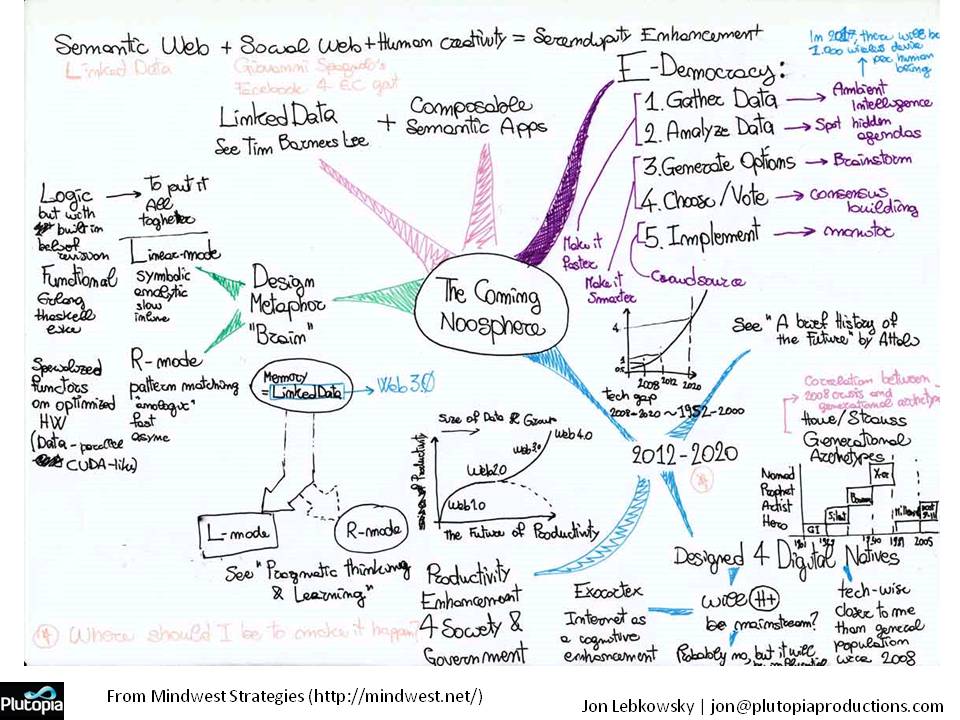
Jon Lebkowsky is, among many things, contributing editor of Extreme Democracy (Lulu.com, 2005).  His briefing below brings up many points, among which three stand-out:

1.  There is no lack of intelligence–what is lacking are the tools for achieving extreme democracy in the face of a tsunami of noise and electronic pollution, with five core functional requirements:   gather data, analyze data, generate options, choose/vote, and implement.

2.  The principle challenge to democracy at this point in time is not from governments, but rather from those corporations that presume to “own” the Internet and all content irrespective of who generates it.

3.  Freedom Box (and what we have begun calling the Autonomous Internet) are an alternative–while he does not go into detail it is clear that there is a sufficiency of both money and knowledge to create a distributed Autonomous Internet.

Click on Image to Enlarge

Source of the Graphic

Briefing Online (Downloadable, No Notes)

See Also:

Lebkowsky at Phi Beta Iota

Mother Jones: It’s the Inequality, Stupid!

07 Other Atrocities
Click on Image to Enlarge

Eleven charts that explain everything that's wrong with America.

— By Dave Gilson and Carolyn Perot

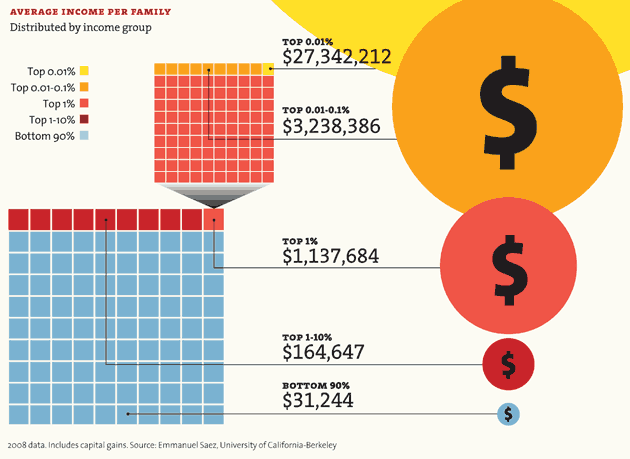
How Rich Are the Superrich?

A huge share of the nation's economic growth over the past 30 years has gone to the top one-hundredth of one percent, who now make an average of $27 million per household. The average income for the bottom 90 percent of us? $31,244.

Phi Beta Iota: We don't make this stuff up.  Read all eleven charts.

O3b Satellite Broadband — Google Cell Play?

Autonomous Internet

O3b Networks delivers broadband connectivity everywhere on Earth within 45 degrees of latitude north and south of the equator.

Our vast coverage area includes emerging and insufficiently connected markets in Latin America, Africa, the Middle East, Asia and Australia, with a collective population of over 3 billion people.

Home Page (About)

SatMagazine 2010 Year In Review on O3b

O3b Networks: A far-out plan to deliver the Web (CSM)

Africa, Web Access: What Google's Doing Right (ABC)

Continue reading “O3b Satellite Broadband — Google Cell Play?”

noble gold