Senior American military officials Wednesday threw cold water on reports of an attempted coup d'etat in Qatar, nerve center for the U.S. military campaigns in Iraq and Afghanistan.
+++++++
Original Source
Arab Websites Report On Failed Coup Attempt In Qatar
Various Arab websites are reporting on the sudden firing of senior Qatari military officials after they staged a failed coup attempt.
BY THREATENING to veto the defense appropriations bill if it included money for more F-22 stealth fighter planes, President Obama signaled that he was going to put an end to the way business has been done in Washington. We applaud the president?s announcement, but so far it is more symbolic than real.
In the attached essay, my friend Jeff Madrick uses the unbridled greed of the finance industry (now trying to rescue itself from its own excesses by sucking at the government teat) to highlight the basic hypocrisy in the so-called free-market economy of go-go capitalism. Jeff summarizes the results of two recent mainstream economic studies which show the egregious bonuses in the finance industry are simply the fruits of unfair economic privilege. To economists, this privilege takes the form of obscene economic “rents” — i.e., the excessive revenues and inefficiencies that competition is supposed to eliminate under the capitalist theory (ideology) of free markets.
David Jimenez holds an A.A.S. in Intelligence and Imagery Analysis from the Community College of the Air Force, a B.S. in Management and Human Resources from Park College, and an M.A. in Human Resource Development from Webster University. A United States Air Force retiree, Mr. Jimenez was awarded the Distinguished Meritorious Medal, several Air Force Meritorious Service Medals, and three Air Force Commendation medals. He is the recipient of a 2002 Golden Candle Award from Open Source Solutions Network (OSS.Net) for 21st Century Emerging Leadership (for hosting the Intelligence, Security, & Terrorism Conference (IST), 2002, attended by 400 individuals from law enforcement, government, military, security, business, and first responders).
Some of the leading doyens of the Washington national security set recently returned from Afghanistan where they were part of new Afghan commander Gen. Stanley McChrystal’s strategy review. CSIS’s Anthony Cordesman reported back last week with a generally pessimistic take on the state of affairs on that front.
One point Cordesman made in his briefing to Washington reporters really jumped out: the surprisingly poor intelligence we have on the enemy. How is it that eight years into this war we don’t have better intelligence on exactly who we’re fighting?
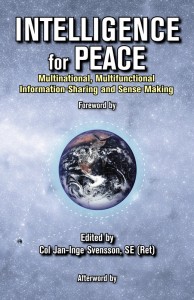
INTELLIGENCE for PEACE: Multinational, Multifunctional Information-Sharing and Sense-Making, edited by Col Jan-Inge Svensson, SE (Ret), the foremost authority and educator on peace intelligence and the use of unclassified decisions support, goes to the printer on or about 1 December 2009.
Anyone wishing to contribute to this book, now tentatively scheduled to go to the printer on 1 December, must contact Col Svensson at the Folke Bernadotte Academy. Ideally, submit to him a one page overview of the proposed piece, which must address practical concepts, doctrines, tactics, tools, and produres relevant to peace intelligence. This book is intended to be the interim handbook for the United Nations Open-Source Decision-Support Information Network (UNODIN), a global grid that incorporates the Joint Military Analysis Centers (JMAC) and Joint Operations Centers (JOC), but does all that the Brahimi Report recommended, and more.
Over 35 peices are now in hand and being weeded down, in many cases simply being shortened with an easy link to the longer online version. As with all OSS/EIN books, the book–and in this case–additional supporting materials–will be easily available online at www.oss.net/Peace.
A global study into 60 citizen journalism projects in 33 countries found citizen journalism flourished under governments which could be characterized as “soft authoritarianism” regimes such as in Malaysia and South Korea. Professor Michael Bromley from the University of Queensland School of Journalism and Communication told The Australian that citizen journalism flourishes “where there is room to comment and to intervene and to participate but there are strict rules: for example, the media is controlled by the state. That creates a need for it.” In repressive countries, such as Burma, there were fewer examples. Citizen journalists, Bromley said, “come out of a history that includes social activism. Bloggers and tweeters [users of micro-blogging site Twitter] can be citizen journalists but it's not just that independent personal view. It's about investigating, going to primary sources, offering your opinion. Often the blogger is the primary source.”