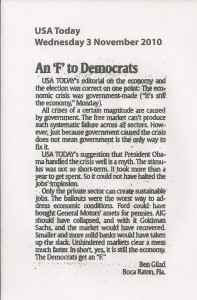
Journal: F for Democrats by Ben Gilad

03 Economy, 07 Other Atrocities, 11 Society, Budgets & Funding, Commerce, Commercial Intelligence, Corporations, Cultural Intelligence, Government, Money, Banks & Concentrated Wealth, Policy, Power Behind-the-Scenes/Special Interests
Click on Image for PDF

Phi Beta Iota: Ben Gilad, one of the top commercial intelligence analysts around, has a point, but he forgets that the modern looting of the USA began in 1981 and reached a cresendo with the Phil Gramm (R-TX) deregulation of the financial “services” industry.   For the most recent and most superb story on the axis of crime from Wall Street to the two political parties sharing the power of the public purse, see Matt Taibbi's book, Griftopia–Bubble Machines, Vampire Squids, and the Long Con That Is Breaking America.

Journal: “Queer Kissing Flash Mob” to Confront Pope

11 Society, Civil Society, Cultural Intelligence
Pope Benedict XVI

Barcelona is known as one of Spain's most vibrant cities, but when Pope Benedict XVI touches down there Sunday, he'll be greeted with something extra colorful: a massive “queer kissing flashmob.”

According to the event's Facebook page, organizers have invited same-sex couples from all over Spain to congregate in front of the city's cathedral Nov. 7 and start kissing as soon as the pope emerges from the building at 10 a.m. Organizers say that though the event will last for a mere two minutes, over 300 people are planning to attend.

Read full article online at Huffington Post….

Journal: Labor Strikes in Europe

03 Economy, 11 Society, Civil Society, Commerce, Commercial Intelligence, Cultural Intelligence

Chuck Spinney Recommends...

Squeezing the Working Class

What's Happening in Europe?

By VINCENT NAVARRO

Counterpunch

Europe is seeing some of the largest demonstrations since World War II, with labor agitation being the major trademark. The reasons for this labor unrest are easy to see. Let’s look at several facts, starting with unemployment. Europe has always had lower unemployment than the United States. No longer. Since 1982, unemployment (as an average of the EU-15) has been higher in the European Union than in the United States. Actually, unemployment had already started to rise in Europe by the late 1970s, coinciding with the first steps by the EU-15 countries to construct what they later called the European Union. One consequence of forming this Union was higher unemployment, and from that time, unemployment has increased, eventually exceeding that in the United States.

Read complete article….

Reference: Water, Earth, and We

12 Water, Blog Wisdom, Briefings (Core)

Maude Barlow

Our Commons Future is Already Here

A stirring call to unite the environmental and global justice movement from Maude Barlow

By Maude Barlow

Maude Barlow gave this stirring plenary speech, full of hope even in the face of ecological disasters, to the Environmental Grantmakers Association annual retreat in Pacific Grove, California. Barlow, a former UN Senior Water Advisor, is National Chairperson of the Council of Canadians and founder of the Blue Planet Project.

– – – – – –

Half the tropical forests in the world – the lungs of our ecosystems – are gone; by 2030, at the current rate of harvest, only 10% will be left standing. Ninety percent of the big fish in the sea are gone, victim to wanton predatory fishing practices. Says a prominent scientist studying their demise “there is no blue frontier left.” Half the world’s wetlands – the kidneys of our ecosystems – were destroyed in the 20th century. Species extinction is taking place at a rate one thousand times greater than before humans existed. According to a Smithsonian scientist, we are headed toward a “biodiversity deficit” in which species and ecosystems will be destroyed at a rate faster than Nature can create new ones.

We are polluting our lakes, rivers and streams to death. Every day, 2 million tons of sewage and industrial and agricultural waste are discharged into the world’s water, the equivalent of the weight of the entire human population of 6.8 billion people. The amount of wastewater produced annually is about six times more water than exists in all the rivers of the world. A comprehensive new global study recently reported that 80% of the world’s rivers are now in peril, affecting 5 billion people on the planet. We are also mining our groundwater far faster than nature can replenish it, sucking it up to grow water-guzzling chemical-fed crops in deserts or to water thirsty cities that dump an astounding 200 trillion gallons of land-based water as waste in the oceans every year. The global mining industry sucks up another 200 trillion gallons, which it leaves behind as poison. Fully one third of global water withdrawals are now used to produce biofuels, enough water to feed the world. A recent global survey of groundwater found that the rate of depletion more than doubled in the last half century. If water was drained as rapidly from the Great Lakes, they would be bone dry in 80 years.

The global water crisis is the greatest ecological and human threat humanity has ever faced.

Read full presentation….

See Also:

Worth a Look: Book Reviews on Water

Reference: 12 Core Policy Domains

Blog Wisdom, Policies

Robert David SteeleRobert David Steele

Serial pioneer, hacking humanity…

Posted: October 27, 2010 05:16 PM

12 Core Policy Domains

For those seeing this Blog for the first time, this is the 12th in a 24-part series appointing a Virtual Cabinet and creating a balanced sane intelligence-driven budget as a baseline for evaluating any candidate for public office.

There are twelve policies that must be managed together. Inspired by the High-Level Threat Panel's identification and prioritization of the ten high-level threats to humanity addressed in my Tuesday blog (see 10 High-Level Threats to Humanity), I pulled out my copies of the “Mandate for Change” books from the last four presidential campaigns, and came up with this list. Of course there are many policies and sub-policies, from infrastructure to labor to population, but this is my best effort and I hope you find it helpful.

Here's the important part: what might be good for one policy domain is often very bad for other policy domains. A proper government must understand the true costs of all policy options, not only in and of themselves, but in relation to all other policy domains.
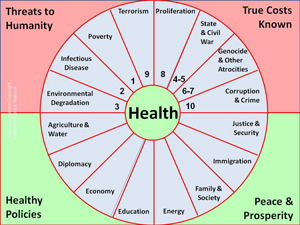
2010-11-01-HolisticHealthContextJPEG.jpg
By way of example for why we must address all policies together: it makes no sense to allow landowners to sell water aquifers that are part of our national commonwealth, or to allow soda pop companies to empty aquifers for export, or to use water we don't have to grow grain we cannot eat to create fuel when we have natural gas right here, right now. Above all, it makes no sense to subsidize elements of the food industry that are very bad for all of us — animals for food come with huge water, disease, and fuel costs that have yet to be understood by the public. [For a video on the “true cost” of meat as food, check out The Secret Life of Beef; see also this Duck Duck Go listing of top hits on the true cost of meat.

Below are snapshots of each of the twelve policies and why they matter. In celebration of the new HEALTH section here at the Huffington Post, I am posting this Blog under Health instead of Politics, and below I provide a graphic of how Health Policy must be central to, and in relation to, all ten threats and the other eleven policies, as well as a graphic unique to Health Policy.

Continue reading “Reference: 12 Core Policy Domains”

Journal: US to Fund 2,308 New Diplomatic Gerbils

02 Diplomacy
DefDog Recommends...

Leading Through Civilian Power

Redefining American Diplomacy and Development

By Hillary Rodham Clinton

Foreign Affairs

November/December 2010

Summary:

To meet the range of challenges facing the United States and the world, Washington will have to strengthen and amplify its civilian power abroad. Diplomacy and development must work in tandem, offering countries the support to craft their own solutions.

HILLARY RODHAM CLINTON is U.S. Secretary of State.

Today's world is a crucible of challenges testing American leadership. Global problems, from violent extremism to worldwide recession to climate change to poverty, demand collective solutions, even as power in the world becomes more diffuse. They require effective international cooperation, even as that becomes harder to achieve. And they cannot be solved unless a nation is willing to accept the responsibility of mobilizing action. The United States is that nation.

I began my tenure as U.S. Secretary of State by stressing the need to elevate diplomacy and development alongside defense — a “smart power” approach to solving global problems. To make that approach succeed, however, U.S. civilian power must be strengthened and amplified. It must, as U.S. Secretary of Defense Robert Gates has argued in these pages, be brought into better balance with U.S. military power. In a speech last August, Gates said, “There has to be a change in attitude in the recognition of the critical role that agencies like [the] State [Department] and AID [the U.S. Agency for International Development] play . . . for them to play the leading role that I think they need to play.”

This effort is under way. Congress has already appropriated funds for 1,108 new Foreign Service and Civil Service officers to strengthen the State Department's capacity to pursue American interests and advance American values. USAID is in the process of doubling its development staff, hiring 1,200 new Foreign Service officers with the specific skills and experience required for evolving development challenges, and is making better use of local hires at our overseas missions, who have deep knowledge of their countries. The Obama administration has begun rebuilding USAID to make it the world's premier development organization, one that fosters long-term growth and democratic governance, includes its own research arm, shapes policy and innovation, and uses metrics to ensure that our investments are cost-effective and sound.

Phi Beta Iota: The full reprint can be purchased for under one dollar.  The bottom line is that this is more lipstick on the pig.  Apart from the fact that the US would be hard-pressed to find, clear, and hire 3,000 people actually competent at diplomatic and developmental work who are linguistically and cultural qualified as well as “clearable,” there is no real money associated with this initiative.  Until the USA has a strategic analytic model and a deep-seated commitment to eradicating the ten high level threats to humanity, something that will require the redirection of at least $250 billion from Program 50 to Program 150, this is just more gerbils–and they are still outnumbered by military musicians and cooks.  The term “gerbils on a wheel” is how Madeline Albright characterized herself and her diplomatic colleagues in her memoire–no disrespect is intended, rather the intent is to demonstrate that absent a coherent strategy that balances means (money), ways (methods), and ends (moral), no amount of hiring is going to be serious.

Poverty Is Not a Game (PING) – A game about poverty

01 Poverty, 04 Education, Technologies
link

PING is an online game made for secondary schools, forming a starting point to discuss the subject ‘poverty’ and what it means to be poor. Ping is aimed at the students of the secondary and third degree. The students become the main characters in the game. They can choose between Jim or Sofia, who, due to certain circumstances, end up on the street and need to find their own path.

PING shows that games can help to introduce complex social subjects like poverty in the class room.

The partners of the PING project want to contribute to the social debate encouraging the use of games at school as a tool to open the difficult discussion about poverty.

PING was made possible with the help of The King Baudouin Foundation (Belgium), IBBT (Belgium), with The Network of European Foundations, the Robert Bosch Stiftung (Germany) , the Fundação Calouste Gulbenkian (Portugal/UK) and Fondation Bernheim (Belgium).

Play the game on line or download PING.

For the development of the game there was an intensive collaboration with the European Schoolnet (umbrella organization consisting of 31 ministries of education from the European member states) and the European Poverty Network (umbrella organization of poverty organizations from the European member states) to make games discussable in an educational context. The manual and game will be distributed in all secondary schools in Belgium with the support of the Belgian government.

PING was internationally launched on October 20th 2010 at the European convention “Poverty is not a game. Serious Games as a mean to discuss complex societal issues” in Brussels.

The game and manual are now available on the website.

Also available in Nederlands,  Français, and Deutsch

noble gold