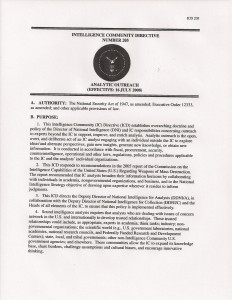
Reference: Intelligence Community Directive (ICD) 205 Analytic Outreach

Analysis, Director of National Intelligence et al (IC), Methods & Process
ICD 205

This is an excellent directive that is being ignored across the entire U.S. Intelligence Community, and most speciicially is being violated by the unpressional narrow and unresponsive (and largely ignorant) behavior of the Central Intelligence Agency (CIA) Open Source Center (OSC) which is supposed to be a service of common concern but has obstinantly refused to modernize since this matter was first brought up with its predecessor, the Foreign Broadcast Information Service (FBIS) in 1992 by the US Marine Corps.  For a critique of FBIS's rotten approach to open sources at that time, see 1992: USMC Critique of CIA/FBIS Plan for Open Source Intelligence (OSINT).  For the broader history of opposition see 2004 Modern History of Public Intelligence and the Opposition.

Analytic Outreach will not happen until the analysts themselves, and their branch chiefs, are given virtual “chips” they can cash in within a national and a defense open source intelligence program.  Long ago we called for $100,000 per year for each analysts, and $1 million per year for each branch chief, to support discretionary outreach, more often than not to uncleared foreign nationals and experts in the US wanting nothing to do with the secret world.  We specifically exclude “body shops” like CENTRA from consideration–if the individual analyst does not know specifically who is best in class and who to hire, they have not done their homework.  See the “cell” we first recommended to the Defense Intelligence Agency, note the financial individual able to execute credit card and other small contracts without further approvals, within the individual, branch, and division budgets.

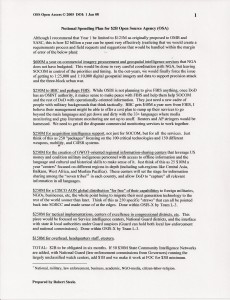
Memorandum: $2 Billion Obligation Plan Centered on Defense, for a New Open Source Agency

Budgets & Funding, Memoranda

This is the budget created to support Col Vincent Stewart, USMC, then the action officer for surveying Open Source Intelligence (OSINT) reequirements and capabilities across the Department of Defense (DoD).  This amount–not necessarily these specific priorities–was offered to the U.S. Special Operations Command (USSOCOM), which continues to have the only full-spectrum OSINT capability in the USA, but turned down by subordinates to the Combatant Commander who did not understand that the Long War is a war of both ideas, and universal coverage at the neighborhood level of granulaty, as Dr. Stephen Cambone so wisely called for in January 2004.

If $1.5 Billion is added to this budget for 50 Community Information-Sharing and Sense-Making Networks, a total of no less than $3 billion a year, and ideally $3.5 billion a year, is recommended.

$2B for OSA
$2B for OSA

2008 AFCEA Conference on Information-Sharing

Government, Methods & Process, Military, Technologies
Resource Page
Resource Page

Tip of the hat to AFCEA for its 2008 Information Sharing Conference.  They have provided one of the most remarkable resource pages we've seen, with audio as well as slides.  Although focused primarily on the technical side of sharing, the event touched on content and culture.

A few of the many presentations that caught our attention:

Ambassador Thomas E. McNamara
Program Manager Information Sharing Environment
Office of the Director of National Intelligence

Track 4: Cultural and Policy Implications of Information Sharing

Panelist: Mr. Al Johnson, Director of Integrated Information and Communications Technology Support (IIS), OASD/NII | PRES


Panelist: Mr. Steve Pitcher, Joint Staff | PRES

Journal: Worth a Look–the Echo Chamber Project

Collaboration Zones, Communities of Practice, Historic Contributions, Methods & Process, Reform, Technologies
Kent Bye
Kent Bye

Echo Chamber Project: Interviews at OSS '06

Praise for this effort

Submitted by Robert David Steele (not verified) on Sat, 2006-03-11 18:48.
I have never, in 18 years of OSINT advocacy, seen a more professional and intelligent endeavor to understand and report on what we are trying to do. This is absolutely world-class, and my admiration is unbounded. This creative individual has a lifetime free pass to our conferences. His technical, legal, and people skills are of the highest order.
+ + + + + + +
Kent's photo links to the ten video interviews he did at OSS '06, the last conference before it was stolen and consequently destroyed  by an individual that broke his promise (one of several) and is fortuitously no longer responsible for anything of significance. All of the interviews are recommended, but then Congressman Simmons, now running for Senator in place of Senator Chris Dodd of Connecticutt, is especially noteworthy.  No one in government has, in the twenty one years we have been fighting this fight, gotten a better grip not just on the idea of Open Source Intelligence (OSINT) as a separate discipline, but on OSINT as a means of revitalizing American education, improving decision-support to every Congressional jurisdiction (most get NOTHING from the secret intelligence world), and helping the President and the Cabinet Secretaries manage Whole of Govenrment Planning, Programming, Budgeting, and Operational Campaigns.
Among those interviewed that we hold in very high esteem are Michael Andregg, Carolyn Stewart, Mats Bjore, Ralph Peters, Robert Young Pelton, Stephen E. Arnold, and Peter Morville.  There is also an interview with Robert Steele, who is not tagged within this website.
Below is a direct link to Kent Bye and a collage of clips from each of the people he interviewed.  We consider this the single best most brilliant piece of citizen journalism on the concept of OSINT.
Overview Video
Overview Video
Below are the currently available links for audio only for all those interviewed:

Michael Andregg on Secrecy and Insanity

Stephen E Arnold on Technology

Mats Bjore on Globalization

Peter Morville on Ambient Findability

Robert Young Pelton on Hearing all Sides

Ralph Peters on Wars of Blood and Faith

Rob Simmons on the Big Picture for America

Robert Steele on Washington Running on 2%

Carolyn Stewart on Information Operations

Below links directly to the Simmons interview, use the photograph link above to select any of the others.  NOTE: the video portion appears to have been disabled for all of them, you get audio only right now, we are working on this with Kent, it is vastly better to see these individuals in full multi-media form.

Rob Simmons
Rob Simmons

2006 Stephen E. Arnold (US) Google and Sharing Across Boundaries

Historic Contributions, Technologies, Tools
Stephen E. Arnold
Stephen E. Arnold
Stephen E. Arnold
Stephen E. Arnold

Stephen E. Arnold has been the virtual Chief Technology Officer (CTO) for the global multinational open source information grid, and remains the “top gun” for seeing the future of non-state civil society information technologies.

PLATINUM LIFETIME AWARD, Mr. Stephen E. Arnold

For his constant demonstration of the utility of Open Source Intelligence (OSINT) in the understanding of social networks, emerging technologies, and cultural realities.  As a world-renowned authority on information and communications, with a deep understanding of the public policy value of open source information, he has made himself available around the world, and had much more influence than most realize.  His publication of the book, “The Google Legacy,” is a mere milestone in one of the most distinguished information careers in the world

Frog Left gets you to his online book for sale, really an intense analysis of Google patents, most not visible to normal researchers, entitled Google 2.0: The Calculating Predatory.  Frog Right gets you to our review of Arnold contribution, which was also send to four Ambassadors and eight CEOs with the most to gain or lose from understanding the totality of the Google supranational strategy.

Google 2.0: The Calculating Predator
Review of Google 2.0

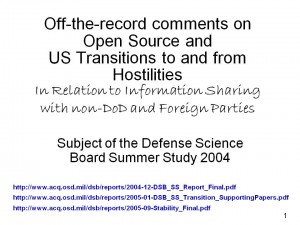
2006 Markowitz (US) Open Source Information and US Transitions to and from Hostilities (Defense Science Board Report, December 2004), in Relation to Information-Sharing with non-DoD and Froeign Parties

10 Security, Analysis, Budgets & Funding, Collaboration Zones, Communities of Practice, Historic Contributions, Legislation, Policy, Strategy, Threats
Joe Markowitz
Joe Markowitz

NOTE: By “off the record” Dr. Markowitz has clarified that this information may be shared as we are sharing it, but those benefiting from our sharing should treat the knowledge as if they had acquired it “off the record,” as personal views that should not be attributed nor accepted as anything other than background perceptions.

Joe Markowitx
Joe Markowitx

PLATINUM LIFETIME AWARD, Dr. Joseph Markowitz

Dr. Joseph Markowitz is without question the most qualified Open Source Intelligence (OSINT) pioneer in the ranks of those presently in or retired from U.S. government service.  As the only real chief of the Community Open Source Program Office (COSPO) he tried valiently to nurture a program being systematically undermined by both the leadership and the traditional broadcast monitoring service.  When he moved on to advise the Defense Science Board, he served America well by helping them fully integrate the need for both defense open source information collection and exploitation, and defense information sharing with non-governmental organizations.  His persistent but diplomatic efforts merit our greatest regard.

noble gold