Neal Rauhauser: Curator Skill Sheet — Future of Public Intelligence from the Bottom Up

Crowd-Sourcing, Governance, Innovation, Knowledge, P2P / Panarchy, Transparency
Neal Rauhauser
Neal Rauhauser

Compiled this from the source document:

Curator Types
•  Aggregator
•  Distiller
•  Elevator
•  Masher
•  Chronologist

Curator Skills
•  Sense-making: the ability to determine significance
•  Social intelligence: the ability to connect with others in a deep way
•  Adaptive thinking: the ability to come up with novel solutions
•  Cross-cultural competency: the ability to operate in new contexts
•  Computational thinking: ability to think abstractly and make data-driven decisions
•  New media literacy: the ability to assess new media critically and use itappropriately
•  Transdisciplinarity: ability to understand concepts across a range of disciplines
•  Design mindset: the ability to understand how the physical environment impactsthinking and make conscious choices in using it
•  Cognitive load management: the ability to filter information
•  Virtual collaboration: the ability to be a productive part of a virtual team

Curator Methods
•  Optimizes
•  Edits
•  Formats
•  Selects
•  Excerpts
•  Writes
•  Classifies
•  Links
•  Personalizes
•  Vets
•  Credits
•  Filters
•  Taps
•  Suggests
•  Searches
•  Scouts
•  Hacks Filters & Searches
•  Is Transparent
•  Recommends
•  Crowdsources

Based on:  Robin Good: Attention Doesn’t Scale – the Role of Content Curation in Membership Associations

Jean Lievens: Thomas Malone on Collective Intelligence — You Have to Give Away Old Power In Order to Gain New Power

Crowd-Sourcing, Culture, Governance, Innovation, Knowledge, P2P / Panarchy
Jean Lievens
Jean Lievens

Thomas Malone, director of the MIT Center for Collective Intelligence,  is one of the leading thinkers in the realm of anticipating how new technologies will transform the way work is done and leaders lead. His 2004 book, The Future of Work: How the New Order of Business Will Shape Your Organization, Your Management Style, and Your Life,helped thousands of executives and would-be executives see their organizations, and themselves, in startling new ways. As a result, many organizations are becoming more collaborative and democratic. Now, Malone is exploring how social business, data analytics and cognitive computing will transform organizations once again. Here, he talks about the revolution that is coming.

IBM: In your book The Future of Work, you talked about society being on the verge of a new world of work, a key element of which is decentralization of the organization. Since then, the social networking phenomenon has emerged and is sweeping not just popular culture but business organizations as well. How has this explosion of social networking affected your thinking?

Malone: Social networking is a good example of the kind of thing I was talking about in my book when I talked about how the cost of communication was decreasing. At the time I wrote the book, people were looking at e-mail and the Web. But since the book was written, there are these new ways of communicating electronically–Twitter, Facebook, et cetera. I think those are all excellent examples of the same underlying phenomena.

As information technology reduces the cost of communication, it becomes much easier for lots more people to know lots more things and in many cases they’re able to be well enough informed to make more decisions for themselves instead of just following orders from somebody above them in a hierarchy.

Continue reading “Jean Lievens: Thomas Malone on Collective Intelligence — You Have to Give Away Old Power In Order to Gain New Power”

Jean Lievens: Internet Phases: Past, Present, and Future

Access, Architecture, Crowd-Sourcing, Culture, Data, Design, Economics/True Cost, Education, Governance, Innovation, Knowledge, Materials, Mobile, P2P / Panarchy, Resilience, Transparency
Jean Lievens
Jean Lievens

Internet Phases: Past, Present, and Future

Jeremiah Owyang

web-strategist.com, 11 June 2013

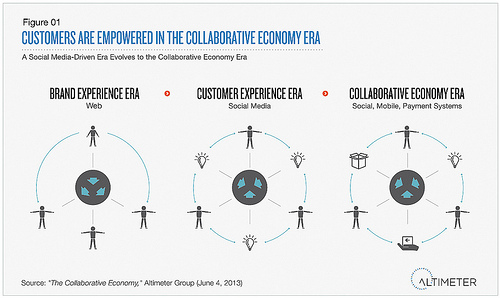
Thanks to you, last week’s report on the collaborative economy was readily received, and has been viewed over 26k times, the media picked up on it, and bloggers alike.  As we digest what it means, it’s important to recognize this is the next phase in the internet, and the next phase of social business.  An interesting finding is that the second era (social) and the third era (collaborative economy), use the same technologies (social technologies) but instead of sharing media and ideas –people are sharing goods and services.  This is all part of a continuum and we need to see our careers progress as the market moves forward with us.

[Social technology enabled the sharing of media and ideas called social business –the same tools enable sharing of goods and services called the collaborative economy]

Click on Image to Enlarge


Internet Phases: Past, Present, and Future

Attribute Brand Experience Era Customer Experience Era Collaborative Economy Era
Driving technology CMS and HTML Social Technologies Social Technologies
Years 1995: Internet had 14% american adoption 2005: Business blogging disrupted corporations 2013: AirBnb, TaskRabbit, Lyft, gain mainstream attention
What is shared Vetted Information Personal Ideas and Media Goods and Services
Who shares Few Many Many
Who receives Many Many Many
What it looks like Brands and media talk, people listen Everyone talks and listens Buy once, share many, need to buy less
Who has the power Brands and publishers Those who use social Those who share goods and services
Who is disrupted Traditional mediums: TV, Print Corporations, governments Corporations, governments
What must change Media models Communication and marketing strategy Business models
How corporations responded Created their own corporate website Adopted social tools internally, externally Learn to share products, enable marketplace
Software needed CMS and design tools SMMS, monitoring, communities Marketplace, ecommerce, communities, SMMS, Monitoring
Services needed User Experience, Design, Content Social strategy, community managers, communicators Agencies that help with trust, customer advocates, ?
Who wins Those who adopt Those who adopt Those who adopt

What it means to your career, clients, and company:

Continue reading “Jean Lievens: Internet Phases: Past, Present, and Future”

Michelle Monk: Geke.US Lays Out Government-Corporate Circles of Corruption

Access, Crowd-Sourcing, Data, Design, Economics/True Cost, Education, Geospatial, Governance, Innovation, Knowledge, Money, Politics, Transparency
Michelle Monk
Michelle Monk

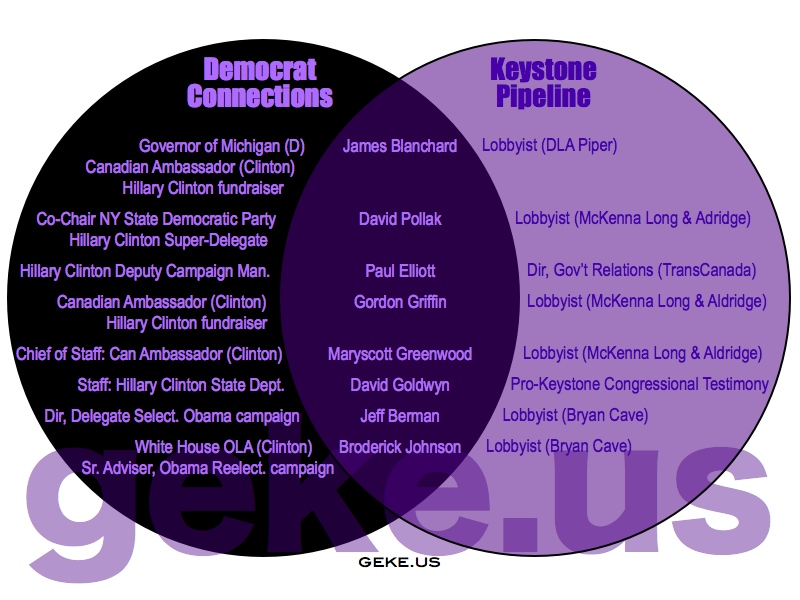
Here is what they have as of today.  An extraordinary effort that should soon become automated.   You won't find these on LinkedIn!  Click for individual Venn diagram similar to the Keystone Pipeline shown below.,

Nominally Good:

AFL-CIO

The Rest:

Comcast   .   Defense Contractors   .   Disney   .   Enron   .   Fannie Mae   .   General Electric   .   Goldman Sachs   .   Green Energy   .   Keystone Pipeline   .   Media   .   Monsanto   .   Motion Picture Association of America   .   Oil Industry   .   Pharmaceuticals   .   Planned Parenthood   .   Social Networking Sites   .   Tobacco Industry   .   Walmart

Click on Image to Enlarge

Phi Beta Iota: Now imagine this being done at every level of government from the municipality on up, across every policy domain, with whole systems analytics, true cost economics, and all trade-offs clearly visible. This is where we are going.  Humanitarian technology and Open Source Everything (OSE) are going to empower the public in a manner no government or corporation can conceive or achieve.

Patrick Meier: Using Waze, Uber, AirBnB and SeeClickFix for Disaster Response

Crowd-Sourcing, Design, Geospatial, Governance, Software
Patrick Meier
Patrick Meier

Using Waze, Uber, AirBnB and SeeClickFix for Disaster Response

After the Category 5 Tornado in Oklahoma, map editors at Waze used the service to route drivers around the damage. While Uber increased their car service fares during Hurricane Sandy, they could have modified their App to encourage the shared use of Uber cars to fill unused seats. This would have taken some work,  but AirBnB did modify their platform overnight to let over 1,400 kindhearted New Yorkers offer free housing to victims of the hurricane. SeeClick fix was used also to report over 800 issues in just 24 hours after Sandy made landfall. These included reports on the precise location of power outages, flooding, downed trees, downed electric lines, and other storm damage. Following the Boston Marathon Bombing, SeeClick fix was used to quickly find emergency housing for those affected by the tragedy.

Read full post with additional graphics and links.

Continue reading “Patrick Meier: Using Waze, Uber, AirBnB and SeeClickFix for Disaster Response”

Jean Lievens: Video (1:39:09) Science Beyond Reductionism – “Model Free Methods” as a Holistic Shift

Crowd-Sourcing, Culture, Design, Economics/True Cost, Education, Governance, Knowledge, P2P / Panarchy, Politics, Resilience, Transparency
Jean Lievens
Jean Lievens

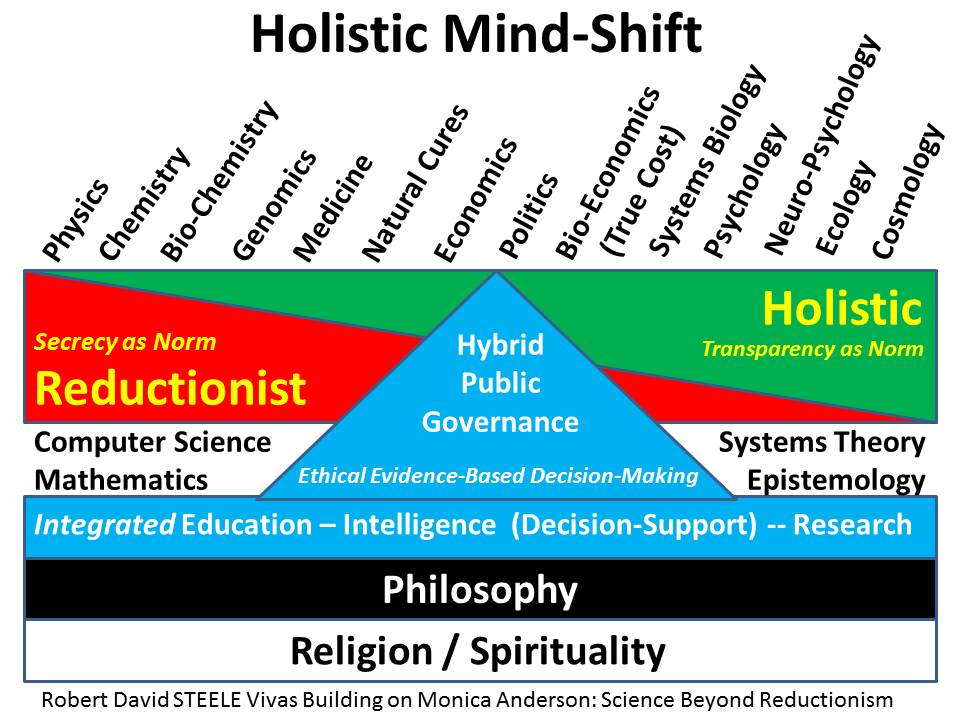
Monica Anderson is CEO of Syntience Inc. and originator of a theory for learning called “Artificial Intuition” that may allow us to create computer based systems that can understand the meaning of language in the form of text. Here she discusses the ongoing paradigm shift – the “Holistic Shift” – which started in the life sciences and is spreading to the remaining disciplines. Model Free Methods (also known as Holistic Methods) are an increasingly common approach used on “the remaining hard problems”, including problems in the domain of “AI” – Problems that require intelligence. She illustrates this using a Model Free approach to the NetFlix Challenge. Her website provides some background information.

Page for starting video

Click on Image to Enlarge