Review: Bulletproof

5 Star, Empire, Sorrows, Hubris, Blowback

Amazon Page
Amazon Page

5.0 out of 5 stars This is NOT “FIction”–Explosive Valuable Insights,

December 9, 2005
Thomas Graves
This is NOT a book of “fiction.” Although the author of necessity had to present it as such, it plays the same role for the world of oil, corruption, crime, and spying that Winn Schwartau's book “Terminal Compromise” played for information security and Y2K.

I am a former spy, lived overseas for twenty years as the son of an oil engineer and executive, then another ten as a spy and Marine Corps infantry officer. This book is REAL. This book is so good that it should be required reading at the Foreign Service Institute where we train our diplomats, at the clandestine training facility for the CIA, and at universities. We continue to send out to the world naive young white boys that have no clue about the real world.

This book *is* the real world. Do not be put off by the shipping time, something Amazon does when the book is not physically stored in the USA. I got my copy in less than 10 days, and it was worth the wait.

Two other books that complement this are Robert Young Pelton's “World's Most Dangerous Places,” and John Perkin's “Confessions of an Economic Hit Man.”

Vote on Review
Vote on Review

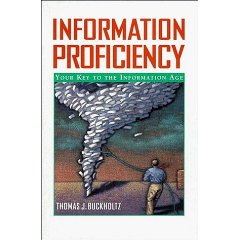
Review: Information Proficiency–Your Key to the Information Age (Industrial Engineering) (Hardcover)

5 Star, Information Operations, Information Society, Information Technology

Amazon Page
Amazon Page

5.0 out of 5 stars Quite Extraordinary–Handbook for Creating Wealth Though Information,

November 26, 2005
Thomas J. Buckholtz
The publisher has done a very poor job of communicating the value and depth of this book. It is superb. Easy to read, clear-cut concepts, well-defined chapter order, and above all, solid gold thinking.

As someone who specializes in fostering effective public intelligence and reducing wasteful ineffective secret intelligence, I could not help but marvel at how useful this book is in evaluating two completely opposite approaches to decision-support: Google, and the U.S. Intelligence Community.

The author's chapters run logically from developing a framework to setting goals to improving personal information proficiency and then organizational learning, and thence to managing information as a resource to help make better decisions that yield profit, cut costs, and result in mission accomplishment.

This is a book that should be read by every leader of any type of organization, large and small. What I like most about the book, even though the author is partial to maximizing investments in information technology, is his dual understanding that 1) the point is to make better decisions not buy more technology; and 2) information and information technology that are considered out of context and in isolation from other relevant information, are inherently flawed.

Wow. Google fails this test, and so does the CIA. Google gives you a million hits on “Colombia,” without any visualization, synthesis, etc., while CIA tells you either that they don't know, or what they know is too secret to tell you.

The heart of the book is about actually measuring information proficiency along multiple scales. I will not belabor the point, and will only stress this once that on a scale of 1 to 5, with 1 being ignorant incompetence, 2 being ad hoc isolated processes, and 5 being fully integrated and optimized data collection (including historical and parallel data), processing, analysis, decision, AND implementation, both Google and the CIA got an average of 2. That's a 40%, folks, a failing grade in any school district. Now, since the U.S. Intelligence Community costs $70 billion a year and serves only the President, and Google costs nothing to the end-user and serves hundreds of millions, we give them the advantage. We're betting Google will grow faster than CIA and the IC can reform.

It merits comment, in passing, that this book is a very elegant recycling of earlier work by the author within the U.S. Government, subsequently published in earlier versions. This version is the best, and potentially revolutionary. I recommend that it be read in conjunction with Robert Buckman's Building a Knowledge-Driven Organization and if you really want to get into it, Margaret Wheatley's Leadership and the New Science: Discovering Order in a Chaotic World; Thomas Stewart's The Wealth of Knowledge: Intellectual Capital and the Twenty-first Century Organization Barry Carter's Infinite Wealth: A New World of Collaboration and Abundance in the Knowledge Era my own Information Operations: All Information, All Languages, All the Time as well as Alvin and Heidi Toffler's new book, Revolutionary Wealth: How it will be created and how it will change our lives, and the work praised by Lawrence Lessig among others, Yochai Benkler's The Wealth of Networks: How Social Production Transforms Markets and Freedom.

Vote on Review
Vote on Review

Review: How to Do Everything with Google (Paperback)

5 Star, Information Society, Information Technology

Amazon Page
Amazon Page

5.0 out of 5 stars People's “Primer” for 21st Century,

November 24, 2005
Fritz Schneider
I completely disagreed with the “know it alls” that trash this book. This is in fact the people's “primer” for the 21st Century. In the industrial era one needed to learn reading, ‘riting, and ‘rithmetic. Today one needs to know how to find the needle in the haystack. While Google is still in the 4th grade, it will evolve quickly in the next few years, and the Google founders appear well on their way to making all of the world's information available to anyone anywhere. This will itself change the world.

This is a tremendous resource, and I do not consider it outdated because it is still the best available orientation to Google. I do agree that there are online supplements that can update the knowledge in this book and cover emerging capabilities from Google.

Bottom line: Google is central to all our lives now, this book is a useful jump start to anyone who wishes to leverage all of Google, not just the 10% most people see. For advanced IT people, I recommend Stephen Arnold's book, “The Google Legacy,” available from Infonortics.co.uk, or at IOP '06 in January 2006.

Vote on Review
Vote on Review

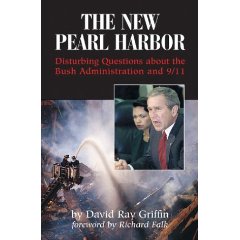
Review: The New Pearl Harbor–Disturbing Questions About the Bush Administration and 9/11 (Paperback)

5 Star, 9-11 Truth Books & DVDs, Crime (Government), Executive (Partisan Failure, Reform), Truth & Reconciliation

Amazon Page
Amazon Page

5.0 out of 5 stars Beyond a Reasonable Doubt–Makes Case for Public Investigation,

November 24, 2005
David Ray Griffin
I am a former Marine Corps Infantry officer, a clandestine case officer, the senior civilian responsible for founding the Marine Corps Intelligence Command, the author of books on intelligence, and since about 2001, the #1 Amazon reviewer for non-fiction about national security matters, into which category this book certainly falls.

For those who would doubt the depths to which privilege power might go to get its way, let me just point out that it is now a documented fact that the Joint Chiefs of Staff proposed the staging of a terrorist attack within the US that would murder U.S. citizens, in order to provide a pretext for an invasion of Cuba in the early decades of the Cold War. Do not ever under-estimate what the Dick Cheney's and Karl Rove's and Goldman Sach's of the world might be willing to do to further their profits. Also do not underestimate the power of blind mis-placed loyalty within the military, doing its “duty” to the President while overlooking its more sacred duty to the Constitution.

There are four aspects of this book that stand out with me, and that I believe warrant the appointment of a 12-person citizen's commission with full access, no holds barred, able to apply “Able Danger” data mining technologies to *all* materials bearing on 9-11.

First, I am absolutely persuaded by all my reading, that the Administration, the CIA, and the FBI, at a minimum were complicit in allowing 9/11 to happen, as a pretext for invading Afghanistan (for energy and drug reasons, since Rumsfeld let 3,000 Al Qaeda escape when we had them surrounded) and Iraq.

Second, I find the objective case, from Fire Engineering and other serious sources, against the buildings having been brought down by the fire, and instead that they were brought down by pre-placed explosives, to be sufficiently compelling so as to cast a reasonable doubt on the Administration's story, and hence a need for a full and open investigation.

Third, I find the objective case for a U.S. missile hitting the Pentagon, instead of Flight 77, to be, again, compelling enough to raise a reasonable doubt, particularly since no aircraft parts were recovered at the Pentagon and all bodies from the flight appeared in Dover without every appearing to have been transported from the Pentagon. I helped clean up a jet crash in San Diego long ago and there was luggage, seats, debris, everywhere. (The third one, the crater, looks like a bomb crater with a truck load of metal debris dumped in–military analysts scorn that one.

Fourth, the fact that relatives of George Bush were in charge of World Trade Center security, and that there was a total power down prior to the 9-11 event that would have allowed the explosives charges to be planted while also ensuring no security camara records, and that there were both insurance claims and stock futures transactions against key losers, that the Bush Administration continues to obscure, all suggest that this matter has not been properly investigated (see next comment).

I also read the author's follow-on book, The 9/11 Commission Report: Omissions And Distortions and I find that compelling as well. He recasts all that he knows from the previous book, into a parallel critique of the 9-11 Commission. While I consider the Commissioners to be individuals of very high integrity, I believe they failed in their dual mission of properly investigating this matter, and of devising recommendations to avoid failure in the future.

Taken together, the author's two books comprise a “People's Grand Jury” that surely calls for a People's Investigation. This would be something that receives funding form concerned philanthropists, and the focus of effort for popular investigation between now and November 2006.

See also the varied DVDs, and especially Webster Griffin Tarpley's 9/11 Synthetic Terror: Made in USA, Fourth Edition

Vote on Review
Vote on Review

Review: The 9/11 Commission Report–Omissions And Distortions (Paperback)

5 Star, 9-11 Truth Books & DVDs

Amazon Page
Amazon Page

5.0 out of 5 stars Compelling Report Card Fails the 9-11 Commission,

November 24, 2005
David Ray Griffin
This book is best appreciated if one first reads the author's original book on The New Pearl Harbor: Disturbing Questions About the Bush Administration and 9/11. In that book, he compiles extensive research and systematically raises questions that have not yet been answered.

In this book, he methodically tears apart each aspect of the 9-11 Commission Report, identifying omissions and distortions covering everything from the alleged hijackers to the actual causes of the collapse of the towers to the role of the Secret Service and the CIA and the FBI to the Saudi and Pakistani engagements with America. In part II, he focuses on the Commission's defense of the U.S. military and its evident failures of either complicity or inaction in relation to each of the flights.

In the end, both books point to the Bush Administration and its neo-conservative ideologues and Wall Street/energy company supporters as being those who gain the most from this crime. In most investigations, that would be a starting point.

See also the various DVDs under 9-11, and see especially Webster Tarpley's book, 9/11 Synthetic Terror: Made in USA, Fourth Edition.

Vote on Review
Vote on Review

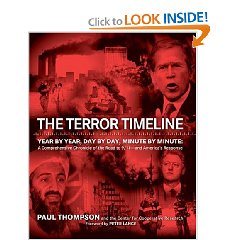
Review: The Terror Timeline–Year by Year, Day by Day, Minute by Minute: A Comprehensive Chronicle of the Road to 9/11–and America’s Response (Paperback)

5 Star, 9-11 Truth Books & DVDs

Amazon Page
Amazon Page

5.0 out of 5 stars Goes as far as any team can go–missing digital tools,

November 24, 2005
Paul Thompson
This extraordinary compilation of honest objective research goes as far as any human team can go. Paul Thompson and the Center for Cooperative Research are national–nay, global–treasures.

The timeline is most useful if read in conjunction with David Griffin's two books, “The New Pearl Harbor” and also “The 9/11 Commission Report: Omissions and Distortions.”

Here are the two bottom lines:

1) There is, beyond reasonable doubt, a case to be made that elements of the U.S. Government were actively complicit with the terrorists, with the Bush family security company controlling the World Trade Center, with certain Wall Street firms, and with the Saudi Royal Family, in permitting 9/11 to happen as a pretext for war to secure energy resources in Afghanistan and Iraq.

2) The consequent “investigations” are a mockery of the American people and disrespect our concept of justice. There is no question but that the varied investigations have been both frustrated by an Administration in active denial mode, and by a Congress reluctant to confront the hands that feed them: the special interests.

It is clear to me that we need a People's Grand Jury that has access to the same level of technology that is represented by “Able Danger,” that is to say, we must be able to do data mining on all of this information, and create public intelligence reports–and public counterintelligence reports–that connect the dots for the people. We must do this before November 2006.

I believe that if such an endeavor is successful, it will demonstrate that the CIA and the FBI were both corrupt and incompetent prior to, during, and after 9/11; that the U.S. military was put on “stand down” to allow 9/11 to happen; and that Dick Cheney specifically, but the Bush Administration neo-cons generally, mis-led the President, Congress, the media, and the public with a web of lies intended to further their pre-conceived ideological fantasies.

We the People need to get our collective public intelligence enterprise going before November 2006. America is close to a tipping point. This author, and David Griffin, give us a slight taste of the power that can be restored to the public if we pay attention. That makes them national heros.

Vote on Review
Vote on Review

Review: India and the Knowledge Econom– Leveraging Strengths and Opportunities (Wbi Learning Resources Series) (Paperback)

5 Star, Economics, Information Society, Information Technology

Amazon Page
Amazon Page

5.0 out of 5 stars These guys are creative and business geniuses,

November 24, 2005
Carl J. Dahlman
This is a seriously powerful volume. Published by the World Bank Institute, it lays out a strategy for leveraging strengths and opportunities within India's emerging knowledge economy.

This book is so well written and clearly organized that it could be a strategy document for any country, from China to Venezuela. Indeed, what I see in this book is the possibility of India becoming a knowledge “hub” nation, where its call centers make the leap up to becoming intelligence analysis centers, with Indians skilled in all languages, having access to all information all the time, and able to create distilled synethic knowledge–answers on demand–across all topics for all levels of users.

The six chapters, 12 appendices, and numerous figures and tables reflect the very highest quality of thinking, clarity, and purpose. This is an extraordinary reference, and I will read it again on my way to India in December, where we will be discussing the creation of a global Information Merchant Bank that builds on and exceeds what Google has been able to accomplish, by adding the human element–human translators, human finders, human analysts, human reporters.

Vote on Review
Vote on Review
noble gold