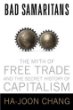
Review: Bad Samaritans–The Myth of Free Trade and the Secret History of Capitalism

5 Star, Capitalism (Good & Bad), Empire, Sorrows, Hubris, Blowback

Bad SamaritansSpeaking truth to power, helpful revisionism, February 22, 2008

Ha-Joon Chang

While other books (linked below) have focused on the evils done in our name, this is the first book I have seen that dissects economic history in order to demonstrate the hypocrisy of the current regime that bullies lesser developed countries with the IMF-WTO-World Bank interlocking conditionalities.

The author comes down solidly in favor of protectionism, foreign investment controls, state-owned enterprises, avoidance of privatization, not allowing patents to clash with the public interest, the need to defy the marketplace and respect the role of manufacturing, and the influence of culture (and changing the culture through government direction).

This is a nuanced book that trashes the neo-liberals while speaking truth to power. On any given prescrption, the author will say “it depends” and avoid leaning to one extreme over another.

He touches on democracy as not necessarily good for developement, and corruption not necessarily bad.

Other books that I respect as much as this one:
The Bottom Billion: Why the Poorest Countries are Failing and What Can Be Done About It
The End of Poverty: Economic Possibilities for Our Time
The Fortune at the Bottom of the Pyramid: Eradicating Poverty Through Profits (Wharton School Publishing Paperbacks)
Confessions of an Economic Hit Man
The Shock Doctrine: The Rise of Disaster Capitalism
Manufacture of Evil: Ethics, Evolution, and the Industrial System
Open Society: Reforming Global Capitalism
The Pathology of Power – A Challenge to Human Freedom and Safety
Blessed Unrest: How the Largest Movement in the World Came into Being and Why No One Saw It Coming
The Unconquerable World: Power, Nonviolence, and the Will of the People

See also my varied lists.

Review: Microtrends–The Small Forces Behind Tomorrow’s Big Changes

3 Star, Future

MicrotrendsEye-glazing trivia of limited value to seeing big changes, February 22, 2008

Mark Penn

Edit of 23 Feb 08 to reexamine conclusion of book and add context.

FOUR STARS for trivia buffs. Absolutely nothing wrong with the well-organized micro-trends, but they don't connect to “tomorrow's changes.”

I like books that pupport to discuss trends that reveal “tomorrow's big changes,” but this book, while clever, has been over-sold.

Rather than provide my usual summative review, I will describe this book with just one word: disappointing.

Below are books I pulled from my shelf that I have found to be much better, along with everything ever written by Alvin and Heidi Toffler.

What Kind of Nation: Thomas Jefferson, John Marshall, and the Epic Struggle to Create a United States
The Nine Nations of North America
How The World Really Works
The Clustering of America
The Clustered World : How We Live, What We Buy, and What It All Means About Who We Are
Tribes: How Race, Religion and Identity Determine Success in the New Global Economy
New Rules Searching for Self Fulfillment in a World Turned up Side Down
The Cultural Creatives: How 50 Million People Are Changing the World
The Battle for the Soul of Capitalism
Vice: Dick Cheney and the Hijacking of the American Presidency

On the latter book, I have to ask myself how is it possible for the two Democratic contenders to campaign for the Presidency without once mentioning Dick Cheney and the documented high crimes and misdemeanors he is alleged to have committed? I place the last two books at the opposite extreme from this book on microtrends. The book lacks any semblance of a “so what” and it certainly does not portend, as its subtitle claims, “tomorrow's big changes.”

Out of respect for the early negative comment, I reread the conclusion and reconfirmed that while it lays claim to predicting increased fragmentation in the future and a heavy Internet play such as Internet marriages, this is much too facile and presumptuous. My reading focuses on the collapse of complex societies, the desperate straits of the five billion at the bottom, one billion of them in extreme poverty that produces wars, crime, and disease without borders. It is in that light that I find this book to be disappointing. This is a rich boy's tour of his own (expanded neighborhood) and has no connection to the reality that I follow on a daily basis via Earth Intelligence Network.

Definitely FOUR STARS for mega-trivia, but only three, at best, for serious students of how we might shape our future to create a prosperous world at peace.

Review DVD: The World Without US – With Niall Ferguson

3 Star, America (Anti-America), Empire, Sorrows, Hubris, Blowback, Reviews (DVD Only)

World Without UsClever in a sophmoric way–selective, Inconclusive, and naive, February 14, 2008

Mitch Anderson

I have been going blind the past two weeks doing the index to the new edited work by Mark Tovey, COLLECTIVE INTELLIGENCE: Creating a Prosperous World at Peace, playing DVDs in the background.

This one fooled me right up to the end with its able review of the disconnect between most Arab oil going to China and Europe (so why should the US protect it), the great strengths of the German and Japanese economies, the great wealth of the Arab countries to whom we give most of our foreign military assistance….

I was especially intregued by his use of putative candidates for president promising to pull all our troops back and reinvest in the homeland, something Mayor Mike Bloomberg has been harping on.

Then he pulled the plug with, as I say, a clever but sophmoric conclusion that is NOT, as one “official” review would have it, conclusive at all–the DVD ends with a nuclear explosion and a replay of Hiroshima, with one Asian mother in the rubble asking another to tell her daughter (who is assuredly vaporized) that she loves here. Then she dies and the movie dies with her.

This happens to be my lifetime focus, so here are a few thoughts:

1) For what we spend on war all over the world, $1.3 trillion a year, we could use one third of it to retain essential military and law enforcement capabilites, one third of it to completely rebuild our homeland, and one third of it to invest in massive undersea, outerspace, paranormal, and inter-cultural innovation.

2) Washington DC is run by four crime families: the Clintons, the Bushes, the Republicans and the Democrats. They specialize in picking the taxpayers' pocket, robbing the many to enrich the few. At the same time, Wall Street has migrated from being a fiduciary trust to being a financial intermediary, and as John Bogle spells out in his most recent book, these asset managers have skimmed off one fifth of the wealth as “fees” without any of the “owners” being any the wiser.

3) The ten high level threats to mankind have now been definitively established, and they are poverty, infectious disease, environmental degradation, inter-state conflict, civil war, genocide, other atrocities, proliferation (which is best practiced by the arms mongering of the five permanent members of the Security Council), terrorism (note how this is NINTH yet consuming the current White House), and transnational crime (the latter a $2 trillion a year endeavor, against $7 trillion in the “legal” economy and an almost certain $1 trillion in corporate fraud and tax avoidance and another $1 trillion in barter and intangible exchange.

The USA needs the following:

1) Electoral reform and a citizenship mindful of its civic duties.

2) Honest politicians committed to transparent open government and no legislation without pre-publication in detail.

3) A strategy that commits to eradicating the ten high level threats, and buy-outs or force-oputs for the 44 dictators, 42 of whom we love to love, two of whom we love to hate (one being Cuba, which has the best health care in the world, the only sustainable agricultural model without pesticide and with full employment, and oh yes, they can send 10,000 doctors to Venezuela without blinking.

4) Recognition that all ten threats, poverty for example, require the harmonization of twelve policis from Agriculture to Water (for example, US wastes roughly a third of the food it grows, which consumed water we cannot afford to lose).

5) Recognize that nothing the US or EUR do will matter unless we can create an EarthGame that serves as the Operating Manual for Spaceship Earth, and presents in compelling terms sustainable architectures that can be adopted by the eight demographic giants who–if they repeat our mistakes–will consume the entire planet within 3 to five generations.

Enough. This is an annoying movie for its lack of nuance and serious understanding of the complexities as well as the opportunities that lie before us.

Better DVDs:
The Fog of War – Eleven Lessons from the Life of Robert S. McNamara
Why We Fight
Tibet – Cry of the Snow Lion
Gandhi (Widescreen Two-Disc Special Edition)
The Snow Walker

Better Books:
The Unconquerable World: Power, Nonviolence, and the Will of the People
Breaking the Real Axis of Evil: How to Oust the World's Last Dictators by 2025
The leadership of civilization building: Administrative and civilization theory, symbolic dialogue, and citizen skills for the 21st century
A Power Governments Cannot Suppress
The Battle for the Soul of Capitalism

Afterthought: anyone can search on the terms in brackets for more:
[Chinese Irregular Warfare Memorandum oss.net]
[Steele Joint Forces Quarterly Asymmetric]
[Steele Alternative Paradigm for National Security]
[Steele Presidential Leadership oss.net]

And of course there are the books I have written and the ones we are publishing and providing free online at Earth Intelligence Network.

Review: The Keys to a Successful Presidency

4 Star, Executive (Partisan Failure, Reform), Leadership

PresidencyPublished in 2000, Essential Reference but Outdated and Incomplete, February 13, 2008

Alvin Felzenberg

I am spending most of my time, in the course of publishing three edited works and my own on “War & Peace: Seventh Generation Intelligence,” thinking about how to radically redirect the organization of both the Presidency and Congressional jurisdictions. I consider David Abshire to be one of the top thinkers on this subject.

The book covers, in fast easy to read fashion:

1) Achieving a Successful Transition

2) Running the White House

3) Staffing a New Administration

4) Turning the President's Agenda into Administration Policy

5) Enacting a National Security Agenda

6) Working with Congress to Enact an Agenda

7) Managing the Largest Corporation in the World

8) Building Public Support for the President's Agenda

Each of the above chapters has between three and five sub-chapters, none long, all drawing on substantive past performers.

Now here is what is NOT in this book:

1) How to achieve a deep understanding of a complex world in which nation-states are devolving and new assemblages including social business, social entrepreneurship, and bottom-up citizen social networks are self-governing, creating wealth, and policing corporations. In other words, there is not INTELLIGENCE chapter in this book. (search for <New Rules of the New Craft of Intelligence Chapter 15> for a free answer.

2) Chapter 4 neglects to discuss the role of the Office of Management and Budget, which dropped the Management part of its role sometime back in the 1970's as best I can tell. Since the Comptroller General has declared the US insolvent as of 2007, and the Bush-Cheney regime has put the country into a 9 trillion debt and a 40 trillion future unobligated deficiency, this should be the most important part of the next President's staff, and it better have someone at the top that understands the ten threats, twelve policies, and eight challengers, and the spine to redirect money from secret satellites to open education; from a heavy metal military to waging peace; and from corporate subsidies to infrastructure and other homefront priorities. I recommend Colin Gray's book (or see my review), Modern Strategy and Tony Zinni's latest book, The Battle for Peace: A Frontline Vision of America's Power and Purpose. Free online are my Army War College presentations and chapters on “Presidential Leadership” and “An Alternative Paradigm for National Security.”

3) The national security chapter is very disappointing. I will just list a handful of books that must be already in the mind of the National Security Advisor before Inauguration:

The Unconquerable World: Power, Nonviolence, and the Will of the People

The Search for Security: A U.S. Grand Strategy for the Twenty-First Century

The Paradox of American Power: Why the World's Only Superpower Can't Go It Alone

The leadership of civilization building: Administrative and civilization theory, symbolic dialogue, and citizen skills for the 21st century

How to Change the World: Social Entrepreneurs and the Power of New Ideas, Updated Edition

The Wealth of Networks: How Social Production Transforms Markets and Freedom

There are so many other books that could be usefully distilled for a new president. Only Mike Huckabee and Barack Obama, in my personal judgement, have minds open enough, and willing to consider that national security is, as Thomas Jefferson taught us, to be found in an educated citizenry. We need a transpartisan sunshine cabinet NOW, one that can propose a balanced national budget by 4 July 2008, and from there, We the People can have a national conversation about restoring America the Beautiful

I will, on the basis of all I have read, put this bluntly: McCain and Clinton are the last vestiges of the industrial-era spoils system that makes decisions in backrooms, by, of, and for the elite. The only way this country is going to resurrect itself is if we get a President who knows how to harness the collective intelligence of We the People, how to uncomplicate and sharply reduce the federal government, and how to create a national strategy that eradicates the ten threats within ten years (including an end to all dictators and our support for them( by harmonizing the twelve policies. This is not rocket science. All it requires is the framework, integrity, an open mind, and an ability to listen. We do NOT need a “war leader.” We need an Epoch B Swarm Leader.

None of that is in this book. What is in the book is first class. What is not in the book is fatally absent.

Two DVDs just for grins:
Why We Fight
The Fog of War: Lessons from the Life of Robert S. McNamara

Vote on Review

Review: Pagan Christianity?: Exploring the Roots of Our Church Practices

5 Star, Corruption, Religion & Politics of Religion

Pagan ChristianitySmashes the False Foundations of Didactic Churches, February 13, 2008

Frank Viola

Didactic means “one way” and is a word used by scholars to describe conferences where there will be lectures instead of round tables. Generally they are sterile and annoying. Most churches today are like that, one-way, everyone sitting like rote students, a false sense of community that eschews integral consciousness.

This book joins The Complete Conversations with God (Boxed Set) as an extremely important work. I concluded long ago that the Catholic Church was a form of legalized organized crime picking the pockets of the many for the advantage of the few, and that certainly applies to most fundamentalist movements in the US, where “carpetbagger” is the first term I think of, followed by “cult” and “hypocrit.”

I really respect David Flower's review and his list of books, all unknown to me. Here I will list several others: the first two support this book's contention, the others touch on the good and the bad of religion and politics in the USA.

101 Myths of the Bible
Misquoting Jesus: The Story Behind Who Changed the Bible and Why (Plus)

See also, books I admire about faith done right and done wrong:

God's Politics LP
The Left Hand of God: Taking Back Our Country from the Religious Right

Dogs of God: Columbus, the Inquisition, and the Defeat of the Moors
Tempting Faith: An Inside Story of Political Seduction
American Fascists: The Christian Right and the War On America

This is a very valuable book. See also, shortly, my review of Carl Sagen's The Varieties of Scientific Experience: A Personal View of the Search for God

Review: The Varieties of Scientific Experience–A Personal View of the Search for God

5 Star, Cosmos & Destiny

VarietiesA Gift to Mankind–Cosmos Vision for Leaders, February 13, 2008

Carl Sagan

I have ten pages of notes on this book. It is a beautifully presented volume of lectures that includes slides and stunning color photographs in the body.

The forward by Ann Druyan, editor, has several noteworthy lines:

+ He believed that the little we do know about nature suggests that we know even less about God.

+ His argument was not with God but with those who believed that our understanding of the sacred has been completed.

+ We are spiritually and culturally paralyzed, unable to face the vastness, to embrace our lack of centrality and find our actual place in the fabric of nature.

+ [His] vision of a critically thoughtful public, awakened to science as a way of thinking, impelled him….

+ The working title for these lectures was “Ethos.”

The occasion of the lectures was a series on Natural Theology, which is defined as everything about the world not supplied by revelation.

Here are my flyleaf notes:

+ Coping with godliness versus superstition

+ Universe is mostly nothing/blackness; light is the rarity

+ Religion means “binding together” (consistent with those who seek to make religion more of a communitarian endeavor instead of supporting vast hierarchies of “leaders” living off the backs of the far-flung people)

+ 500 million years from now Earth will probably explode–worlds have lifetimes just as humans do.

+ Earth consists is one of a trillion bits in the universe, with 400 billion comprising our galaxy.

+ Churchs have sought to build a wall against science and be exempt from scientific examination.

+ Origin of earth can be conceptualized as a natural selection over millions of years, in which a single particle of dust, this one time, leads to a chain of collisions, electrical energy, and heat melting reactions that took millions of year to evolve to this point

+ Stability of atoms is a *spectacular* phenomenon.

+ Bio-chemical fossils have been recovered.

+ Sir William Higgins frightened the Earth in 1910 when gas-light analysis revealed that cyanide was present in distant stars some thought were on a collision course with earth.

+ Given millions of years the accidental or incidental spontaneous creation of amino acids is perfectly reasonable.

+ Densities in outer space are consistent with organic matter

+ Titan, specifically, has great lakes of liquid hydrocarbons (“chicken soup” for life) Date of this information from NASA: July 2006)

Search for extraterrestrial intelligence could be compared to the search for God. There are two calculations:

+ Tough formula: just one, and it is us.

+ Liberal formula: a million other planets with life, but the nearest one is 100 light years away

+ Mathematics would appear to be the common language for inter-galactic communication (see my online review of “Google 2.0: The Calculating Predator–their computational mathematics are “out of this world.”

+ UFO fraud is akin to the sale of religious relics

+ Scientology (declared a cult in Germany) has transmorgified from Dianetics

+ Spinoza and Einstein considered God to be the embodiment of all natural scientific principles

+ Religious “conversions” tend to “join” the existing prevalent community religion

+ Six arguments about the origins of the universe do not satisfy:
– Cosmological
– From Design
– Moral
– Ontological
– Consciousness
– Experience

+ Indigenous peoples recognize other levels of consciousness

+ Emotions may be bio-chemical attributes, and “religion” could be a molecule that produces social conformity

+ Book concludes with a chapter on “Crimes Against Creation” that is most t imely. The author worried about nuclear holocausts leading to firestorms (I would add, aggravated by the collapse of urban water systems). He speaks of a witches' brew of pyrotaxins, ultraviolet light, and time scale readiological fall-out (see also books such as

High Tech Trash: Digital Devices, Hidden Toxics, and Human Health
Pandora's Poison: Chlorine, Health, and a New Environmental Strategy
The Blue Death: Disease, Disaster, and the Water We Drink
Exposed: The Toxic Chemistry of Everyday Products and What's at Stake for American Power

+ Golden Rule matters!

+ The author saw a steady trend of individuals identifying with ever larger wholes to the point of “Whole Earth” [Co-Evolution Quarterly by Stewart Brand, Whole Earth Review by Howard Rheingold, Whole Earth ‘Lectronic Link or WELL in the 1970-1990 timeframe; today, the World Index of Social and Economic Responsibility led by Paul Hawken and Peggy Duvette, among others).

The Q&A section is a very fine segue to the book.

Q: How do you recognize truth?

A: It must be consistent of itself, not inconsistent with what is already proven, and we must really understand how badly we want to know or are biased toward accepting without question. Good science is reproducible; miracles are not.

Q: If universe expanding, what is it expanding into?

A: Additional dimensions beyond three.

Q: What is to be done to avoid self-immolation?

A: Demand and practice participatory democracy with a vengeance.

On this latter, see also:
The Tao of Democracy: Using Co-Intelligence to Create a World That Works for All
Society's Breakthrough!: Releasing Essential Wisdom and Virtue in All the People
All Rise: Somebodies, Nobodies, and the Politics of Dignity (BK Currents)
One from Many: VISA and the Rise of Chaordic Organization
Leadership and the New Science: Discovering Order in a Chaotic World
The Cultural Creatives: How 50 Million People Are Changing the World

Pagan Christianity?: Exploring the Roots of Our Church Practices
Misquoting Jesus: The Story Behind Who Changed the Bible and Why (Plus)
101 Myths of the Bible
Thank God for Evolution!: How the Marriage of Science and Religion Will Transform Your Life and Our World
To Govern Evolution: Further Adventures of the Political Animal
The Age of Missing Information
Forbidden Knowledge: From Prometheus to Pornography
Fog Facts: Searching for Truth in the Land of Spin
Voltaire's Bastards: The Dictatorship of Reason in the West
The Republican War on Science

Other books I would have linked if allowed:
Plan B 3.0: Mobilizing to Save Civilization, Third Edition
The Future of Life
The leadership of civilization building: Administrative and civilization theory, symbolic dialogue, and citizen skills for the 21st century

I put the book down regretting that I never had a chance to hear the author speak in person.

Review: Creating a World Without Poverty–Social Business and the Future of Capitalism

5 Star, Change & Innovation, Future, Peace, Poverty, & Middle Class

World Without PovertyOther Side of C. K. Prahalad's Fortune at the Bottom, February 13, 2008

Muhammad Yunus

I realized close to two years ago, after reading C. K. Prahalad's The Fortune at the Bottom of the Pyramid: Eradicating Poverty Through Profits (Wharton School Publishing Paperbacks), that I wanted to be intelligence officer to the poor instead of to a president, and that I needed to create the field of public intelligence (decision support for everyone at no cost). I strongly recommend that the two books be read together. See my review of that book. See also John Bogle's The Battle for the Soul of Capitalism as well as William Grider's The Soul of Capitalism: Opening Paths to a Moral Economy. Natural Capitalism, Capitalism 3.0, Green to Gold, Cradle-to-Cradle, all book titles, are converging with Social Entrepreneurship and Social Business as well as unconventional Global Assemblages.

This book, the last that I read during a power outage lasting most of the day, really rocked me. Apart from the fact that the author has labored anonymously for three decades before being propelled into the public consciousness with his well-served Nobel Peace Prize (a prize that Prahalad should be considered for as well), everything in this book resonates with the path the 24-founders of Earth Intelligence Network have chosen.

The author's Nobel presentation, “Poverty is a Threat to Peace,” is at the back of the book, and has since been validated by the UN High-Level Threat Panel in A More Secure World: Our Shared Responsibility–Report of the Secretary-General's High-level Panel on Threats, Challenges and Change.

The author not only lent to the poor, he lent to beggars at no interest with no schedule, and proved conclusively that the poor and beggars are “credit worthy” by virtue of “being alive.” He also pushed technology to rural areas.

By page xvii I have goosebumps and a glorious feeling that good stuff is happening faster and bigger than most realize.

The author notes early on that unfettered capitalism creates sccial problems rather than solving them. He suggests most compellingly that social business fills a gap left by government, foundations, and multilateral institutions.

While the book is missing a sense of shared information and a global Range of Gifts Table that anyone, from individual to foundation, can use to make precision contributions and interventions, it is very easy to see how this book and Yochai Benkler's book, The Wealth of Networks: How Social Production Transforms Markets and Freedom as well as How to Change the World: Social Entrepreneurs and the Power of New Ideas, Updated Edition and all come together with Prahalad's vision and my own of public intelligence in the public interest.

The author recognizes, as Alvin Toffler and others have pointed out, that all of our institutions are failing. I recommend books I have listed and reviewed on how complex societies collapse. I would venture to say that the US Government, with 27 secessionist movements, is collapsing from a mix of political and economic corruption compounded by cultural arrogance, but most importantly, because the government is stuck in the top down elite driven secret information Weberian model, and the government has failed to empower all local communities and all individuals with bottom up resilient adaptable information sharing capabilities.

The bookm draws a stark contrast between the World Bank which measures loans given out, and the Grameen Bank, which measures outcomes at multiple levels including kids staying in school.

As I read about a social business, I envision every village as its own business.

The author addresses and dismisses Corporate Social Responsibility (CSR) as insufficient. He calls for proactive collaborative engagement with potential customers in the five billion poor, and I am instantly reminded of the Business Week cover story of 20 June 2005, on the power of mass volunteer collaboration.

The author focuses on women, mothers, and their children. This tallies with Michael O'Hanlon and Ralph Peters, both of whom regard the education of women as the single best investment bar none.

The author took several steps beyond his pioneering micros-cash loans. He created social networks of those being helped, and he froze payments or interst and did whatever necessary to get defaulters back on track without penalty. This guy is the Mother Teresa of micro-economics!

Today self-help groups of around 20 can apply to the National Bank for Agriculture and Rural Development for group loans.

His integrity is without peer. Interest over the life of the loan would never exceed the loan itself.

He prefers social business to charity because charity encourages corruption (in my own experience, 50% of every AID or contractor dollar goes toward corruption or fraud).

He observes that social business does not have conventional metrics, but it provides meaning and opportunity, and I observe in my own note, it lowers the “true costs” of virtually everything it touches.

Featured in this book, the middle half, is the French company Danone, and the joint venture to create a yogurt for the poor children, ultimately being delivered in a bio-degradable cup that converts into fertilizer.

The last chapter is on information technology for the poor. I personally envision free cell phones for each village, then for each neighborhood, and finally for each household, monetizing the transactions and the real-time knowledge.

The author concludes that we need new social value metrics and even a Social Dow Jones Index. This is the opposite of what I have been thinking about ever since Paul Hawkins taught me about “true costs.” Now that Scanback allows a person at the point of sale to photograph a bar code and send it to Amazon to get their price, the channel is open to send back water content (4000 liters in a designer shirt from Bangladesh cotton), fuel content, child labor hours, and tax avoidance status).

The last note is one I want to present to a Fortune 50 Assets Management firm. Danone is to be admired and respected for committing to a sccial business, and it found a solution that permitted it to engage without letting down its investors: it created a new fund explicitly advertised as 90% traditional and 10% social business, and it was over-subscribed instantly.

On page 25 are listed 25 distinct Gameen companies. On pages 58-59 are Sixteen Decisions that alone warrant the Nobel Peace Prize. What these sixteen decisions do for the beneficiaries of micro-cash loans is nothing less than a socially-inspired form of the Ten Commandments, focused on creating health people in a healthy family within a healthy community.

A few other exceptional books:
The leadership of civilization building: Administrative and civilization theory, symbolic dialogue, and citizen skills for the 21st century
How to Change the World: Social Entrepreneurs and the Power of New Ideas, Updated Edition
Society's Breakthrough!: Releasing Essential Wisdom and Virtue in All the People

I am increasingly uncomfortable with the fact that all the books I am reading and reviewing are in English. I have read a few in English stemming out of India and elsewhere, and I am beginning to feel a very deep vacuum that needs to be filled. I envision 100 million volunteers using Telelanguage.com to educate the poor one cell call at a time, but I now also see an urgent need to translate and make available non-fiction literature in other languages, easily retrievable in micro-text for micro-cash.

noble gold