Worth a Look: Routledge International Handbook on Hate Crime

5 Star, Justice (Failure, Reform), Worth A Look
Amazon Page
Amazon Page

Routledge International Handbook on Hate Crime

Edited by Nathan Hall, Abbee Corb, Paul Giannasi, John Grieve

Routledge – 2014 – 624 pages

FORTHCOMING 15 May 2014

This book brings together many of the world's leading experts, both academic and practitioner, in a single handbook that examines key international issues in the field of hate crime. Collectively, this represents the first single text to provide a detailed picture of the hate crime ‘problem’ around the world and will serve as the definitive publication in this area.

Broken into four parts, this book covers theory, concepts and history; the international geography of hate; key issues in hate crime; and international efforts to combat hate and hate crime.

Recommended by Berto Jongman

If You Cannot Wait, Available Now:

2012  Hate Crimes: Causes, Controls, and Controversies, 2nd Edition

2003 Spaces of Hate: Geographies of Discrimination and Intolerance in the U.S.A.

2003 Hate and Bias Crime: A Reader

2001 In the Name of Hate: Understanding Hate Crimes

2001 From Hate Crimes to Human Rights: A Tribute to Matthew Shepard
Review (Guest): The Blood Telegram – Nixon, Kissinger, and a Forgotten Genocide

5 Star, Atrocities & Genocide
Amazon Page
Amazon Page

Gary Jonathan Bass

5.0 out of 5 stars Enabling Pakistani Genocide, September 29, 2013
Herbert L. Calhoun

Although the two superpowers managed to avoid a cataclysmic disaster during the almost 40 years of the Cold War, the same could not be said of the many states “standing-in” as their ideological proxies. The list of nations suffering various degrees of irreparable damage as a result of the “Cold War” is almost unending. Among them, one would be remiss not to include Cuba, Angola, Vietnam, Laos, Cambodia, Indonesia, Nicaragua, Grenada, Chile, Guatemala, just to name the ones that come immediately to mind. Two other such nations were India, a Russian ally; and Pakistan, a U.S. ally. Both suffered immeasurably in the genocide exposed here.

As the author tells the story, Pakistan just happened fortuitously to get tripped into a genocide that cost more than a million (mostly Hindu) lives, merely by being in the path of destruction that rippled across the geopolitical landscape called Nixon-Kissinger Cold War realpolitik.

Continue reading “Review (Guest): The Blood Telegram – Nixon, Kissinger, and a Forgotten Genocide”

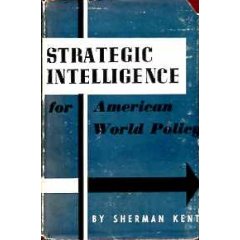
Review: Strategic Intelligence for American World Policy

5 Star, Intelligence (Government/Secret)
cover kent
Amazon Page

Sherman Kent

5.0 out of 5 stars Seminal Work for the Middle Period of Intelligence, September 28, 2013

The history of national intelligence in terms of spies, satellites, and secrets can be concisely separated into three eras: the era of secret wars, the era of strategic analysis, and the era of open source intelligence.

Sherman Kent was without question the dean and the prophet for the second era, and this gem of a book remains a standard in the field and required reading for any intelligence professional (collector, analyst, or other). He did not realize his vision because the clandestine service (of which I was a member) took over the CIA and subordinated the analysts, and because in so doing, the CIA lost touch with most of the open source world.

Today Kent is succeeded by Jack Davis, whose term “analytic tradecraft” can be used to find his collection of memos on the web, and by the CIA University. However, the secret world is now under attack by the emergent World Brain, in which Collective (Public) Intelligence utilizes open sources of information to create Open Source Intelligence (OSINT) that is better than secret information, cheaper than secret information, and more useful than secret information because it can be shared broadly.

Those whose sense of self is defined by the secret world will have difficulty adjusting to this, witness the continued references in the secret world to “Open Sources.” Max nix. The war is over, and Kent's vision will ultimately be realized in the third era, the era of open sources.

Consider also:

Continue reading “Review: Strategic Intelligence for American World Policy”

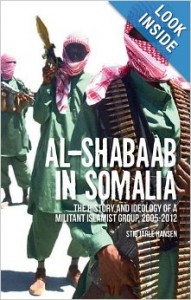
Berto Jongman: Al Shabaab in Somalia

01 Poverty, 05 Civil War, 07 Other Atrocities, 09 Terrorism, 5 Star, Terrorism & Jihad, Threats (Emerging & Perennial), Worth A Look
Berto Jongman
Berto Jongman

Since early 2007 a new breed of combatants has appeared on the streets of Mogadishu and other towns in Somalia: the ‘Shabaab', or youth, the only self-proclaimed branch of al-Qaeda to have gained acceptance (and praise) from Ayman al-Zawahiri and ‘AQ centre' in Afghanistan. Itself an offshoot of the Islamic Courts Union, which split in 2006, Shabaab has imposed Sharia law and is also heavily influenced by local clan structures within Somalia itself. It remains an infamous and widely discussed, yet little-researched and understood, Islamist group.

Amazon Page
Amazon Page

Hansen's remarkable book attempts to go beyond the media headlines and simplistic analyses based on alarmist or localist narratives and, by employing intensive field research conducted within Somalia, as well as on the ground interviews with Shabaab leaders themselves, explores the history of a remarkable organisation, one that has survived predictions of its collapse on several occasions. Hansen portrays al-Shabaab as a hybrid Islamist organization that combines a strong streak of Somali nationalism with the rhetorical obligations of international jihadism, thereby attracting a not insignificant number of foreign fighters to its ranks. Both these strands of Shabaab have been inadvertently boosted by Ethiopian, American and African Union attempts to defeat it militarily, all of which have come to nought.

See Also:

Qwant: Al Shabaab Across the Board

Al Shabaab Tweets [Account Suspended]


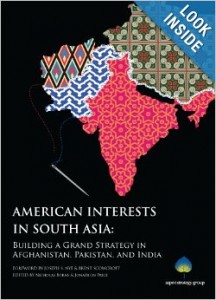
Review: American Interests in South Asia (Ho Ho Ho)

3 Star, Country/Regional, Diplomacy, Empire, Sorrows, Hubris, Blowback, Military & Pentagon Power, Misinformation & Propaganda, Politics, Power (Pathologies & Utilization), Security (Including Immigration), Voices Lost (Indigenous, Gender, Poor, Marginalized), War & Face of Battle
Amazon Page
Amazon Page

Nicholas Burns (Editor) , Jonathon Price (Editor) , Joseph S. Nye Jr. (Foreword) , Brent Scowcroft (Foreword)

3.0 out of 5 stars Parallel Universe — Divorced from Reality, September 20, 2013

I am in Afghanistan with the opportunity to think about all of the external and internal realities impacting on 2014, and this book attracted my immediately interest, along with Afghanistan: The Perfect Failure: A War Doomed By The Coalition's Strategies, Policies and Political Correctness. If I had the time I would buy and read both books, but sadly I have to focus on the here and now with just two comments:

01 All of these big names write great stuff, but I have to ask myself, who are they writing for? Who, if anyone is listening? Among all these great ideas, there is not a single one that has been implemented, funded, sustained, or effective. So why do we have smart people and think tanks? Are they a form of public entertainment, of public self-stroking, completely removed from the reality that the White House and Congress are so lacking in moral and intellectual fortitude as to be a constant danger to both the Republic and all other nations?

Continue reading “Review: American Interests in South Asia (Ho Ho Ho)”

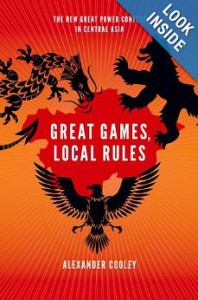
Review: Great Games, Local Rules: The New Great Power Contest in Central Asia

3 Star, Country/Regional
Amazon Page
Amazon Page

Alexander Cooley

3.0 out of 5 stars Neither the Book Nor the Other Reviews are Serious, September 16, 2013

I am in Afghanistan, where I spend my time thinking about all external and internal factors bearing on 2014, and I was greatly looking forward to reading this book. It arrived, I read it, and I am hugely disappointed. Judging by the long list of grants and stipends that the author names in the front of the book, I have to ask myself, how on earth did he ever arrive at such a sadly simplistic rendering of what is in essence the center of the world?

This book gets three stars from me because it fails across virtually every significant point of analysis — not that the facts are wrong — journeymen argue about facts, masters debate models and assumptions. I gave this book the benefit of my “first class” read, which is to say, I started with the index, the bibliography, and the notes. Here are reasons this book does not rise about the three star level:

01 No strategic model, no intelligence in the sense of decision support. Visit Phi Beta Iota the Public Intelligence Blog to learn everything that academics and think tanks have absolutely no clue about in relation to the evolving discipline of intelligence.

02 Afghanistan is a side show, not really included in the book in any substantive sense, nor is the author at all cognizant with the major tribes that bleed over the borders, the key personalities, etcetera. This is an anticeptic book that could easily have been written from an air-conditioned cubicle in the USA.

03 India gets 10 mentions, Iran 6, Pakistan 13, Turkey 5, and Saudi Arabia 3. Granted, the author is focusing his article in a hard cover (I have written longer monographs) on Russia, China, and the USA in relation to the ‘stans less Afghanistan — but this alone is grounds for disqualifying the book from any serious collection. The book is largely devoid of historical knowledge of the great game, and it is laughably empty when it comes to itemizing and explaining the local rules.

Continue reading “Review: Great Games, Local Rules: The New Great Power Contest in Central Asia”

Review: The American Style of Foreign Policy

5 Star, Empire, Sorrows, Hubris, Blowback

Amazon Page
Amazon Page
Robert Dalleck

5.0 out of 5 stars A classic, publisher needs to present it properly, September 12, 2013

This book was strongly recommended to me by Chuck Spinney, the top defense critic since he made the cover of TIME in the 1980's. I am in Afghanistan and focused on other matters, but I am so disappointed in the failure of the publisher to properly present the book (e.g. providing Look Inside the Book data to Amazon), and the three star review that provides so little detail and a questionable low rating, that I am moved to simply give this book, sight unseen five stars on the strength of Chuck's recommendation, and also list some other books below.

The bottom line is that the US lacks intelligence with integrity. Secret intelligence is too easy to ignore, and in the absence of public intelligence in the public interest, the politicians do what others pay them to do, not what is in the best interests of the public. Iraq, Afghanistan, Libya, Syria are all examples of wars based on lies, wars that cost the public blood, treasure, and spirit, while enriching the few that have bought the politicians.

Other books supporting this book, whose main theme is the moral and intellectual vacuum of US foreign policy, include the following, a selection from my broader reading and reviewing here at Amazon (to see many more books lined up in 98 reading categories, visit Phi Beta Iota the Public Intelligence Blog).

Continue reading “Review: The American Style of Foreign Policy”

noble gold