… the design includes a combination of water and a single, external car battery that’s used to produce electricity, and spark the process that separates the hydrogen from the water molecule. As a result, the necessary energy to power the bike is created.
The Open Source Ecology Bulldozer Workshop is a 10 day immersion experience where we build Open Source Ecology’s largest machine to date – a 12 ton, 168 hp bulldozer. This workshop builds upon our recent production of 6 Power Cubes and the MicroTractor.
Was Chattanooga a Large False Flag Stymied by Unwitting Shooters?
According to Navy sources in contact with blogger Allen West, Lt. Cmdr Timothy White, a Naval officer who exchanged gun fire with a shooter who killed five service members in Chattanooga, Tenn., will be charged by the Navy for illegally discharging a firearm on federal property, though a more recent story indicates the Navy denies he will be charged.
News sources give the impression that US Marines were shot and killed at a mall recruiting station, but the actual fire fight took place across town seven miles away at the Navy Operational Support Center and Marine Corps Reserve Center, and supposedly within “minutes” after the recruiting station shooting. The shooter must have had an incredibly fast car that, as one writer pointed out, which “can overcome traffic lights, speed limits, and the physical laws of science.”
the competitive perspective is almost always the least important aspect in managerial decision-making. Internal operational issues including execution, budgets, and deadlines are paramount in a company’s deliberation, but what other players will do is hardly ever in focus. This “island mentality” is surprisingly prevalent among talented, seasoned managers.
It breaks my heart to watch all things cyber continue along very corrupt paths associated with a melange of linear thinking, bureaucratic inertia, truly evil covert operations that undermine cyber-security, and of course the persistent lack of accountability.
Winn Schwartau
It was my great privilege to be among the first to sound the alarm on cyber-security, joining with Winn Schwartau in sponsoring the Information Warfare Conference. Although I left that endeavor to focus on Open Source Solutions, Winn and I continue to marvel at how little everyone has learned.
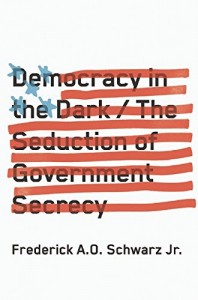
From Dick Cheney's man-sized safe to the National Security Agency's massive intelligence gathering, secrecy has too often captured the American government's modus operandi better than the ideals of the Constitution. In this important new book, Frederick A.O. Schwarz Jr., who was chief counsel to the U.S. Church Committee on Intelligence uses examples ranging from the dropping of the first atomic bomb and the Cuban Missile Crisis to Iran Contra and 9/11 to illuminate this central question: how much secrecy does good governance require? Schwarz argues that while some control of information is necessary, governments tend to fall prey to a culture of secrecy that is ultimately not just hazardous to democracy but antithetical to it. This history provides the essential context to recent cases from Chelsea Manning to Edward Snowden. Democracy in the Dark is a natural companion to Schwarz's Unchecked and Unbalanced, co-written with Aziz Huq, which plumbed the power of the executive branch—a power that often depends on and derives from the use of secrecy.