“I was recently asked to talk about the idea of “open”, and I realized the term is used in at least eight different ways. The distinct interpretations are all important in different but interlocking ways. Getting them confused leads to a lot of misunderstanding, so it’s good to review them all.
When we tease apart their meanings, we can understand more clearly which aspects of each are the most important. The first, one of the most important forms of openness for the Web, is its universality.
Universality
When I designed the Web protocols, I had already seen many networked information systems fail because they made some assumptions about the users – that they were using a particular type of computer for instance – or constrained the way they worked, such as forcing them to organize their data in a particular way, or to use a particular data format. The Web had to avoid these issues.
The goal was that anyone should be able to publish anything on the Web and so it had to be universal in that it was independent of all these technical constraints, as well as language, character sets, and culture.
Net Neutrality is essential to an open, fair democracy Close to the principle of universality is that of decentralization, which means that no permission is needed from a central authority to post anything on the Web, there is no central controlling node, and so no single point of failure. This has also been critical to the Web’s growth and is critical to its future.
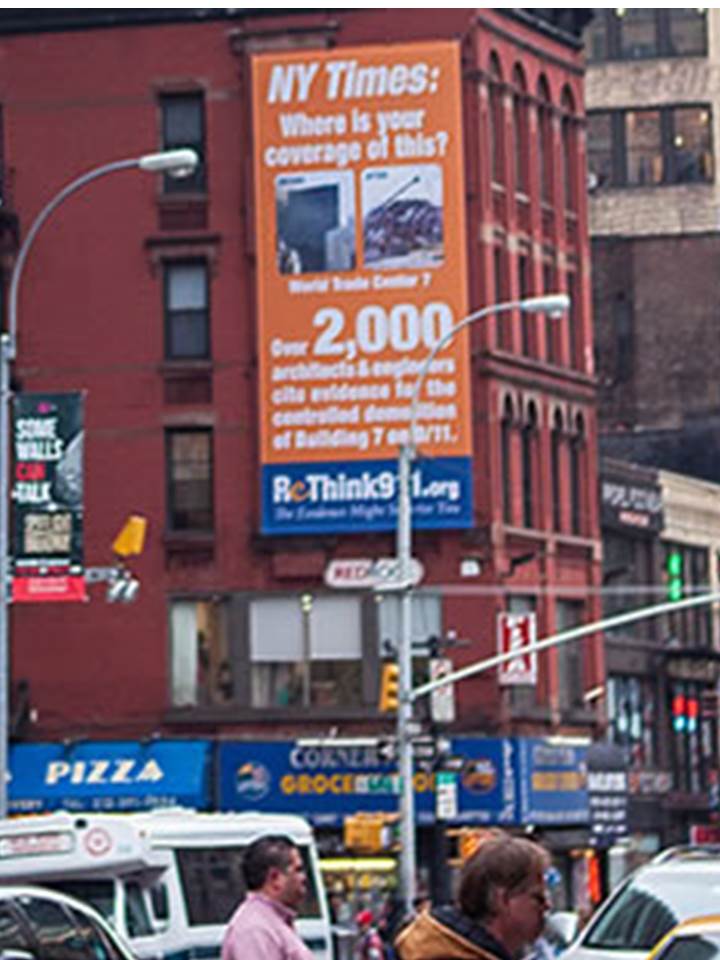
Installed on the afternoon of October 31, ReThink911’s 29-foot by 13-foot billboard will stand tall in the shadow of the New York Times Building throughout the month of November, intriguing 100,000 passersby each day and calling upon the Times to cover this vitally important issue.
Welcome to the Free Software Supporter, the Free Software Foundation's monthly news digest and action update — being read by you and 71,727 other activists. That's 1,011 more than last month!
The old guard, with a touch of guilt and and what remains of integrity, is trying to call a halt to the rape of the Army. The neo-con dead-enders and Obamites feel their wings getting clipped and are enlisting the Barnos to sharpen their beaks.
David W. Barno, a retired Army lieutenant general, is a senior adviser and senior fellow at the Center for a New American Security. He commanded U.S. and coalition forces in Afghanistan from 2003 to 2005.
The U.N. and Human Rights Watch and Amnesty International recently released a flurry of deeply flawed reports on drone murders. According to the U.N.'s special rapporteur, whose day job is as law partner of Tony Blair's wife, and according to two major human rights groups deeply embedded in U.S. exceptionalism, murdering people with drones is sometimes legal and sometimes not legal, but almost always it's too hard to tell which is which, unless the White House rewrites the law in enough detail and makes its new legal regime public.
When I read these reports I was ignorant of the existence of a human rights organization called Alkarama, and of the fact that it had just released a report titled License to Kill: Why the American Drone War on Yemen Violates International Law. While Human Rights Watch looked at six drone murders in Yemen and found two of them illegal and four of them indeterminate, Alkarama looked in more detail and with better context at the whole campaign of drone war on Yemen, detailing 10 cases. As you may have guessed from the report's title, this group finds the entire practice of murdering people with flying robots to be illegal.
Alkarama makes this finding, not out of ignorance of the endless intricacies deployed by the likes of Human Rights Watch and Amnesty International. Rather, Alkarama adopts the same dialect and considers the same scenarios: Is it legal if it's a war, if it's not a war? Is it discriminate, necessary, proportionate? Et cetera. But the conclusion is that the practice is illegal no matter which way you slice it.
Effects – Death and Horrific Sickness – of First Waves of the Radioactive Tsunami in Japan
World Network For Saving Children From Radiation, Oct. 26, 2013: […] A case like this is just a tip of iceburg […] IKKO is a Buddhist monk. His life is ending. He is only 34 years old and lives in Hiwada town [near Koriyama] in Fukushima. He had a heart attack two days ago, and his doctor announced brain death. He is now connected to life-support. My sister in Fukushima knows him through her student […] She and IKKO got engaged and were planning to get married next year. She has just lost her father from cancer last April. He had worked at Fukushima Nuclear Power Plant […] My sister was present when IKKO had a heartattack and is in disbelief of what is taking place since he was fine before this […] There have been many cases of sickness and death among young generations in Fukushima although it is not reported by media…Mother from Tokyo, Japan during Q & A at Cinema Forum Fukushima, Published July 3, 2013 (at 2:20 in): In Japan, it’s really a total blackout of media, even though there are lots and lots of people who have been developing symptoms…I was outside on the 15th of March in Tokyo, and then about 1 month later, I had fever of like 103ºF for 8 days. And this [baby] boy, he was totally healthy, now he’s OK, but at the time he had 101ºF fever on and off for 13 times in the duration of 3 months. He had rash all over and he was really, really sick […] he became real skinny and he stopped growing for 3 or 4 months. It is really happening. I have 2 nodules in my thyroid, and my boy has countless number of minor nodules.”
“The coordination of the multibillion dollar Fukushima decontamination operation relies on Japan’s organized crime, the Yakusa, which is actively involved in the recruitment of “specialized” personnel for dangerous tasks. “The complexity of Fukushima contracts and the shortage of workers have played into the hands of the yakuza, Japan’s organized crime syndicates, which have run labor rackets for generations.” (Reuters, October 25, 2013) The Yakuza labor practices at Fukushima are based on a corrupt system of subcontracting, which does not favor the hiring of competent specialized personnel. It creates an environment of fraud and incompetence, which in the case of Fukushima could have devastating consequences. The subcontracting with organized crime syndicates is a means for major corporations involved in the clean-up to significantly reduce their labor costs. This role of Japanese organized crime also pertains to the removal of the fuel rods from Reactor no. 4. As documented in several GR articles, this undertaking –if mishandled– by careless workers under the lax supervision of corrupt subcontractors (linked to the Yakusa) creates an environment which could potentially lead to a massive radioactive fallout:
An operation with potentially “apocalyptic” consequences is expected to begin in a little over two weeks from now – “as early as November 8″ – at Fukushima’s damaged and sinking Reactor 4, when plant operator TEPCO will attempt to remove over 1300 spent fuel rods holding the radiation equivalent of 14,000 Hiroshima bombs from a spent fuel storage tank perched on the reactor’s upper floor. While the Reactor 4 building itself did not suffer a meltdown, it did suffer a hydrogen explosion, is now tipping and sinking and has zero ability to withstand another seismic event. A recent Reuters report documents in detail the role of Japan’s Yakuza and its insidious relationship to both TEPCO as well as agencies of the Japanese government including the Ministry of Health, Labor and Welfare. Nearly 50 gangs with 1,050 members operate in Fukushima prefecture dominated by three major syndicates – Yamaguchi-gumi, Sumiyoshi-kai and Inagawa-kai, police say.
Ministries, the companies involved in the decontamination and decommissioning work, and police have set up a task force to eradicate organized crime from the nuclear clean-up project. Police investigators say they cannot crack down on the gang members they track without receiving a complaint. They also rely on major contractors for information. In a rare prosecution involving a yakuza executive, Yoshinori Arai, a boss in a gang affiliated with the Sumiyoshi-kai, was convicted of labor law violations. Arai admitted pocketing around $60,000 over two years by skimming a third of wages paid to workers in the disaster zone. In March a judge gave him an eight-month suspended sentence because Arai said he had resigned from the gang and regretted his actions. Arai was convicted of supplying workers to a site managed by Obayashi, one of Japan’s leading contractors, in Date, a town northwest of the Fukushima plant. Date was in the path of the most concentrated plume of radiation after the disaster. A police official with knowledge of the investigation said Arai’s case was just “the tip of the iceberg” in terms of organized crime involvement in the clean-up.”