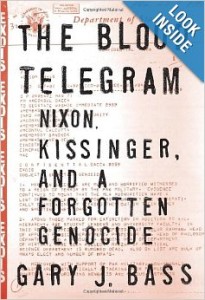
Review (Guest): The Blood Telegram – Nixon, Kissinger, and a Forgotten Genocide

5 Star, Atrocities & Genocide
0Shares
Amazon Page
Amazon Page

Gary Jonathan Bass

5.0 out of 5 stars Enabling Pakistani Genocide, September 29, 2013
Herbert L. Calhoun

Although the two superpowers managed to avoid a cataclysmic disaster during the almost 40 years of the Cold War, the same could not be said of the many states “standing-in” as their ideological proxies. The list of nations suffering various degrees of irreparable damage as a result of the “Cold War” is almost unending. Among them, one would be remiss not to include Cuba, Angola, Vietnam, Laos, Cambodia, Indonesia, Nicaragua, Grenada, Chile, Guatemala, just to name the ones that come immediately to mind. Two other such nations were India, a Russian ally; and Pakistan, a U.S. ally. Both suffered immeasurably in the genocide exposed here.

As the author tells the story, Pakistan just happened fortuitously to get tripped into a genocide that cost more than a million (mostly Hindu) lives, merely by being in the path of destruction that rippled across the geopolitical landscape called Nixon-Kissinger Cold War realpolitik.

Continue reading “Review (Guest): The Blood Telegram – Nixon, Kissinger, and a Forgotten Genocide”

Marcus Aurelius: N.S.A. Gathers Data On Social Connections Of U.S. Citizens

Corruption, Government, Idiocy, Military
0Shares
Marcus Aurelius
Marcus Aurelius

New York Times
September 29, 2013
Pg. 1

N.S.A. Gathers Data On Social Connections Of U.S. Citizens

By James Risen and Laura Poitras

WASHINGTON — Since 2010, the National Security Agency has been exploiting its huge collections of data to create sophisticated graphs of some Americans’ social connections that can identify their associates, their locations at certain times, their traveling companions and other personal information, according to newly disclosed documents and interviews with officials.

The spy agency began allowing the analysis of phone call and e-mail logs in November 2010 to examine Americans’ networks of associations for foreign intelligence purposes after N.S.A. officials lifted restrictions on the practice, according to documents provided by Edward J. Snowden, the former N.S.A. contractor.

The policy shift was intended to help the agency “discover and track” connections between intelligence targets overseas and people in the United States, according to an N.S.A. memorandum from January 2011. The agency was authorized to conduct “large-scale graph analysis on very large sets of communications metadata without having to check foreignness” of every e-mail address, phone number or other identifier, the document said. Because of concerns about infringing on the privacy of American citizens, the computer analysis of such data had previously been permitted only for foreigners.

Continue reading “Marcus Aurelius: N.S.A. Gathers Data On Social Connections Of U.S. Citizens”

Marcus Aurelius: NSA’s Creeping Cloud

Corruption, Government, Idiocy, Military
0Shares
Marcus Aurelius
Marcus Aurelius

New York Times
September 29, 2013
Pg. SR11

Creeping Cloud

By Maureen Dowd

BLUFFDALE, Utah — AT the Husband and Wife lingerie store here in Mormon country — where babies are welcome amid the sex toys and the motto is “Classy, tasteful and comfortable” — no one had heard of it.

At the Allami smoke shop across the street, adjacent to a hypnosis center that can help you stop smoking, they were disturbed by it. Down the road at Quiznos, the young man making subs went on a rant about his insular community’s compliance with the government’s intrusions into Americans’ private lives.

Indeed, this valley of subdivisions, sagebrush and one of the remaining polygamous sects gets more exercised about the letter “c” — there’s a Kapuccino cafe, a Maverik convenience store and a Pikasso print shop — than they do about the National Security Agency’s secretive new $2 billion, one- million-square-foot data death star.

As Mark Reid, Bluffdale’s city manager, told The Times’s Michael Schmidt, the community’s initial excitement about new jobs faded because many of the data analysts are elsewhere. The good jobs, he says, are for security dogs who have a “plush” kennel.

“They don’t interact with anybody, they don’t let anybody come up there,” he said: “It is like they are not there. It is not like they are I.B.M. and they join us for town days and sponsor a booth.”

At a hearing of the Senate Intelligence Committee in Washington on Thursday, Democratic Senator Mark Udall of Colorado tried to pin down the shadowy and largely unchecked Emperor Alexander, as the N.S.A. head, Gen. Keith Alexander, is known, on whether his agency is indiscriminately Hoovering Americans’ phone records.

“I believe it is in the nation’s best interest to put all the phone records into a lockbox that we could search when the nation needs to do it, yes,” Alexander said.

When Alexander was asked a year ago if the Bluffdale center would hold the data of Americans, he replied no: “We don’t hold data on U.S. citizens,” adding that reports that they would “grab all the e-mails” were “grossly misreported.”

Democratic Senator Ron Wyden of Oregon told me ruefully that on Thursday, “Alexander put in a lockbox information that he’s told the public he doesn’t have. This is what we’re dealing with.

Continue reading “Marcus Aurelius: NSA's Creeping Cloud”

Jean Lievens: Seven Ways Occupy Changed America — And Is Still Changing It

Cultural Intelligence
0Shares
Jean Lievens
Jean Lievens

Before Occupy came along, the Tea Party narrative was dominant in American politics. Conservative activists told a story about how big government was strangling taxpayers and small businesses, holding back growth, fiscally bankrupting the nation, and attacking freedom. Occupy’s rise was a pivot point away from that narrative. It legitimized public discussion of inequality and helped embolden Democrats to talk about this problem, including President Obama, who gave a hard-hitting speech on inequality in Osawatomie, Kansas just three months after demonstrators first appeared at Zuccotti Park.

List Only:

1. Putting Inequality on the Agenda
2. Shaping the 2012 Election
3. Influencing Tax Debates
4. Reviving Progressive Populism
5. Seeding the New Union Organizing
6. Keeping the Heat on Wall Street
7. Offering Alternatives to Capitalism

Read full article.

Phi Beta Iota: Totally delusional but well-intentioned.  Occupy — and Ron Paul and Dennis Kucinich and all of the small party presidential candidate that refused to join We the People Reform Coalition for a “red line” stand on electoral reform — all had their chance and they blew it.  A meltdown is coming.  We pray it restores the neighborhood.

See Also:

Manifesto Extracts
NATO OSE/M4IS2 2.0
Open Source Agency (OSA)
Public Intelligence 3.8
USA Reform Ideas
Way of the Truth
We the People Reform Coalition

Rickard Falkvinge: ON ART

#OSE Open Source Everything
0Shares
Rickard Falkvinge
Rickard Falkvinge

The Question Was Never “How Do We Make Sure Artists Are Paid”. It Was Always “How Do We Ensure Art Is Made And Available”.

Posted: 28 Sep 2013 12:14 PM PDT

Money

Copyright Monopoly:  The copyright monopoly was never intended to ensure income for a particular group of people. This is a common false counterargument in the copyright monopoly debate, even among people who agree that the current monopoly is beyond insane: “but we must find a way to ensure that artists are compensated for their work”. This is simply a thoroughly false statement; the goal of policymaking is to ensure art is created and available to the public, and whether somebody is paid for it is completely beside the point.

This argument about rewarding creators of art is a very common way of trying to derail a discussion about the copyright monopoly. Regardless of the logical dishonesty in defending a system that locks 99.995% of artists away from any royalty with the argument that “artists must get paid”, and then steals most of the rest of the money from the 0.005% of the artists, it’s still a recurring argument. The problem is that it is utterly false and a diversion; compensating artists monetarily was never a goal with the copyright monopoly.

As I’ve written before, nobody is entitled to any compensation for any amount of work, ranging from minuscule to infinite. The only thing that entitles an entrepreneur – artists included – to any kind of compensation is a sale.

Continue reading “Rickard Falkvinge: ON ART”