Neal Reauhauser: Exploring E-International Relations

Access, Crowd-Sourcing, Culture, Design, Governance, Knowledge, P2P / Panarchy
0Shares
Neal Rauhauser
Neal Rauhauser

Exploring e-International Relations

When I was checking out the Think Tanks & Civil Societies Program I noticed e-International Relationsthe world’s leading website for students of international politics. They had an About page similar to that of Wikistrat, listing all of their volunteer editors and some additional information on them.

Last night I entered most of that information into e-IR-base, a Maltego graph. Those who want to follow along can download the graph file, get the free Maltego Community Edition, and do a portion of the things I do with it. The free version has very limited access to Paterva‘s transform servers, so I will provide the necessary intermediate files.
Click on Image to Enlarge

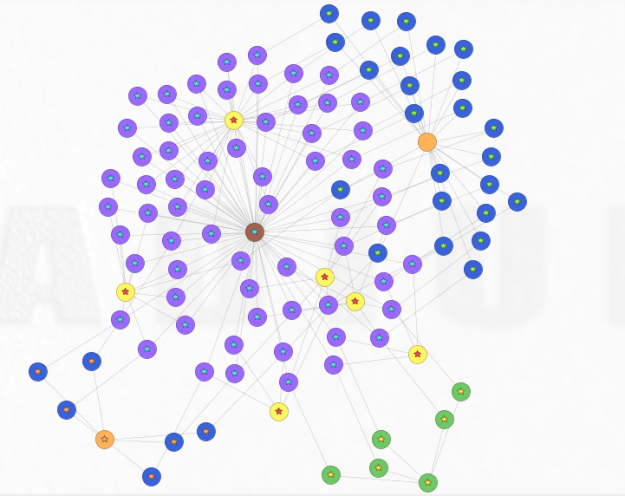
This is a top level view of the e-IR graph. What I say next presumes some knowledge of hands on work with Maltego.

The lavender dots are Person entities – a place for a first and last name, and like every entity you can makes notes and attach files to it. The blue dots at the upper right are URL entities and they contain links to an editor’s profile on the official site. Not everyone has a profile – this seems to be for people who produce their own content as well as work as editors. The five green dots are Twitter accounts, the five blue dots with an orange dot in the middle are LinkedIn profiles and an entity for the domain itself.

Maltego provides different types of entities, but here at the start we are only using Person, Domain, URL, and Phrase. Maltego provides a way to group different types of entities using colored stars – blue, green, yellow, orange, and red. This is useful for searching and organizing tasks – if you run a transform that starts with the five Twitter accounts shown here, but gets back over a thousand responses, how do you spot your originals?

Read full post with additional graphics and links.

Jean Lievens: Open source hardware meets the p2p economy

Hardware
0Shares
Jean Lievens
Jean Lievens

Open source hardware meets the p2p economy

We are at this moment in history when we can say with certainty that open source hardware (OSHW) is economically viable. The video below tells the success story of Adafruit Industries. Barely formed, this business model relying on OSHW might already be obsolete. A new model, the open value network, is already threatening to transform the landscape of the open source economy. This article explains why.

Most people find it counter-intuitive that companies can survive in a highly competitive capitalistic environment, designing and distributing high tech products, giving away their recipes, AND allowing (even encouraging) everyone else to copy them, WITH THE RIGHT TO MAKE COMMERCIAL USE.

If you don't believe it, stop wasting your time arguing against it. It is real, it is here, you better understand it fast before the world changes around you, leaving you an alien in your own surroundings.

Click on Image to Enlarge

The business around open innovation cannot be learned in school. It belongs to a new economic paradigm. Old arguments don't apply anymore, because the semantics and the logic are not the same. Some time ago, we published the article How to play the open game in the present and future economy, which tries to capture the essence of sustainable open innovation. You should revisit this article from time to time, becausewe'll continue to improve it.

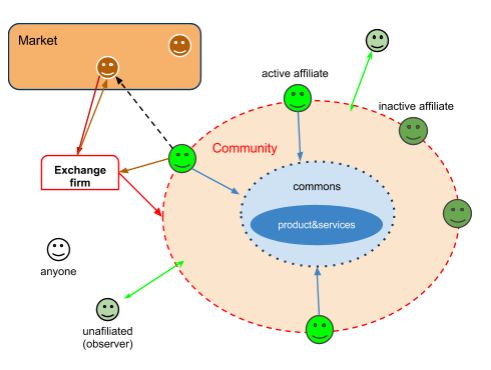
GRAPHIC:  The open value network is model for commons-based peer production. See SENSORICA as an example.

The most successful ventures build around OSHW, like ArduinoAdafruitSparkfun, etc., can only be understood within their larger ecosystem. We can identify two main structures: a commercial entity and a community. The commercial entity is a classical form, usually a corporation or a co-op. It takes care of manufacturing, insures quality, structures and integrates the feedback from the community into new products, nurtures the community, performs legal functions, integrates all the transactional logistics (storage, shipping, payment), and provides services. The community plays different roles: consumers of products, provide feedback on products, provide new designs, spread the buzz, educate new members of the community and provide help, etc.

Phi Beta Iota:  Emphasis added.

See Also:

Open Source Everything

Sepp Hasslberger: Monsanto GM Corn Nutritionally Dead, Highly Toxic — and Totally Approved by a Corrupt US Congress

01 Agriculture, 07 Other Atrocities, Commerce, Corruption, Government, Politics of Science & Science of Politics, True Cost
0Shares
Sepp Hasslberger
Sepp Hasslberger

Analysis Finds Monsanto’s GM Corn Nutritionally Dead, Highly Toxic

Is GMO corn nutritionally equivalent to non-GMO corn? Monsanto will tell you the answer is a big ‘yes’, but the real answer is absolutely not. And the simple reality is that they are continuing to get away with their blatant misinformation. In fact, a 2012 nutritional analysis of genetically modified corn found that not only is GM corn lacking in vitamins and nutrients when compared to non-GM corn, but the genetic creation also poses numerous health risks due to extreme toxicity.

With the recent passing of the Monsanto Protection Act, there is no question that mega corporations like Monsanto are able to wield enough power to even surpass that of the United States government. The new legislation provides Monsanto with a legal safeguard against federal courts striking down any pending review of dangerous GM crops. It is ironic to see the passing of such a bill in the face of continuous releases of GMO dangers.

Non-GMO Corn 20x Richer in Nutrition than GMO Corn

Continue reading “Sepp Hasslberger: Monsanto GM Corn Nutritionally Dead, Highly Toxic — and Totally Approved by a Corrupt US Congress”

Rickard Falkvinge: Smash Copyright [and Flush DRM]

Commerce, Corruption, Government, Law Enforcement
0Shares
Rickard Falkvinge
Rickard Falkvinge

Let’s Reform Copyright. With A Sledgehammer. Into Smithereens

One of the better attempts at solving the problems with the copyright monopoly has been Creative Commons. Creative Commons does great work in encouraging creative people to think differently about the copyright monopoly, and about what other people are allowed to do with their work. Unfortunately, there’s one big problem. Here’s an infographic to sum it up:

This is the problem with any law based on the copyright monopoly: it only protects people who can afford to file a lawsuit. If you have the money, if you have the time, and if you have the will to go through a process that often takes years of stress and silliness, then you get to enjoy the benefits of the monopoly. Otherwise, it’s a joke.

Read full article.

SchwartzReport: GMO Poison, Nuclear Seepage, Eat Less Die Less, Obama’s Three Failures

01 Agriculture, 03 Environmental Degradation, 05 Energy, 06 Family, 07 Health, 07 Other Atrocities, 08 Proliferation, 11 Society
0Shares

schwartz report

BioTech Lies Exposed: Genetically Modified Corn Is Loaded With Chemical Poisons
JONATHAN BENSON – Global Research

The more I learn about GMOs (See The Great Experiment: Genetically Modified Organisms, Scientific Integrity, and National Wellness http://www.explorejournal.com/article/S1550-8307%2812%2900222-4/fulltext) the more I am convinced that this is a vast planet wide animal study, and we are the animals. We must label the presence of these organisms in our foods. ! Sign every petition you can, donate, lobby. We are up against a very powerful corporate force, but our health depends upon our behavior

This is the latest on a slow motion nuclear accident taking place with almost no public awareness.

Seepage From an Aging Nuclear Site
GINA MASON – Consortiumnews.com

An unintended mass population experiment reveals a great deal that you may find useful in your own life.  Click through to see the graphic.

The Cuban Diet: Eat Less, Exercise More – and Preventable Deaths Are Halved
JEREMY LAURANCE – The Independent (UK)

Obama has been a disappointment in many ways. The big three, in my view, are the failure to address climate change in a meaningful way; the failure to hold the corrupt financial sector accountable; and the failure to develop a foreign policy that was not just an extension of the Bush-Cheney policies.

Losing Pakistan: An Insider’s Look at How the U.S. Deals With Its Ally
OMAR WARAICH – Time

Mini-Me: Boston List of Suspects Updated 1.3

07 Other Atrocities, 09 Terrorism, IO Deeds of War
0Shares
Who?  Mini-Me?
Who? Mini-Me?

Huh?

Superceded by:

Owl: Boston Official Story Unraveling — Plan for TSA Everywhere? TSA Rousting the Homeless in Seattle [with Photo]

Original story (and updated table of suspects) below:

U.S. was warned of terror attacks

Source: Look for trail through Sri Lanka, Bangladesh

Reza Kahlili

WND, 16 April 2013

Although it is not known yet who is responsible for Monday’s heinous bombings at the Boston Marathon that killed three and injured more than 100 people, a source within Iranian intelligence services told WND the Islamic regime was behind them and to look for trails through Sri Lanka and Bangladesh.

The source said the bombs were planted near the end of the race so that the horrific images of the blasts would be captured by all the media there and be replayed over and over throughout the world.

Read full article.

Continue reading “Mini-Me: Boston List of Suspects Updated 1.3”