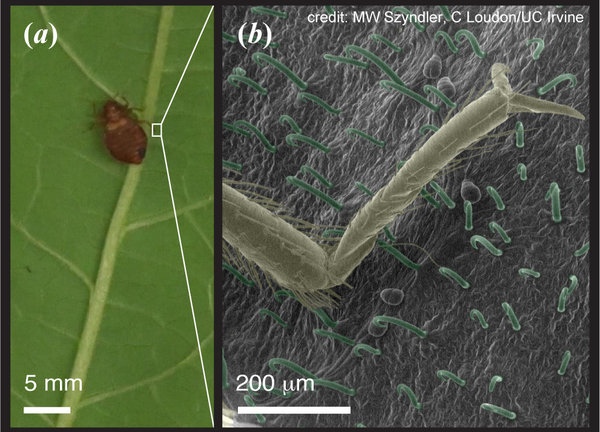
Generations of Eastern European housewives doing battle against bedbugs spread bean leaves around the floor of an infested room at night. In the morning, the leaves would be covered with bedbugs that had somehow been trapped there. The leaves, and the pests, were collected and burned — by the pound, in extreme infestations.
I have reached a point where I have been forced to conclude that Monsanto is an evil corporation, as I understand that word. I know, from what you have written me that many of you, as have I and Ronlyn, have signed petitions against Monsanto. Now take the next step. Stop buying their products. Here is a URL where you will find the list of the companies Monsanto owns.
WARNING NOTICE: The list is not accurate and has been removed from Phi Beta Iota. The concept remains valid, but the public must first properly identify all Monsanto companies. We continue to wonder why farmers are not suing Monsanto for willful trespass, unlawful deprivation of property use, and health violations related to the toxicity and third generation infertility that are associated with Monsanto's GMO offerings.
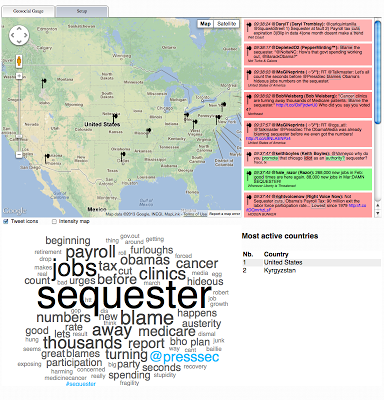
Over the last couple of months we have been working on getting our GeoSocial Gauge system up and running. The idea behind the website is to bring together social media and geographical analysis to monitor and explore people’s views, reactions, and interactions through space and time. It takes advantage of the emergence of social media to observe the human landscape as the living, breathing organism that it is: we can witness the explosion-like dissemination of information within a society, or the clusters of individuals who share common opinions or attitudes, and map the locations of these clusters. This is an unprecedented development that broadens drastically our understanding of the way that people act, react to events, and interact with each other and with their environment. We refer to this novel approach to study the integration of geography and society as GeoSocial Analysis.
The GeoSocial Gauge has several live streams ranging from exploring the political issues (e.g. Sequester) to to see what people are tweeting about TV (The Walking Dead).
Phi Beta Iota: Some very interesting spontaneous combustion is happening, with convergence slow but sure to come.
SEED-Scale (Self-Evaluation for Effective Decision-making) is a methodology for community-organizing and resilience-building pioneered by the NGO Future Generations. SEED-Scale is a powerful and attractive alternative in an environment presently dominated by the over-professionalized and foundation-funded 501(c)3 Model. Unlike the 501(c)3, SEED-Scale approaches community-organizing from a much different perspective. In many ways it recaptures the spirit of grassroots movements such as AIM (American Indian Movement), and is in important respects similar to the Zapatistas democratic/egalitarian/bottom-up approach in Latin America:
SEED-SCALE offers a solution…It does this by focusing on the one resource available to us all: Human Energy. When human energy is viewed as the essential commodity that will improve lives, individuals are shown to already posses an infinite resource they can build on. Therefore, resourcefulness is the end result, rather than a compulsion for resource consumption. Working with resources already owned—and everyone who is alive owns the resource of their own energy—then technologies, social systems, information, financing will all follow. And if momentum builds around the application of human energy, it will shape to local ecology, economy, and values.
Government officials and their families and associates in Azerbaijan, Russia, Canada, Pakistan, the Philippines, Thailand, Mongolia and other countries have embraced the use of covert companies and bank accounts.
The mega-rich use complex offshore structures to own mansions, yachts, art masterpieces and other assets, gaining tax advantages and anonymity not available to average people.
Click on Image to Enlarge
Many of the world’s top’s banks – including UBS, Clariden and Deutsche Bank – have aggressively worked to provide their customers with secrecy-cloaked companies in the British Virgin Islands and other offshore hideaways.
A well-paid industry of accountants, middlemen and other operatives has helped offshore patrons shroud their identities and business interests, providing shelter in many cases to money laundering or other misconduct.
Ponzi schemers and other large-scale fraudsters routinely use offshore havens to pull off their shell games and move their ill-gotten gains.
EXTRACT
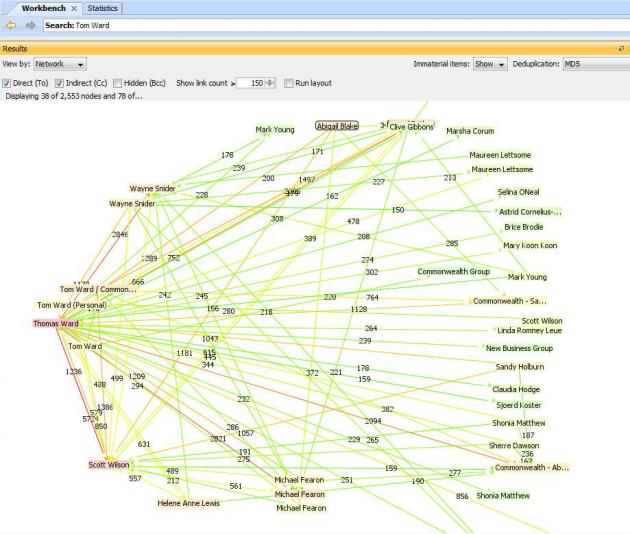
The major software tools used for the Offshore Project were NUIX of Sydney, Australia, and dtSearch of Bethesda, Md. NUIX Pty Ltd provided ICIJ with a limited number of licenses to use its fully featured high-end e-discovery software, free of charge. The listed cost for the NUIX software was higher than a non-profit organization like the ICIJ could afford, if the software had not been donated.
Executive Conference Room (ECR), 7th Floor, Intercultural Center (ICC)
Georgetown University Main Campus
37th and O Streets, N.W., Washington, D.C.
The “invisible” infrastructures of the Internet’s lower layers – addresses, protocols, domain names – are increasingly used to serve political objectives different from the purpose they were initially designed for. Are we currently experiencing a “turn to infrastructure” for Internet governance?
This conference explores the political, social and technical implications of this recent tendency, by focusing on a particularly controversial aspect of Internet infrastructure: the Domain Name System, the Internet’s “phone book.”