By David Goldman @CNNMoneyTech April 8, 2013: 1:41 PM ET
“When people don't see stuff on Google, they think no one can find it. That's not true.”
That's according to John Matherly, creator of Shodan, the scariest search engine on the Internet.
Shodan runs 24/7 and collects information on about 500 million connected devices and services each month.
It's stunning what can be found with a simple search on Shodan. Countless traffic lights, security cameras, home automation devices and heating systems are connected to the Internet and easy to spot.
David S. Kris and J. Douglas Wilson’s second edition of National Security Investigations & Prosecutions is a necessary read, or at least necessary to have in your library, for just about anyone who practices, teaches, or writes about national security law. Kris and Wilson offer what appears to be the country’s sole comprehensive treatise on the law and procedures governing national security investigations. There are at least three audiences who benefit from this work: (1) practicing attorneys in the DOJ and elsewhere in government, who can use the treatise as an operating manual of sorts; (2) law professors, who can use the treatise as a course textbook or to design curricula in national security law courses; and (3) policymakers and legislators, who can use the treatise to explore contemporary issues such as whether the government overreaches in national security investigations and prosecutions, or whether the statutory guidance provided by the Foreign Intelligence Surveillance Act (FISA) and Classified Information Protection Act (CIPA) is sufficient to protect civil liberties and criminal defendants’ rights. It is a testament to Kris and Wilson’s expertise and knowledge that they have assembled a work that will simultaneously appeal and provide significant value to all three audiences.
The treatise consists of thirty three chapters that are organized in two volumes.
Phi Beta Iota: This book has been previously published in 2007, this appears to be a substantially enlarged and updated replacement. It is not yet listed on Amazon.
Researchers use an algorithm to diagnose infectious disease a continent away.
EXTRACT
“Real world information is often vague, minimal, and at times contradictory, so the challenge is to find ways to make good inferences (disease identifications) from such limited data,” says epidemiologist Stephen Morse of Columbia University, one of the paper’s co-authors and creator of the ProMED-mail site.
Click on Image to Enlarge
But the potential to detect outbreaks much faster through the use of statistical models applied to field reports is clear. These tools will find their greatest value in places where deadly pathogens are numerous, diagnostic equipment is hard to find, and time is short.
. . . . . . . .
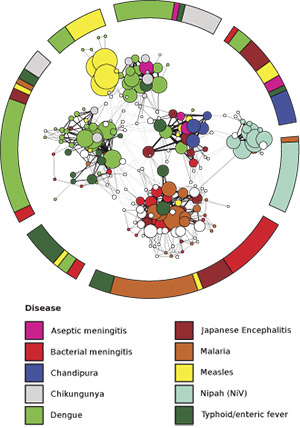
The network of diagnosed outbreaks of diseases with the potential to cause encephalitis (colored) and outbreaks of encephalitis where the cause was removed (white). The inner network describes the strength and relationship of individual outbreaks to each other. The outer ring gives the composition of the 7 communities of disease that were found by the detection algorithm. Each circle represents one outbreak report. Lines connecting two nodes indicate shared traits between two reports.
FBI and CIA Documents claim: Israel has achieved the ability to produce a nuclear bomb after receiving approximately 260 kilograms of enriched uranium from the NUMEC plants, owned by the Jewish-American Zalman Shapiro. According to his testimony in 1981, Karl Dukat, who was Deputy Director of the Central Intelligence Agency stated: “when Richard Helms, CIA director, passed on the evaluation of this important intelligence to President Lyndon Johnson, the President told Helms: Do not tell anyone what you reported to me, not to Dean Rusk (then Secretary of State) or Bob McNamara (then Secretary of Defense). Contacts at NUMEC at the time were Rafi Eitan (then head of the Bureau of Scientific Relations) and Avraham Shalom Bendor, later head of the Shin Bet.”
Nicholas Carr, futurist and author of The Shallows: What the Internet Is Doing to Our Brains, has provided a tremendous amount of insight into how/why technology, and the Internet specifically, shapes both our behaviors and neurophysiology. According to Carr while the Web is unarguably a tremendous asset, it has also re-wired our neural pathways via neuro-plasticity. Due to the design of Web 2.0 the Internet has made us less contemplative, less empathetic, and more schizophrenic in our thinking. Carr's work serves as an excellent compliment to the writings of other Web 2.0 contrarians such as Jaron Lanier and Doug Rushkoff.
Post below is a brief interview with Carr conducted in late 2012:
The Center for Complex Operations (CCO) has produced this edited volume, Convergence: Illicit Networks and National Security in the Age of Globalization, that delves deeply into everything mentioned above and more. In a time when the threat is growing, this is a timely effort. CCO has gathered an impressive cadre of authors to illuminate the important aspects of transnational crime and other illicit networks. They describe the clear and present danger and the magnitude of the challenge of converging and connecting illicit networks; the ways and means used by transnational criminal networks and how illicit networks actually operate and interact; how the proliferation, convergence, and horizontal diversification of illicit networks challenge state sovereignty; and how different national and international organizations are fighting back. A deeper understanding of the problem will allow us to then develop a more comprehensive, more effective, and more enduring solution.