There are many challenges to being able to move virtual machines to and from your datacenter and public cloud hosting service providers (in other words to obtain hybrid cloud mobility). In this book, members of the OpenStack and Xen.org communities discuss the open source and open standards approach that they are taking and include some of the challenges they face.
John Garbutt is a Senior Software Developer with Citrix. Since October 2010, John has been contributing to OpenStack, with a particular focus on the XenServer support. Previous to his work on cloud, he worked on Citrix Web Interface, Citrix StoreFront Services and Citrix Receiver. In his spare time, John plays the Tuba.
We have 100 pins in stock, and over 2,500 subscribers growing daily. One hundred people giving $15 each would produce $1500 in operating revenue for this public interest site (the first $500 of which would go to order more pins).
If the material our 25+ contributing volunteer editors produce is adding substantively to your intellectual tour of the horizon, please consider a donation today. Credit cards and debit cards are welcomed by PayPal. Thank you!
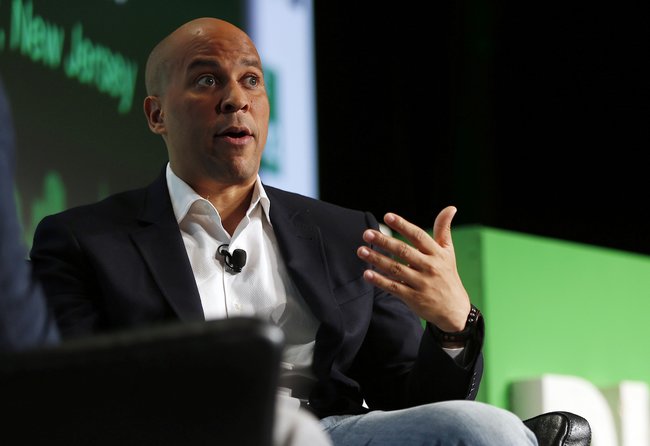
Cory A. Booker is hoping to be the next U.S. senator from New Jersey. But the constituency he seems keenest to represent is the future itself.
Perhaps more than any prominent American politician, Mr. Booker — the 43-year-old Democrat and mayor of the rust-coated, luck-starved city of Newark — has cultivated his brand as a leader of, by and for a new era.
He tweets with something approaching the frequency of his own heartbeat, so much that his staff calls Twitter his girlfriend. He meditates. He balances old-school talk of God with new-age ideas of being “open to what the universe brings me.” He champions Big Data and knows how many consumer impressions he got last week. He gushes over what may be called the hipster economy: using technology to rent out bedrooms, borrow vacuum cleaners, share cars and raise seed capital.
Educated at Stanford, Oxford and Yale, Mr. Booker is a model of self-propelled ascent in a postindustrial city where rises like his have grown ever rarer. In conversation, he might cite the writers James Baldwin and Langston Hughes; Shiva, the Hindu god of destruction; the business book “Built to Last”; ancient Roman history; and an African proverb about going fast alone but far together. Owing in part to the gap between his own sophistication and the travails of the city he has led since 2006, he has endured ceaseless speculation about whether Newark is merely a steppingstone.
Now, as he turns his attention to a U.S. Senate race in 2014, the more interesting question may be whether a self-styled politician from the future can make it to the Washington of right now — and what a city of marble, pearls and power ties might make of him.
Even as the Republican Party undergoes a time of soul-searching, self-flagellation and contestation, Mr. Booker’s emergence hints at schisms to come among Democrats. He represents the Googly-Facebookish wing of the party — liberal as ever in its views on issues like same-sex marriage and abortion rights, but more libertarian than the old guard on economics, more trusting of markets than unions to improve lives, more reliant on the business jargon of “synergy” and “scale” than the language of activism and justice.
Mr. Booker sounds like a new kind of Democrat, for example, when he says that running Newark has made him trust data more than his own liberal principles on the issue of reducing gun violence.
GeoFeedia was not originally designed to support humanitarian operations. But last year’s blog post on the potential of GeoFeedia for crisis mapping caught the interest of CEO Phil Harris. So he kindly granted the Standby Volunteer Task Force (SBTF) free access to the platform. In return, we provided his team with feedback on what features (listed here) would make GeoFeedia more useful for digital disaster response. This was back in summer 2012. I recently learned that they’ve been quite busy since. Indeed, I had the distinct pleasure of sharing the stage with Phil and his team at this superb conference on social media for emergency management. After listening to their talk, I realized it was high time to publish an update on GeoFeedia, especially since we had used the tool just two months earlier in response to Typhoon Pablo, one of the worst disasters to hit the Philippines in the past 100 years.
The following is a condensed version of the very excellent information contained on jimstonefreelance.com based on official records and evidence which cannot be silenced. The fact that even a large proportion of the truth movement has shunned this report proves how deep the conspiracy goes.
1. Photographs of Fukushima show Reactor 3 is completely missing, which means the press and anyone who has claimed anything about pressures, temperatures, containment, etc., at reactor 3 after March 14 is lying. Pictures of the destroyed facility of the vanished reactor prove that there was no actual quake damage to Japan and the original Japanese seismic charts prove there was no 9.0. The linked public records prove that the very real tsunami which destroyed everything in it's path could not have been natural.
Activists, take note: People support reform if they believe the changes will enhance the future character of society, according to a study published online this month in the Personality and Social Psychology Bulletin. Namely, people support a future society that fosters the development of warm and moral individuals.
‘There are implications for communication, but also for policies themselves. The ‘easy’ answer would be to promote a policy or cause in terms of how it will make people more warm/moral,” Paul G. Bain of the University of Queensland, the lead author of the study, explained to Raw Story via email. ‘But I think for this to really work it needs to be authentic/real and not just rhetoric – the policies themselves need to promote this.”
Bain, along with four colleagues, sought to explore Noam Chomsky’s dictum that ‘social action must be animated by a vision of a future society” – a proposition they said had not been investigated by social psychologists.