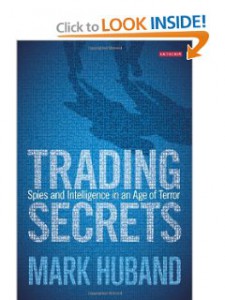
Review: Trading Secrets: Spies and Intelligence in an Age of Terror

5 Star, Intelligence (Government/Secret)
0Shares
Amazon Page
Amazon Page

Mark Huband

5.0 out of 5 stars Useful to Policy and Intelligence Professionals, as Well as Students and the Public, March 23, 2013

I enjoyed this book, and particularly enjoyed the rather clever the way the author is able to say some pretty devastating things about intelligence failures in a rather bland manner. This book ends with a clear statement on how the US and UK intelligence agencies are trying — and failing — to “future proof” their calling. As I have spent the past 20 years thinking about that topic, for me this book is perhaps more valuable than some might find it–it has helped me to think about what seven points I might make to the serving heads of intelligence if I were asked, and I end my review with those.

At root this book outlines the following:

01 How the UK and US intelligence systems spent 50 years developing sources and methods suited to the Cold War state on state confrontation, only to find that today those sources and methods are largely useless against both fanatical non-state actors and dispersed non-state actors.

02 How the primary value of intelligence in the past may have been the ability to detect plans and intentions being kept secret, but today there are too few surprises, and the real challenge is understanding the underlying political, socio-economic, ideo-cultural, and techno-demographic parameters that make any given body do what it does.

03 Citing Christopher Andrew, how still today, and for the past decade since 9/11, the intelligence communities have no learned to work together nor learn from history.

04 In relation to the elective war on Iraq, the author finds the intelligence elements seriously abused by policy-makers who misrepresented the truth, and now seriously in need of reinstatement, but does not provide a prescription, something I offer below at the end of my review.

05 Knowing what is “really” going on is a grass-roots human intelligence deliverable, and not to be confused with the blithering of the think tanks, academics, media, and agitating activists.

Continue reading “Review: Trading Secrets: Spies and Intelligence in an Age of Terror”
Winslow Wheeler: GAO (A Legislative Entity) Plays Courtesan to Lockheed, DoD, and the Congressional Recipients of Lockheed Largesse + F-35 RECAP

Commerce, Corruption, Government, Ineptitude, Military
0Shares
Winslow Wheeler
Winslow Wheeler

DOD is circling the wagons to keep the F-35 propped up in the declining Pentagon budget.  Importantly, as noted by a prime Lockheed mouthpiece offering his thankfulness for it, GAO's newest report on the F-35 offers a conclusion that the F-35 is on track for improvement–the data notwithstanding.  In point of fact, what the GAO conclusion does show is that some long term negative–and management induced–trends have gone viral in the investigatory agency where I once worked.  As a result, DOD has been allowed unseen influence on a GAO report.  Skeptical?  The latter half of a new piece at Foreign Policy explains.

The magazine's title for my article only off-handedly hints at the nature of the problem; it is not so much a “conspiracy” as the effects of an equal relationship between GAO and DOD.  The piece is available at http://www.foreignpolicy.com/articles/2013/03/22/error_report and below:

Foreign Policy

Error Report

Is there a government conspiracy to save the F-35?

BY WINSLOW WHEELER | MARCH 22, 2013

Until recently, the F-35 Joint Strike Fighter had been having a pretty rough time.

In 2012, its estimated average “program acquisition unit cost” was reported to have doubled, from the $81 million per copy anticipated in 2001 to $161 million, flight tests revealed deficiencies in achieving the F-35's modest performance requirements, and scheduled full-rate production was delayed to 2019.

Continue reading “Winslow Wheeler: GAO (A Legislative Entity) Plays Courtesan to Lockheed, DoD, and the Congressional Recipients of Lockheed Largesse + F-35 RECAP”

Michel Bauwens: Peer Governance and Wikipedia (interview with Bauwens & Bruns)

P2P / Panarchy
0Shares
Michel Bauwens
Michel Bauwens

Peer Governance and Wikipedia (interview with Bauwens & Bruns)

This week the interviews with experts and (ex-)Wikipedians, on which parts of my paper “Peer Governance and Wikipedia: Identifying and Understanding the Problems of Wikipedia’s Governance (2009)” were based, are going to be presented in a series of separate posts. This first post contains the short interviews with Michel Bauwens and Axel Bruns who are answering the same questions.

Read full interview.

Phi Beta Iota:  Strongly recommended.  Wikipedia lacks integrity.  It has been taken over by various cabals including Zionists, the various industrial complexes, and our very own CIA.  Wikipedia is a classic example of a “controlled” asset used to misinform the public at great convenience.  Across the sciences and the humanities, across most public issue areas, and certainly with respect to Open Source Intelligence, WIkipedia is a disinformation source that is very convenient for the loosely educated to embrace.  It is a form of “soft” propaganda and therefore toxic.

Rickard Falkvinge: Does Freedom of Speech Require a Technical Resilience Solution Impervious to Government Corruption?

#OSE Open Source Everything
0Shares

Rickard Falkvinge
Rickard Falkvinge

The Pirate Bay Is A Trailblazer In Technical Resilience

Infrastructure:  The Pirate Bay is a site that has remained online for ten years come this summer, despite attempts from almost every Ancient-Power-That-Be to shut it down. It has often been said that The Pirate Bay hasn’t evolved much at all in the past five years; I disagree, it has adapted and overcome everything thrown in its path. There may soon come a time when we need to learn from its experiences in resilience just to safeguard freedom of speech.

The Pirate Bay went through a user-interface redesign some time late 2005 or early 2006, when it went multilingual, and has remained fairly constant since then. The only other site in the world’s top 100 that has remained similarly consistent could possibly be Wikipedia; for every other site, it’s a necessity to evolve, modernize, and meet new user demands.

It is not without irony that Hollywood’s nemesis number one in distribution technology hasn’t innovated in user experience in almost ten years, and still outcompetes the copyright industry hands down when it comes to who provides better service.

But I would argue that The Pirate Bay has been remarkably innovative, just not in the user experience field – a lot of other sites are blazing that trail. Rather, The Pirate Bay has been a trailblazer in resilience. After all, a number of bought-and-paid-for or just plain misguided legislatures and courts have tried to eradicate the site, and yet, it still stands untouched.

As the freedom-of-speech wars escalate, we will need to start taking cues from what The Pirate Bay has learned in the art of staying online, and that time may be approaching fast. This was never a war over the copyright monopoly; it was a war over the concept of the letter as such, over the right to communicate in private, over the right to publish and broadcast ideas that somebody else wouldn’t like the world to see or hear.

For this is what we see – the techniques originally used to attempt silencing The Pirate Bay have already come to be used against activists trying to highlight abuse of power, and corporations and others are trying the might-makes-right approach. You have the example with Greenpeace’s protest site being silenced in the exact same way by an oil company, just to take one example among many.

There is the idea among people with money and power that they have the right to control what other people can say about them. Unfortunately, they are starting to enforce that idea with what amounts to mafia tactics, using the threat of courtrooms as their battlefield, and using intimidation to squelch dissent. (The Pirate Bay themselves were victims of law in this very manner.)

As this war on freedom of speech escalates, we would do well to study the methods for staying online that The Pirate Bay has pioneered.

SchwartzReport: Supreme Court vs. Monsanto, Autisim, Obesity, & Premature Puberty All Because of Corrupt Food Practices

01 Agriculture, 03 Economy, 04 Education, 06 Family, 07 Health, 09 Justice, 11 Society, Commerce, Corruption, Government
0Shares

schwartz reportLike a car careening down a mountain road, we seem unable as a people and as a nation to gain control of our government and to make it serve national wellness instead of profit. Day after day these stories track the degradation of our quality of life.

Only mass demonstrations and mass voting is going to change this, and we seem to lack the political will as citizens to do either. We hate Congress, but most love their Congressperson, seeing no contradiction.

Monsanto's Death Grip on Your Food
FRITZ KREISS – Nation of Change

Our children are obese because of the “foods” they eat. They have diabetes because of the high fructose corn syrup. We have girls experiencing menarche at 9, and breast development at 10 because of the hormones they unwittingly absorb because of industrial animal husbandry. And now we are discovering a growing number of them are autistic. The list goes on an on, all resulting from a society that is structur! ed for maximum profit for the few.

CDC: One in 50 U.S. School Kids Has Autism
ABBY OHLHEISER – Slate

Continue reading “SchwartzReport: Supreme Court vs. Monsanto, Autisim, Obesity, & Premature Puberty All Because of Corrupt Food Practices”

Chris Matthews: Roasting Dick Cheney, the Neo-Cons, and Blatant (Treasonous) Lies….Ends with a Call for a Truth & Reconciliation Commission

Corruption, Government, Idiocy, Military
0Shares
Chris Matthews
Chris Matthews

Ten years later after the start of the Iraq war, the neocons still don’t see the error of their ways. Mother Jones’ David Corn and author Ron Suskind join Hardball to discuss.

Highlights:  Cheney, Wolfowitz, and Perle skewered  in detail, airing their past words and their present insouciance.  Cheney is called sadistic, all of them are called shameless.  Hard-hitting.  Bottom line: the 935 now-documented lies were deliberate, with the invasion of Iraq as the primary US military objective in the first Bush -Cheney Administration.

Video 14:23

Phi Beta Iota:  This is the single best 15 minute overview of the treason against the Republic by Dick Cheney, Donald Rumsfeld, Paul Wolfowitz, and Richard Perle, among others.  Ron Susskind, perhaps the single best author on insider politics in the US Executive, is now lighting a fire in the public mind.

See Also:

Continue reading “Chris Matthews: Roasting Dick Cheney, the Neo-Cons, and Blatant (Treasonous) Lies….Ends with a Call for a Truth & Reconciliation Commission”