Secrecy News: DoD Inspector General Has Unrestricted Access to Classified Information — Excellent Baby Step

Ethics, Military
0Shares
Steven Aftergood
Steven Aftergood

DOD INSPECTOR GENERAL HAS UNRESTRICTED ACCESS TO CLASSIFIED INFO

A Department of Defense instruction issued on Friday reinforces the policy that the DoD Office of Inspector General (OIG) is to have full access to all records, including classified records, that it needs to perform its function, and that no DoD official other than the Secretary himself may block such access.

“The OIG must have expeditious and unrestricted access to all records…, regardless of classification, medium (e.g. paper, electronic) or format (e.g., digitized images, data) and information available to or within any DoD Component, and be able to obtain copies of all records and information as required for its official use once appropriate security clearances and access are substantiated for the OIG DoD personnel involved,” the instruction states. See “Office of the Inspector General of the Department of Defense Access to Records and Information,” DoD Instruction 7050.03, March 22, 2013.

By stressing that the Inspector General's access is independent of a record's classification, medium or format, this language elaborates and bolsters the text of a previous version of the instruction, which did not make those distinctions.

Furthermore, the new instruction specifies, “No officer, employee, contractor, or Service member of any DoD Component may deny the OIG DoD access to records.”  Only the Secretary of Defense may invoke a statutory exemption to limit IG access to certain intelligence, counterintelligence, or other sensitive matters, which he must then justify in a report to Congress.

As a result these robust access provisions, the DoD Inspector General is well-positioned to conduct internal oversight not only of the Pentagon's extensive classified programs, but also of the classification system itself, particularly since the Department of Defense is the most prolific classifier in the U.S. government.

In fact, the Inspector General of each executive branch agency that classifies national security information is now required by the Reducing Over-Classification Act of 2010 to evaluate the agency's classification program.  Each Inspector General was directed “to identify policies, procedures, rules, regulations, or management practices that may be contributing to persistent misclassification of material.”

The first evaluation is due to be completed by September 30, 2013.  Vexingly, the Act did not provide a functional definition of “over-classification” or “misclassification.”  Therefore, the first hurdle that the IG evaluations must overcome is to determine the nature and the parameters of the problem of over-classification.


Continue reading “Secrecy News: DoD Inspector General Has Unrestricted Access to Classified Information — Excellent Baby Step”

Patrick Meier: Resilience in Anarchy? Anarchy vs. Panarchy?

Politics
0Shares
Patrick Meier
Patrick Meier

Resilience = Anarchism = Resilience?

Resilience is often defined as the capacity for self-organization, which in essence is cooperation without hierarchy. In turn, such cooperation implies mutuality; reciprocation, mutual dependence. This is what the French politician, philo-sopher, economist and socialist “Pierre-Joseph Proudhon had in mind when he first used the term ‘anarchism,’ namely, mutuality, or cooperation without hierarchy or state rule” (1).

As renowned Yale Professor James Scott explains in his latest bookTwo Cheers for Anarchism, “Forms of informal cooperation, coordination, and action that embody mutuality without hierarchy are the quotidian experience of most people.” To be sure, “most villages and neighborhoods function precisely be-cause of the informal, transient networks of coordination that do not require formal organization, let alone hierarchy. In other words, the experience of anar-chistic mutuality is ubiquitous.”

The existence, power and reach of the nation-state over the centuries may have undermined the self-organizing capacity (and hence resilience) of individuals and small communities. Indeed, “so many functions that were once accomplished by mutuality among equals and informal coordination are now state organized or state supervised.” In other words, “the state, arguably, destroys the natural initiative and responsibility that arise from voluntary cooperation.”

This is goes to the heart what James Scott argues in his new book, which he does  in a very compelling manner. Says Scott: “I am suggesting that two centuries of a strong state and liberal economies may have socialized us so that we have largely lost the habits of mutuality and are in danger now of becoming precisely the dangerous predators that Hobbes thought populated the state of nature. Leviathan may have given birth to its own justification.” And yet, we also see a very different picture of reality, one in which solidarity thrives and mutual-aid remains the norm: we see this reality surface over & over during major disasters—a reality facilitated by mobile technology and social media networks.

Read full article.

Continue reading “Patrick Meier: Resilience in Anarchy? Anarchy vs. Panarchy?”

SchwartzReport: Good and Bad Farm News, Lab Organs, Telecommuting Congress

01 Agriculture, 03 Economy, 11 Society
0Shares

schwartz reportThis is some wonderful good news; it offers an alternative to the chemical and poison driven agriculture model that dominates our world now. It also offers an answer to the vast youth unemployment problem we have in our inner cities, as well as eliminating a great deal of pollution arising from trucking food across the country. It is not an entire solution to the poison model, of course, but it could go a long way toward! s ameliorating the toxic web in which we are now trapped.

The article has one major flaw: it's assessment of costs, does not include any of what I have mentioned above and, therefore should be disregarded as a criticism.

Chicago Now Home to Nation’s Largest Vertical Farm
ERIC W. DOLAN – The Raw Story

In this report we see the convergence of two major trends: Water as destiny, and climate change. This is also another argument for the today's lead story, and why the new urban farming model should be pursued.

The Drought That Ravaged US Crops Is Only Going to Get Worse
SUZANNE GOLDENBERG – Mother Jones

This is excellent news. I have been covering this trend for about eight years now, and am heartened by its growing success. This trend will eliminate the rejection issues transplant patients now face, and will allow people who are profoundly disfigured, or who would otherwise die, to survive. It will also eliminate the grey world of body parts suppliers.

Science Fiction Comes Alive as Researchers Grow Organs in Lab
GAUTAM NAIK – Wall Street Journal

I think this is what the future holds but, unlike this report, I see the main importance of this trend to a virtual Congress to be part of the Great Schism trend, in which power devolves to the states, and regional arrangements between the states, with the Federal government overseeing foreign affairs, defense and similar national issues.

The West Coast states, and the Northeastern states increasingly have less and less in common with the Southern states and some of the central states, and the quality of life in the West and Northeast is growing increasingly different than the self-inflicted ignorance, obesity, and poverty of the South. (See Social Values, Social Wellness: Can We Know What Works?)

GOP Lawmaker Seeks ‘Virtual Congress' with telecommuting Plan
JENNIFER MARTINEZ – The Hill

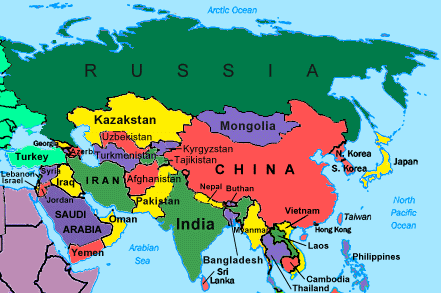
NIGHTWATCH: China Visits Russia, Both Tell US To Shut Up and Back Off — In Simpler Terms, Russia Owns the North, China Owns the South, India and Iran Are Contained

02 China, 06 Russia
0Shares

china russia heartsChina-Russia: Xinhua published today a summary of President Xi Jinping's remarks for different audiences in Moscow.

“During talks with President Vladimir Putin at the Kremlin on Friday, Chinese President Xi stressed that China and Russia are each other's major and most important strategic cooperative partners, and both accord priority to deepening their comprehensive strategic cooperative partnership in their overall diplomatic agenda and foreign policy,” according to Xinhua.

Click on Image to Enlarge

“When meeting with Prime Minister Dmitry Medvedev on Saturday, the Chinese leader said that in recent years, the China-Russia relationship has withstood the tests of changing international circumstances and made substantial progress.”

“He added that there is a greater need now for the two nations to deepen their comprehensive strategic partnership of coordination as the world has seen continuous profound changes.”

Xi told Medvedev the visit “far exceeded my expectations.” Chinese media reported President Xi is the first foreign leader allowed to visit the Russian Armed Forces Operational Command Center, according to China's Global Times.

Continue reading “NIGHTWATCH: China Visits Russia, Both Tell US To Shut Up and Back Off — In Simpler Terms, Russia Owns the North, China Owns the South, India and Iran Are Contained”

Charles Faddis: The United States of Common Sense

03 Economy, 11 Society, Commerce, Ethics, Government
0Shares
Charles Faddis
Charles Faddis

TODAY's INTERVIEW:  Elena Panaritis on Cyprus

Elena Panaritis is an institutional economist, property rights expert, and social entrepreneur. In more than a decade as an economist at the World Bank, Panaritis spearheaded several institutional reforms, particularly property rights reform in Peru. Her book Prosperity Unbound: Building Property Markets with Trust recounts her experience and expounds on her methodology- “Reality Check Analysis”, which is considered one of the best practical applications of institutional economics to property rights issues. She is the founder of Panel Group, a triple-bottom-line advisory group that invests in undervalued property and provides counsel to governments and private sector participants on transforming illiquid real estate and related public policy. She has served as an MP and a special advisor to the Papandreou government in Greece on efforts for public sector reform and reduction in informality. She was elected President of COMSUD (the Commission of Parliamentarians of the Mediterranean countries) in late 2009. Panaritis has taught economic development, housing finance and property markets reform courses at the Wharton Business School, University of Pennsylvania, INSEAD, and the Johns Hopkins University – School of Advanced International Studies (SAIS). She is fluent in Spanish, English, French, Italian, and has basic knowledge of German.


INTERVIEW ARCHIVES

Eagle: One Compilation of Negative Public Opinion About the Department of Homeland Security

Corruption, Government, Idiocy, IO Deeds of War, Law Enforcement
0Shares
300 Million Talons...
300 Million Talons…

Worth reading — trends totally negative, but provides a feeling in the fingertips for the growing anger, especially west of the Mississippi.

Big Flak For Big Sis and Homeland Security

Preston James

Veterans Today, 24 March 2013

Yep, finally there’s “incoming” over at Homeland Security, the New American Gestapo. 

Click on Image to Enlarge

And it’s long overdue.

These folks have been out of control spying on and harassing law abiding Americans ever since the NeoCons created this “New American Gestapo”.

And DHS is one of the most grotesque USG agencies ever conceived, certainly a “house of horrors”.

Their illegitimate step child the TSA has been sexually molesting and harassing air travelers and needlessly destroying the domestic and international travel business.

And as if this wasn’t enough, it has been reported that serious sexual harassment has also occurred deep in the inner bowels of DHS.

According to the claims of recent major lawsuit (1) top DHS Management has sexually harassed male staff and temporarily moved their offices into the men’s lavatory.

Continue reading “Eagle: One Compilation of Negative Public Opinion About the Department of Homeland Security”