great documentary about jacque fresco and the venus project — early articulation of need to restore natural economy instead of the artificial and very corrupt economy that does not properly value natural resources and human resources.
Paradise or Oblivion – A Documentary by the VENUS PROJECT
FOLLOW THE LINKS BELOW TO HELP MAKE THIS DREAM A REALITY
Add to this escalation of toxic leadership, particularly in Army, and senior leader incompetence [see Tom Ricks' book, The Generals] and you get an unappealing prospect]. W/R/T Gen. Mattis specifically, his competence, integrity — and candor — are legendary. His summary characterization of U.S. Marine is classic: “no better friend, no worse enemy.” I've heard Mackubin Owens brief in Pentagon; he's got relevant experience and a very sharp mind. I consider him very credible. I think he's nailed this particular topic.
Cutting the military to fuel the welfare state doesn't instill fear in a nation's enemies
By Mackubin Thomas Owens
Wall Street Journal, February 23, 2013, Pg. 13
The Department of Defense faces some stark choices in the future due to the threat of sequestration. But the continual sounds of shoes dropping at the Pentagon suggest that the sequester may be the least of its problems.
The first shoe was the announcement in December that Marine Gen. James Mattis would leave his post as commander of Central Command in March, well short of what would be expected of a combatant commander who has acquitted himself well since he was appointed in August 2010. Most observers were stunned. There seemed to be no logical reason for his being replaced early. Most unforgivably, he learned of the move when an aide read a Pentagon press release announcing the change.
Summary: financial measures created by bankers and governments are lies writ large — they are totally isolated from the physical reality of the biosphere, and utterly corrupt — therefore they are part of the problem, not part of the solution. The author proposes a more holistic, integral approach with deep integrity that eliminates corruption, the externalization of natural resource costs to the public or the future, and the radical reduction of waste now charged off as an external diseconomy for which corporations and governments are not held accountable. This may well be a ROOT document for any intelligence professional aspiring to be relevant to the public interest going into the future.
After a year's additional work, their fabrication process just got simpler and more efficient – to the point where industrial scale manufacturing of a very efficient battery replacement comes within reach.
Graphene, a very simple carbon polymer, can be used as the basic component of a “supercapacitor” — an electrical power storage device that charges far more rapidly than chemical batteries.
Click on Image to Enlarge
Unlike other supercapacitors, though, graphene's structure also offers a high “energy density,” — it can hold a lot of electrons, meaning that it could conceivably rival or outperform batteries in the amount of charge it can hold.
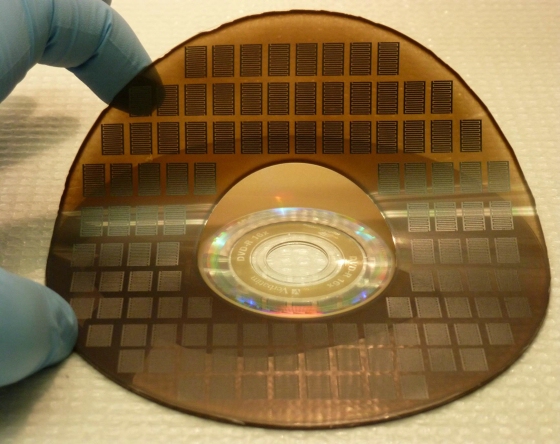
Kaner Lab researcher Maher El-Kady found a way to create sheets of graphene a single carbon atom thick by covering a plastic surface with graphite oxide solution and bombarding it with precisely controlled laser light.
English translation: He painted a DVD with a liquid carbon solution and stuck it into a standard-issue DVD burner.
The result: Absurdly cheap graphene sheets one atom thick, which held a surprising amount of charge without further modification.
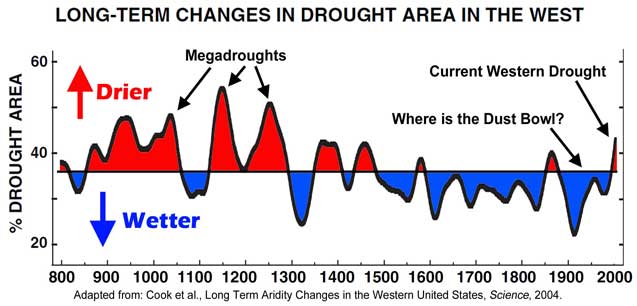
Beginning in just eight years, we could see permanent climate conditions across the North American Southwest that are comparable to the worst megadrought in 1,000 years. (1)
The latest research from the Lamont-Doherty Earth Observatory at Columbia University published in December 2012 has some truly astounding news. The megadroughts referred to in the paper published in Nature Climate Change happened around about 900 to 1300 AD and are so extreme that they have no modern counterpart for comparison (these megadroughts will be referred to in the following as the “12th century megadrought”). The research was funded by the National Oceanic and Atmospheric Administration (NOAA).
We have been warned for decades that we would be facing a megadrought if we did not do something about climate pollution. We did not, and now according to the projections of a new study, that is just what the future may hold. And remember, projected conditions similar to the worst megadrought in 1,000 years would be the baseline conditions. Dry periods, which we normally refer to as drought times today, would be superimposed on top of the megadrought extremeness.
Increasing Public Access to the Results of Scientific Research
By Dr. John Holdren, Assistant to the President for Science and Technology and Director of the White House Office of Science and Technology Policy
Thank you for your participation in the We the People platform. The Obama Administration agrees that citizens deserve easy access to the results of research their tax dollars have paid for. As you may know, the Office of Science and Technology Policy has been looking into this issue for some time and has reached out to the public on two occasions for input on the question of how best to achieve this goal of democratizing the results of federally-funded research. Your petition has been important to our discussions of this issue.
The logic behind enhanced public access is plain. We know that scientific research supported by the Federal Government spurs scientific breakthroughs and economic advances when research results are made available to innovators. Policies that mobilize these intellectual assets for re-use through broader access can accelerate scientific breakthroughs, increase innovation, and promote economic growth. That’s why the Obama Administration is committed to ensuring that the results of federally-funded scientific research are made available to and useful for the public, industry, and the scientific community.
Moreover, this research was funded by taxpayer dollars. Americans should have easy access to the results of research they help support.
To that end, I have issued a memorandum today (.pdf) to Federal agencies that directs those with more than $100 million in research and development expenditures to develop plans to make the results of federally-funded research publically available free of charge within 12 months after original publication. As you pointed out, the public access policy adopted by the National Institutes of Health has been a great success. And while this new policy call does not insist that every agency copy the NIH approach exactly, it does ensure that similar policies will appear across government.