
John Steiner: THE GLOBAL MARCH TOWARD PEACE by Gareth Evans*

BTS (Base Transciever Station), Culture, Peace Intelligence, Resilience
0Shares
John Steiner
John Steiner

A starting point for the new Secretaries of State and Defense.

THE GLOBAL MARCH TOWARD PEACE

by

Gareth Evans, Australia’s foreign minister for eight years and President Emeritus of the International Crisis Group, is currently Chancellor of the Australian National University and co-chair of the Global Center for the Responsibility to Protect. As Foreign Minister, he was at the forefront of recasting Australia’s relationship with China, India, and Indonesia, while deepening its alliance with the US, and helped found the APEC and ASEAN security forums. He also played a leading role in bringing peace to Cambodia and negotiating the International Convention on Chemical Weapons, and is the principal framer of the United Nations’ “responsibility to protect” doctrine.

Project Syndicate, 27 December 2012

CANBERRA – If we were hoping for peace in our time, 2012 did not deliver it. Conflict grew ever bloodier in Syria, continued to grind on in Afghanistan, and flared up periodically in West, Central, and East Africa. There were multiple episodes of ethnic, sectarian, and politically motivated violence in Myanmar (Burma), South Asia, and around the Middle East. Tensions between China and its neighbors have escalated in the South China Sea, and between China and Japan in the East China Sea. Concerns about North Korea’s and Iran’s nuclear programs remain unresolved.

Continue reading “John Steiner: THE GLOBAL MARCH TOWARD PEACE by Gareth Evans*”
Michel Bauwens: Brazilian Alternative Economic Models Going Global

Economics/True Cost
0Shares
Michel Bauwens
Michel Bauwens

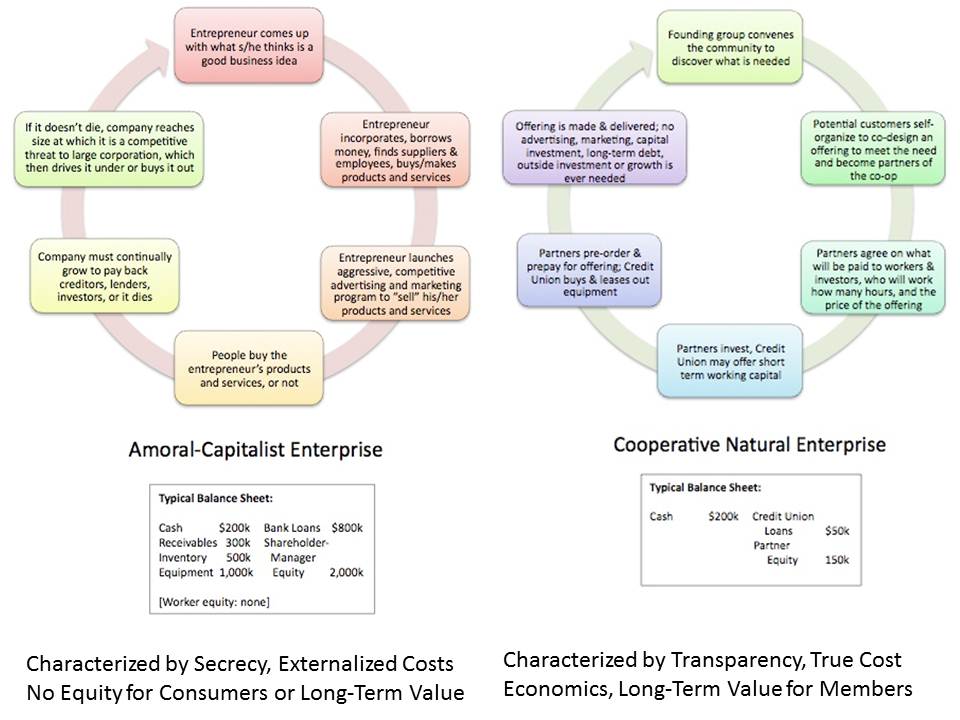
Community-Based Co-op Economy vs. the “A-Moral Capital Economy”

Dave Pollard explains the difference between the two models:

Most people have been brought up to believe that the competitive, grow-or-die, absentee-shareholder-owned, “free”-trade “market” economy is the only one that works, the only alternative to a socialist, government-run economy. This myth is perpetrated in business and other schools, by the media, by accountants and lawyers and bankers and, of course, in the business world. This amoral-capitalist economic model has “succeeded” in the same hostile way our species has “succeeded” — by brutally suppressing, starving for resources, using power to steal from, and, when all else fails, killing off anything deemed a “competitor” or threat to its monopoly on power and resources. It relies on massive subsidies and near-zero interest rates thanks to well-rewarded political cronies, on political graft and corruption worldwide, on oligopoly and restraint of competition, on wage slavery and worker ignorance, on phony money and unrepayable debt, and on advertising, human insecurity, ego and greed to create an artificial demand for its shoddy, overpriced crap. And, on top of all that, it’s utterly unsustainable.

Click on Image to Enlarge

For an alternative, natural economy to work, we either have to wait for this amoral-capitalist economy to collapse (which it will, but probably not for a few decades), or we have to plant the seeds for this alternative economy in the cracks where the current one is already failing most badly — at the community level where the economy is most obviously failing to produce meaningful work, sucking resources, wealth and opportunity out, and dumping mass-produced and imported crap that ends up in the landfill, and pollutants in our air, water, soil and food that make us sick and contribute to climate change. But before we can plant these seeds we need to unlearn the nonsense we’re taught and told about economics, and learn how a healthy economy actually works.

Read full article.

See Also:

Understanding the background to Fora do Eixo, the Solidarity Economy Cultural Network in Brazil

Michel Bauwens,3rd January 2013

Fora do Eixo is becoming a huge and growing Brazilian network of musicians and cultural producers that is based on explicit p2p-oriented business models. In my modest opinion, they will likely expand on a global scale. We have documented their activities here.

But below is a well readable essay that describes their origin, history, governance and business and financing models:

The Brazilian System for the Solidarity Culture – Fora Do Eixo Card

Berto Jongman: Informed Comment on US Drone Strikes

04 Inter-State Conflict, 07 Other Atrocities, 08 Wild Cards, 09 Terrorism, Corruption, Government, Military, Officers Call
0Shares
Berto Jongman
Berto Jongman

Being read in Europe and Asia.

The Secret History of US Drone Strikes in 2012 (Woods et al.)

write at the Bureau of Investigative Journalism:

EXTRACTS

PAKISTAN

Drone strikes in Pakistan are now at their lowest level in five years, as Islamabad protests almost every attack. The CIA also appears to have abandoned ‘signature strikes’ on suspected militants fitting certain patterns of behaviour – at least for the present. Almost all attacks in recent months have been against named al Qaeda and other militant leaders.

As drone strikes fell in Pakistan they rose steeply in Yemen, as US forces aided a major military campaign to oust al Qaeda and other Islamists from southern cities. A parallel CIA targeted killing programme killed numerous alleged militants, many of them named individuals. Yet US officials took more than three months to confirm that American planes or drones had killed 12 civilians.

. . . . . . . .

One reason for a decline in Pakistani strikes may have been growing hostility. Some 74% of polled citizens said they viewed the US as an enemy, and uniquely Pakistan bucked a global trend to register as the only nation favouring Mitt Romney for president. In contrast, the American public appears to staunchly support covert drones – in one poll 83% of respondents were in favour of the strikes.

The British High Court was called on in April to look into US covert drone strikes and possible British co-operation, which some lawyers in the UK insist is illegal. Days before the end of the year the High Court declined to investigate. After years of inactivity, US and Pakistani courts also began to consider legal questions surrounding the campaign.

Continue reading “Berto Jongman: Informed Comment on US Drone Strikes”

Schwartz Report: Why Africa is Turning to China

Uncategorized
0Shares

schwartz reportWhy Africa is turning to China

By Kwei Quartey

Asia Times, 22 December 2012

Ghana held its general elections on December 7 and 8, 2012, re-electing incumbent President John Dramani Mahama. However, Nana Akufo-Addo, flag-bearer of the opposition New Patriotic Party, is challenging Mahama's narrow win and intends to contest the result in court, a legal process that is sure to be prolonged. The verdict could potentially challenge Ghana's generally stable and peaceful political environment. What will not change are the country's close economic ties to China.

On my trip to Ghana in 2011, I observed Chinese foremen at the construction sites of the now completed George W Bush Highway. The massive Ministry of Defense building in Ghana's capital, Accra, was constructed with a US$50 million Chinese grant. The Bui Hydroelectric Dam is a collaborative project of the government of Ghana and SinoHydro, a Chinese construction company. In 2012, China invested in a new Ghanaian airline that serves domestic routes, and it is likely that the China Airports Construction Corporation (CACC) will be involved in building Accra's new international airport.

Ghana is not the only African country in which China operates. Indeed, China is the largest financier on the entire continent. Chinese corporations, financial institutions, and the government have invested billions of dollars in large new dams, for example.

A common charge is that Chinese companies prefer to bring in Chinese employees (and even prisoners) to work on African projects, rather than relying on a local labor force. But Zambian economist Dambisa Moyo maintains that in Zambia, at least, the ratio of African to Chinese workers exceeds 13:1, and that there is no evidence of Chinese prisoners working there.

As African countries like Ghana search for infrastructure improvements to accelerate their economic growth, China has sidelined the role of the West on the continent.

Read full article.

Continue reading “Schwartz Report: Why Africa is Turning to China”

NIGHTWATCH: Pakistan Nuances Not Understood — Same in Syria

IO Deeds of War
0Shares

Pakistan: Pakistani news outlets have denounced the death of Maulvi/Mullah Nazir by a US drone attack last week. A prominent national security commentator, Mahmood Jan Bar, said that “it is a loss for Pakistan.”

Babar said Mullah Nazir and his supporters believed that “Pakistan is an Islamic country and no aggression is being carried out against the country,” and therefore “it is not justified under any circumstances to attack forces in Pakistan.”

Babar said Mullah Nazir's old friends who belonged to the Mehsud tribe were not happy with him. “The people who are being led by Hakimullah Mehsud were not happy with Mullah Nazir … because of people like Mullah Nazir that peace was restored in South Waziristan,” adding he was clear that Taliban “will have to go to Afghanistan if they want to fight a war.”

Comment: The US has not confirmed the death of Mullah Nazir, but Pakistani new services accept that he was killed by a US drone attack.

Nazir's death puts in sharp focus the incongruity between US and Pakistani national security interests. All so-called terrorists are not the same in south Asia. Nazir cooperated with Pakistani authorities to establish security in South Waziristan. His counterpart in North Waziristan, Hakimullah Mehsud, did not. Both men led sub-clans of the Mehsud tribe in ancient Waziristan. Both fought against the US in Afghanistan.

In practical terms their differences meant that the followers of Nazir would fight against US forces in Afghanistan but not against Pakistan. Hakimullah Mehsud's followers fight in both countries. That explains Pakistan Army Chief of Army Staff General Kayani's attitude that bin Laden and many others never posed a threat to Pakistan.

The drone strike that apparently killed Nazir, however, directly affects the security of Pakistan. If the Mehsuds in South Waziristan join the Mehsuds in North Waziristan in attacking Pakistani forces, security conditions west of the Indus River will deteriorate and draw down resources, primarily as the result of a US drone attack whose larger ripple effects evidently were never considered.

NIGHTWATCH KGS Home

Continue reading “NIGHTWATCH: Pakistan Nuances Not Understood — Same in Syria”

Donald Rumsfeld Supports Chuck Hagel

Corruption, Ineptitude, Military
0Shares

Priceless video, one day before 9/11 — military cannot account for 25% of what it already spends.

Phi Beta Iota:  We suspect–lacking direct knowledge–that a considerable portion of the “unaccounted for” funds actually went to pay for underground cities in the continuity of operations / elite fallback bunkers.  This is different from the 41% documented waste in weapons systems contracts that is properly documented.