NIGHTWATCH Extracts: China Rising, African Food Riots

Uncategorized
0Shares

India-China: India conveyed its concerns to China on 3 September about an increase in the Chinese troop presence and activities in Pakistan-administered Kashmir. Embassy officials said Indian Ambassador to China S. Jaishankar met China's Vice Minister for Foreign Affairs Zhang Zhijun in Beijing to discuss India's concerns.  India news papers quoted government sources that 11,000 Chinese have been detected in the Pakistan-controlled section of western Kashmir.  In response to the Indian demarche, the Chinese said the soldiers were assisting with flood relief without further explanation.

NIGHTWATCH Comment: The Indian press indicates China stonewalled India on this and several other issues, especially those related to Kashmir. While not confirmed, the size of the Chinese contingent equals that of an infantry division. The location could be east of Islamabad … if confirmed. Earlier press reports indicated the Chinese troops were providing security for railroad construction, but the Chinese did not confirm those reports.  China appears to be dropping the nuances in its policy actions of the past ten years as to disputed regions of Asia. In doing so, it is siding openly and unequivocally with longstanding allies. This explains China's open embrace of Kim Chong-il, which matches its equally open tilt to Pakistan on the issue of Kashmir.  China is asserting itself as the Asian hegemon from Northeast Asia, through Southeast Asia to Southwest Asia. This is a strategic challenge to the interests of the US, its allies and friends.

Mozambique: Update. News services reported no new food riots in Maputo and one small disturbance in Chimoio in central Mozambique, where 50 protestors were arrested.  One local commentator reported the riots began on Tuesday with an e-mail and SMS campaign urging people to protest against a recent 17 percent increase in the bread price as well as a rise in the costs of water and electricity. The source of the messages is not known. The increase in the price of bread in the past year has been 25%.  The government response to the riots is that the price increases are irreversible.

NIGHTWATCH Comment: New analysts need to pay special attention to increases in the price of bread, cooking oil and heating oil in any country in the less developed world because these are the triggers for most of the coups since World War II. Regardless of the country or culture, price increases in any one of these three commodities plus one or other utilities lead to uprisings and government overthrows.  In 2008 in Mozambique the trigger for rioting was increases in the fares for public transport, on top of food shortages. The increased price of bread and the cost of utilities indicate the riots were mostly a spasm of urban unrest that does not jeopardize the government, at least not yet.  Lying in background is the fact that Mozambique only grows 30% of the wheat it needs. The rest and a host of daily necessities are imported. Riots have ended for now, but they will recur unless prices come down.  People go hungry and get angry when a loaf of bread costs a nickel more, when 70% of the people live on $2.00 a day. No amount of extra labor can supply the extra nickel. That is the point when riots occur.

NIGHTWATCH KGS Home

Search: quantum information phd 2010

Searches
0Shares

We really appreciate searches as pointers, especially so now that we have had to turn off comments to avoid hijacking by Russian spammers.  This is an inspiring search, here are a few links it led us to.

Wikipedia on Quantum Information (see excellent table of links)
QIP 2010 – 13th Workshop on Quantum Information Processing (slides, other outputs)
Calendar of Quantum Meetings (including one in Iran on Quantum Information)
Quantum Mechanics, Quantum Information & Quantum Theory 2010 (PDF Book Catalog, 16 pages)

Quantum Information is not the same as Computational Mathematics, where Google is in the forefront.  Both suffer from a lack of attention to sense-making and a general avoidance of attention to the Internet Economy Meta Language (IEML) being developed by Pierre Levy, a Collective Intelligence thought-leader.  While mathematics may be inherently non-lingual, concepts and sense-making demand an appreciation for language that is lacking in mathematics–this is why no one of weight is helping advance the World Brain & Global Game.

Wikipedia on Computational Mathematics
Stephen E. Arnold, The Google Trilogy
Pierre Levy, Internet Economy Meta Language (IEML)
Robert Steele, HUMAN INTELLIGENCE: All Humans, All Minds, All the Time (2010)
Robert Steele, INTELLIGENCE for EARTH: Clarity, Diversity, Integrity, & Sustainability (2010)

Journal: Australian Muslim cleric calls for beheading of Dutch politician

Cultural Intelligence
0Shares

Full Story Online

Muslim cleric calls for beheading of Dutch politician

(Reuters) – A well-known Australian Muslim cleric has called for the beheading of Dutch anti-Islamic politician Geert Wilders, a newspaper said on Friday.

Wilders told Reuters it was “really terrible news” and that he was taking it seriously.

“I will ask for clarification from the Dutch minister of interior/justice why the secret service and anti-terrorism unit NCTb have not informed me before and what the consequences will be for me,” he said in an email.

. . . . . . .

Wilders is currently on trial in the Netherlands for inciting hatred and discrimination against Muslims.

Tip of the Hat to G. B. at LinkedIn.

Phi Beta Iota: The Netherlands is close to the Nordics in its reasoned governance, but even this great country can make mistakes.  As Howard Bloom discusses so well in Global Brain–The Evolution of Mass Mind from the Big Bang to the 21st Century, what children learn by the age of five to seven is life-defining.  If the government fails to educate the multi-cultural respect it aspires to, then it has to respect the concerns of its citizens who fear unassimilated resident as well as transient Muslims. This is one reason why Phi Beta Iota believes that education, intelligence, and research should be under a single Secretary-General who is co-equal to two others, one for Commonwealth and one for External Relations and Security.

See Also:

Review: While Europe Slept–How Radical Islam is Destroying the West from Within (Hardcover)

Journal: Muslim Tide Arousing US Heartland Anger But Loss of Moral Legitimacy Via Israel and Loss of National Intelligence Shackles America

Worth a Look: Book Reviews on Religion

Journal: General Petraeus–Human Terrain Team NOT

08 Wild Cards, Cultural Intelligence, Methods & Process, Military, Peace Intelligence
0Shares
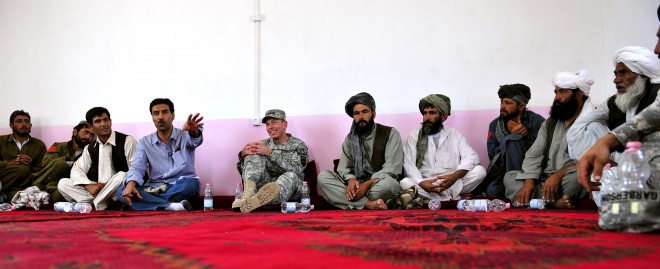
"Is that HTT crawling across the rug over there?"

Did Gen. David Petraeus just call the Human Terrain System worthless? With a few choice sentences to the Wall Street Journal, the top commander in Afghanistan highlighted the disconnect between what the Army’s social science program is supposed to be doing — and what’s actually happening in the field.

We have never had the granular understanding of local circumstances in Afghanistan that we achieved over time in Iraq,” Petraeus told the Journal. “One of the key elements in our ability to be agile in our activities in Iraq during the surge was a pretty good understanding who the power brokers were in local areas, how the systems were supposed to work, how they really worked.”

Phi Beta Iota: The General fails to recollect that under the Cheney-Bremer regime, all were told to ignore the imams and tribal leaders.  It was only much later, after five years of failure, more or less, than some bright general decided to get back to basics.  As Winston Churchill liked to say, “The Americans always do the right thing, they just try everything else first.”  HTT has been a known failure since its inception.  For one view of how it should fit in with the other fourteen slices of Human Intelligence (HUMINT), see the new monograph from the Strategic Studies Institute,  Human Intelligence: All Humans, All Minds, All the Time (June 2010).    See also John Stanton on HTT Failures.

Event: 17-18 March, Washington, DC, USA ICIW 2011

Uncategorized
0Shares
Berto Jongman Recommends...

CFP: International Conference on Information Warfare and Security

17-18 March 2011, Washington, D.C.

Information warfare, cyber-operations, and information security are areas of specialized research covering multiple areas of expertise.  This conference is designed to bring together conceptualists, operators, and researchers to exchange and explore ideas covering these areas.  Past conferences have attracted participants from all over the globe, providing for a rich environment of idea exchange.

Topics for submissions may include, but are not limited to:

  • Cyberwarfare practice and theory
  • The politics of cyberwarfare, including conceptualcyberarms agreements
  • Information security practice
  • Information security management
  • Dual-use technologies
  • Cyber-exploitation execution and detection
  • Neural linguistic techniques in cyberwarfare
  • Other topics

In addition to the primary topics, submissions are welcomed to 4 mini tracks:

International Governance in the Era of Information Warfare

Homeland Security: Waiting For The Next  Shoe(s) To Drop

Cloud Computing and Information Operations

Cybersecurity Education: Approaches and Trends

Journal: Libertarian Perspective on Intelligence

Academia, Civil Society, Government
0Shares

Michael Ostrolenk Recommends

September 2, 2010

Remind Me Again Why We Pay the Intelligence Bureaucracy?

Posted by Karen Kwiatkowski on September 2, 2010 06:48 PM

This detailed geo-statistical analysis entitled “The Fog of War: The Geography of the WikiLeaks Afghanistan War Logs 2004-2009″ has been published, not much more than a month after Wikileaks made available to the world six years of Afghanistan records and reports. The study was honestly, scientifically, and nimbly completed and published at no direct cost to the intelligence community. It was made possible by the decentralization, fluidity, and constant sharing and shifting of roles and responsibilities that comprise the Internet. As I read through this lucid analysis, I recalled the recently published Washington Post project, Top Secret America. Both the Post and the researchers in “Fog of War” tried to be careful not to step on government toes, but the very process and existence of these kinds of analyses are cause for great optimism, and provide a strong justification to radically slash government spending on intelligence that the state has proven to be unable to use effectively.

Phi Beta Iota: Michael Ostrolenk, our newest contributing editor, is a Libertarian with a very broad range of policy interests and an innate desire to use the taxpayer dollar wisely.  The cited item leads to two different pdf files, each with multiple color-coded maps.