Reference: GAO on US State Emergency Preparedness

General Accountability Office
0Shares

Some journalists are observing that the US response to Haiti is starkly representative of the modest change in US emergency Preparedness since Katrina.  Here are a few lessons from Haiti:

1.   Get eyes on the ground immediately.  Do not rely on the media for situational awareness (or the CIA or the Embassy, they are holed up and have no clue).  Do the wide-area surveillance on day one.

2.  Carpet-bomb the place with water, emergency rations, charcoal, plastic, light rope, and enough light lumber or rods to create shelter in a land without timber.  NOTE:  include enough water to cook the rations, don't assume water is available.

3.  Have Peace Jumpers ready to go–mix of medical, military police, combat engineers, landing zone flight directors.

4.  Have a mix of body registration photographers, body handlers, and deep ditch mass grave diggers with air-droppable equipment.

5.  Do NOT try to micro manage from above instead use the military as a “core force” to assure mobility, communications, and general support to a massive influx of volunteer teams able to bring stabilization & reconstruction to one neighborhood at a time.

6.  Start the flow of helicopters, landing craft, field hospitals, and water units on day one.

7.  From Day One, create a global public understanding, in detail, of the situation on the ground, along with a Global to Local Range of Needs Table that can be updated using UNICEF's Rapid SMS as well as Twitter Support Networks.


Journal: Haiti–Perspective of Georgie Anne Geyer

08 Wild Cards, Cultural Intelligence, Earth Intelligence, Ethics, Government, Non-Governmental, Peace Intelligence
0Shares

CAN HAITI SURVIVE?

The United States and many other nations across the globe are sending water, food and troops to benighted Haiti. Charity groups and NGOs from New York to San Francisco are collecting money. The French are calling for a “conference on Haiti's reconstruction and development.” At least in these first few weeks following the horrific earthquake that shook the once-beautiful Caribbean isle, it seems that the world wants to give Haiti everything — except the truth.

Safety Copy of Entire Opinion Below the Line  +  Full Story Online (While It Lasts)
Continue reading “Journal: Haiti–Perspective of Georgie Anne Geyer”

PACOM Week in Review Ending 23 January 2010

Uncategorized
0Shares

NOTE:  This offering ends 9 Feb 10 unless we can find a volunteer to do once a week.

Hot Topics

CN: China's Scary Space Ambitions 01/20/10

CN: Dam forces relocations of 300000 more 01/20/10

CN: Jailing of dissident in China casts doubts on Hong Kong's autonomy 01/20/10

ID: The Indonesian military and its business interests 01/20/10

ID: Indonesia Uses ‘Soft Approach' to Contain Terrorist Threat 01/22/10

IN: India Puts Air Force Bases on High Alert 01/23/10

KP: Heir to the Dear Leader appears from the shadows 01/23/10

KR: If threatened by nukes, South would strike first 01/20/10

MM: Conference demonstrates strong will to fight human trafficking in the Mekong … 01/20/10

MY: Malaysia-led ceasefire monitors to return to southern Philippines 01/21/10

NP: Nepal ramps up airport security 01/23/10

TH: Thailand: Serious Backsliding on Human Rights 01/20/10

Below the Fold: Instability, Special Operations, Security Forces, Foreign Affairs, Crime

Continue reading “PACOM Week in Review Ending 23 January 2010”

Journal: Haiti Op-Ed, Maps and Data, SOUTHCOM

08 Wild Cards
0Shares

Phi Beta Iota: Following up on Zbigniew Brzezinski's articulate expression of concern on CNN, we asked around and here's what we got back, put as bluntly as we heard it: 1.  Not my job. 2.  SOUITHCOM has the lead. 3.  Brazil who?  4.  UN what?

There are three million people in desperate straits including dehydration, two million of them homeless, at least a million at high risk of disease and starvation.  From where we sit, this is Katrina times 10,000, and SOUTHCOM is playing sand-lot ball rather than rising to the big leagues and actually leading a multinational intelligence-driven Stabilization & Reconstruction Mission.

It could and should be the Marshall Plan of the 21st Century in which for the first time a unified network of all possible stake-holders uses open source information to connect aid from the one billion rich to the desperate needs of the three million extreme poor in Haiti, and in so doing, creates the model for state leadership (military central) of non-state campaigns for peace and prosperity.  This is a change to take STRONG ANGEL global and to implement the distributed virtual translation network that allows everyone to channel in French and Creole via broadband assistance.

Right now the Red Cross and all the other “major” NGOs appear to be ripping off the public in the single greatest financial scam since Katrina.  Most of the money being collected is NOT going to get to Haiti.  SOUTHCOM could mobilize Presidential authority to have the Internal Revenue Service audit all Haiti aid funds, and create a means for SOUTHCOM to “draw” on that financial aid by presenting bills for payment sourced from all multinational state and non-state partners.

UC Berkeley Library Maps Online

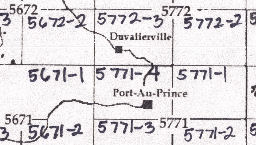
In the wake of the devastating earthquake that took place in Haiti on January 12, 2010, here is a list of some Haiti map and data resources at the Earth Sciences and Map Library, UC libraries, and around the web.

The U.S. Southern Command (USSOUTHCOM) is in charge of the U.S. Government response to Haiti.  Good people who have traditionally been the runts of the litter, we sense that they are not operating at a global level and have not recognized that another 80% is available for the asking.

C–130s have not been mobilized.  All available landing craft and heavy lift helicopters have not been mobilized.  There has been no call to the private sector for any kind of Dunkirk in reverse.  Everyone we talk to seems to be treating Haiti as just another “business as usual” situation.  It is not.  Haiti could well go down in history as the book-end to 9/11, the other side of the coin of Empire lost.

Journal: Haiti Rolling Directory from 12 January 2010

Journal: MILNET Selected Headlines–Epoch A Ending

IO Mapping
0Shares

Phi Beta Iota: What all of these headlines have in common is the failure of Epoch A “leadership” or what Peggy Noonan has called the failure of institutions and Robert Steele called the paradigms of failure.

Top-down command & control is incapable of meshing with bottom-up complexity that demands clarity, diversity, integrity, and legitimacy in order to achieve adaptive sustainable resilience.

SEC mulled national security status for AIG details

US audit attacks Iraq police dea: A watchdog has accused the US state department of grossly mismanaging the oversight of a $2.5bn (£1.5bn) contract for training Iraq's police force.

On the trail of the Taliban in Quetta

Gates Strikes out In Pakistan; Obama's AfPak Policies in Disarray

How Google's Nexus One censors cuss words