Review: Ghost Wars–The Secret History of the CIA, Afghanistan, and Bin Laden, from the Soviet Invasion to September 10, 2001 (Paperback)

Empire, Sorrows, Hubris, Blowback, Intelligence (Government/Secret)
0Shares

Amazon Page
Amazon Page

5.0 out of 5 stars Hard Copy Easier to Read, but Substance is Same: Superb,

April 19, 2005
Steve Coll
Edit of 20 Dec 07 to add links including books since published.

On balance this is a well researched book (albeit with a Langley-Saudi partiality that must be noted), and I give it high marks for substance, story, and notes. It should be read in tandem with several other books, including George Crile's Charlie Wilson's War: The Extraordinary Story of How the Wildest Man in Congress and a Rogue CIA Agent Changed the History of Our Times and the Milt Bearden/James Risen tome on The Main Enemy: The Inside Story of the CIA's Final Showdown with the KGB.

The most important point in the book is not one the author intended to make. He inadvertently but most helpfully points to the fact that at no time did the U.S. government, in lacking a policy on Afghanistan across several Administrations, think about the strategic implications of “big money movements.” I refer to Saudi Oil, Afghan Drugs, and CIA Cash.

Early on the book shows that Afghanistan was not important to the incumbent Administration, and that the Directorate of Operations, which treats third-world countries as hunting grounds for Soviets rather than targets in their own right, had eliminated Afghanistan as a “collection objective” in the late 1980's through the early 1990's. It should be no surprise that the CIA consequently failed to predict the fall of Kabul (or in later years, the rise of the Taliban).

Iran plays heavily in the book, and that is one of the book's strong points. From the 1979 riots against the U.S. Embassies in Iran and in Pakistan, to the end of the book, the hand of Iran is clearly perceived. As we reflect on Iran's enormous success in 2002-2004 in using Chalabi to deceive the Bush Administration into wiping out Saddam Hussein and opening Iraq for Iranian capture, at a cost to the US taxpayer of over $400 billion dollars, we can only compare Iran to the leadership of North Viet-Nam. Iran has a strategic culture, the US does not. The North Vietnamese beat the US for that reason. Absent the development of a strategic culture within the US, one that is not corrupted by ideological fantasy, Iran will ultimately beat the US and Israel in the Middle East.

The greatest failure of the CIA comes across throughout early in the book: the CIA missed the radicalization of Islam and its implications for global destabilization. It did so for three reasons: 1) CIA obsession with hard targets to the detriment of global coverage; 2) CIA obsession with technical secrets rather than human overt and covert information; and 3) CIA laziness and political naiveté in relying on foreign liaison, and especially on Saudi Arabia and Pakistan.

Both Admiral Stansfield Turner and Dr. Zbigniew Brzezinski come in for criticism here. Turner for gutting the CIA, Brzezinski for telling Pakistan it could go nuclear (page 51) in return for help against the Soviets in Afghanistan.

Although the book does not focus on Bin Laden until he becomes a player in Afghanistan, it does provide much better discussion of Bin Laden's very close relations with Saudi intelligence, including the Chief of Staff of Saudi intelligence at the time, Bin Laden's former teacher and mentor. There appears to be no question, from this and other sources, including Yossef Bodansky's book Bin Laden: The Man Who Declared War on America and David Kaplan's US News & World Report on Saudi sponsorship of global terrorism, that Bin Laden has been the primary Saudi intelligence agent of influence for exporting terrorism and Islamic radicalism to South Asia, the Pacific Rim, Africa, Europe, Russia, and the US. CIA and the FBI failed to detect this global threat, and the USG failed to understand that World War III started in 1989. As with other evils, the US obsession about communism led it to sponsor new emerging threats that might not otherwise have become real. However, the book also provides the first documentation I have seen that Bin Laden was “noticed” by the CIA in 1985 (page 146), and that Bin Laden opened his US office in 1986. It was also about this time that the Russian “got it” on the radical Islamic threat, told the US, and got blown off. Bob Gates and George Shultz were wrong to doubt the Soviets when they laid out Soviet plans to leave Afghanistan and Soviet concern about both the future of Afghanistan and the emerging threat from Islamic terrorism.

The middle of the book can be considered a case study in how Pakistani deception combined with American ignorance led us to make many errors of judgment. Some US experts did see the situation clearly–Ed McWilliams from State (“Evil Little Person” per Milt Bearden) comes out of this book looking very very smart.

The final portions of the book are detailed and balanced. What comes across is both a failure of the US to think strategically, and the incredibly intelligent manner in which Bin Laden does think globally, strategically, and unconventionally. Bin Laden understands the new equation: low-cost terrorism equals very high cost economic dislocation.

Side note: CIA provided the Islamic warriors in Afghanistan with enough explosives to blow up half of New York (page 135), and with over 2000 Stinger missiles, 600 of which appear to remain in the hands of anti-US forces today, possibly including a number shipped to Iran for re-purposing (ie London, Dallas, Houston)

One final note: morality matters. I am greatly impressed with the author's judgment in focusing on the importance that Bin Laden places on the corruption of US and Saudi Arabian governments and corporations as the justification for his jihad. Will and Ariel Durant, in “The Lessons of History,” make a special point of discussing the long-term strategic value of morality as a “force” that impacts on the destiny of nations and peoples. The US has lost that part of the battle, for now, and before we can beat Bin Laden, we must first clean our own house and demand that the Saudi's clean theirs or be abandoned as a US ally. Morality matters. Strategic culture matters. On these two counts, Bin Laden is winning for now.

Other books that augment this one:
The Looming Tower: Al Qaeda and the Road to 9/11 (Vintage)
Web of Deceit: The History of Western Complicity in Iraq, from Churchill to Kennedy to George W. Bush
Jawbreaker: The Attack on Bin Laden and Al-Qaeda: A Personal Account by the CIA's Key Field Commander
First In: An Insider's Account of How the CIA Spearheaded the War on Terror in Afghanistan
See No Evil: The True Story of a Ground Soldier in the CIA's War on Terrorism
Sleeping with the Devil: How Washington Sold Our Soul for Saudi Crude
Crossing the Rubicon: The Decline of the American Empire at the End of the Age of Oil

Vote on Review
Vote on Review

Review: The World Is Flat–A Brief History of the Twenty-first Century (Hardcover)

4 Star, Future, History
0Shares

Amazon Page
Amazon Page

4.0 out of 5 stars Massive Op-Ed, Some Food for Thought, Not a Full Meal,

April 11, 2005
Thomas L. Friedman
Edit of 20 Dec 07 to add links.

I confess to being mildly disappointed whenever I encounter a massive Op-Ed without references, and can see in every page ideas that are undoubtedly the author's own, but have also been very ably explored by others–Kevin Kelly in Out of Control: The New Biology of Machines, Social Systems, & the Economic World; Thomas Stewart, The Wealth of Knowledge: Intellectual Capital and the Twenty-first Century Organization; or Howard Rheingold, Smart Mobs: The Next Social Revolution, to name just three of hundreds of bleeding edge sources.

The core idea in this book, that individuals are now empowered and able to practice “C2C” (consumer to consumer or citizen to citizen), is not new. Most of us have been focusing on it since the mid-1990's when we started to tell the Pentagon that top-down command and control based on secret sources and unilateral action was history, being replaced by multilateral bottom up consesus based on open sources.

The heart of the book, the discussion of ten forces that flattened the world (basically, inter-connected the world in a manner unlike any seen before), makes it a solid airplane book, a fine way to spend a few hours.

The following sentence, on page 283, is alone worth the price of the book: “If President Bush made energy independence his moon shot, in one fell sweeop he would dry up revenue for terrorism, force Iran, Russia, Venezuela, and Saudi Arabia onto the path of reform–which they will never do with $50-a-barrel oil–strengthen the dollar, and improve his own standing in Europe by doing something huge to reduce global warming.”

The book provides a good overview of the economic and intellectual challenges from China and India, and makes this memorable by jumping from “eat your dinner and think of the starving children in India” to “do your job well, or lose it to smarter more motivated young men and women from India.”

Other more intellectually rigorous books (added 20 Dec 07):
Modern Strategy
The Unconquerable World: Power, Nonviolence, and the Will of the People
The Fifty-Year Wound: How America's Cold War Victory Has Shaped Our World
The Fortune at the Bottom of the Pyramid: Eradicating Poverty Through Profits (Wharton School Publishing Paperbacks)
The Wealth of Networks: How Social Production Transforms Markets and Freedom

Vote on Review
Vote on Review

Review: You’re in Charge–Now What? The 8 Point Plan

5 Star, Best Practices in Management
0Shares

Amazon Page
Amazon Page

5.0 out of 5 stars May not be the newest, but I found it the most useful,

April 9, 2005
Thomas J. Neff
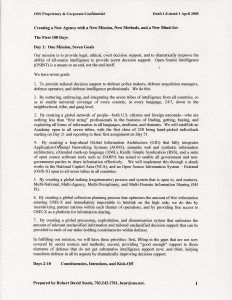
I bought two books on the first 100 days–this one and “The First 90 Days” by Michael Watkins. I found this book the most useful, and it quickly and immediately inspired me to prepare a succinct 100 day plan broken down into 10 day blocks, for a new $2 billion a year agency. Hence, I completely disagree with those that trash this book and recommend “The First 90 Days” instead of this book. I do find both books useful–read this one first, then cherry pick from Watkins.

Sure, anyone can cook a meal with the same ingredients, and sure, there are a number of books on this topic. For me, this book has exactly the right combination of white space, font size, lay-out, progressive structure, and inspiring snippets (including the all-important advocacy for having an in-house revolutionary).

I recommend this book be read in conjunction with Robert Buckman's “Creating a Knowledge-Driven Organization,” Margaret Wheatley's “Leadership and the New Science” (which Buckman told me inspired his own work), and Clayton Christensen's “The Innovator's Solution” (or you can just read my short summative reviews of those three books).

Vote on Review
Vote on Review

Review: The First 90 Days–Critical Success Strategies for New Leaders at All Levels (Hardcover)

4 Star, Best Practices in Management
0Shares

Amazon Page
Amazon Page

4.0 out of 5 stars Slightly second to Neff & Citrin, worth reading both,

April 9, 2005
Michael Watkins
This is a fine book with a lot of substance, and I place it slightly second to Thomas Neff and James Citrin's “You're in Charge–NOW WHAT?.”

From my point of view as the reader, Neff & Citrin actually catalyzed me and inspired me into preparing a 100 day plan broken into 10 ten-day blocks, while Watkins is more of a manual with lots of useful checklists and suggested questions and so on, but between the two, Neff & Citrin actually drove me to the needed outcome: my own 100 day plan.

Both are good. If you buy only one, buy Neff & Citrin, but I do recommend that you buy both, read Neff & Citrin first, and then cherry pick from Watkins–the cost of these books is trivial in comparison to the return on investment.

Vote on Review
Vote on Review

2005 The new craft of intelligence: Achieving asymmetric advantage in the face of nontraditional threats (Studies in asymmetry)

4 Star, Intelligence (Government/Secret), Intelligence (Public), Monographs
0Shares

Amazon Page
Amazon Page

4.0 out of 5 stars

Distillation of the Book, Tailored for Army Audience,

March 22, 2005
Robert David Steele
This monograph is a distillation of my book, “The New Craft of Intelligence,” but one tailored for the U.S. Army, which under the leadership of General Peter Schoomaker has gone full force into the future, creating 40+ brigades out of the 10+ divisions, creating stabilization & reconstruction forces, being the first service to designate Open Source Intelligence (OSINT) as a separate “INT” with its own concepts, doctrine, manning, and funding, and so on. US Army personnel can get a free copy from the Strategic Studies Institute at the US Army War College, and it is also online there, visible to the public and printable as a PDF. Including in this publication are recommendations that have been considered (not necessarily adopted) by the Undersecretary of Defense for Intelligence, who first articulated the need for universal coverage, in all languages, at the neighborhood level, 24/7, in January 2004.
Vote on Review
Vote on Review