Review: Red Dragon (Fiction)

5 Star, Biography & Memoirs, Justice (Failure, Reform)
0Shares

Amazon Page
Amazon Page

5.0 out of 5 stars Superb Insights into Law Enforcement Methods, Broken Minds,

September 21, 2002
Thomas Harris

This author has joined Robin Cooke (the medical disaster novels) as my other “must read” fiction author.

The homework he has done, and the manner in which this book teaches us what absolutely astonishing things can be done by a combination of good street work (don't screw up the site) and good lab work (truly impressive means of making connections, such as classifying the precise brand of gasoline or cleanser based on residual aromatics) just held me spell-bound.

On the darker side, the manner in which he connected childhood abuse and neglect to split personalities and demonic self-concepts that thrived on killing animals and then people, can only cause one of reflect on how many times thoughtless actions by families as well as social workers might have unintended consequences.

The brief love story between a blind woman and the antagonist, who considered himself disfigured, is very well integrated into the plot and adds real value.

Super book, highly recommended.

Vote on Review
Vote on Review

2002 9/11, The Real World, and the Future of Intelligence

Briefings & Lectures
0Shares
Cross-Country Briefing Tour

This lecture, originally developed for the Office of Personnel Management (OPM) Western Management Development Center (WMDC) in Denver, Colorado, was utlimately given to over ten National Security Courses there (for aspiring super-grade or flag officer equivalent government employees), and also delivered to nineteen different locations across the country for the American Committee on Foreign Relations (ACFR), a gras-roots spin off from the Council on Foreign Relations (CFR).

Review: Supreme Command–Soldiers, Statesmen, and Leadership in Wartime

4 Star, Biography & Memoirs, Decision-Making & Decision-Support, Leadership, War & Face of Battle
0Shares

Amazon Page
Amazon Page

4.0 out of 5 stars Isolates Leadership from Intelligence,

August 29, 2002
Eliot Cohen
Edit of 18 May to add links, images, and comment for the war college students.

This is a first-class book and everything that it offers is laudable. Unfortunately, it completely isolates the civilian political to military professional relationship from ethics, intelligence, or the public.

This is not to suggest that leadership cannot take place in the absence of intelligence–indeed, Churchill was at his greatest when he formed his private informal intelligence network to replace the static and myopic official intelligence channels that muddled along in the pre-war years.

However, to discuss Viet-Nam, for example, and not acknowledge what George Allen has documented so well in None So Blind: A Personal Account of the Intelligence Failure in Vietnam, or Michael Hiam in Who the Hell Are We Fighting?: The Story of Sam Adams and the Vietnam Intelligence Wars, to wit, the consistent manner in which policy-makers in Washington refused to listen to accurate intelligence estimates, while their Generals and Ambassadors in Saigon steadfastly “cooked the books,” leaves the reader with a distorted understanding of how the policy-military-intelligence triad actually fails, more often than not, on the policy side rather than on the intelligence side. The manipulation of truth from the Saigon end, and the refusal to listen to truth on the Washington end, resulted in the deaths of hundreds of thousands of people, Vietnamese, Laotian, Cambodian, and American, as well as allied nationalities.

Ethics–and intelligence–matter, and no treatment of Supreme Command should fail to address how these two should be but often are not the foundation for the civilian-military relationship. Let me be blunt: until complete transparency is achieved in how we plan, program, and budget for national security, the military officer corps, not the elected politicians or the secret bureaucrats, are going to be the truth-tellers.

Eight other books (all with my Cliff Note reviews) that I recommend as context:

Modern Strategy: Time is the one strategic variable that cannot be bought nor replaced.

Hope Is Not a Strategy: The 6 Keys to Winning the Complex Sale Neither is ideological fantasy and flag officers that forget their Oath and confuse loyalty with integrity.

Security Studies for the 21st Century Policy makers are seriously stupid about reality, and all too prone to believe classified crap or make up their own (see next two books)

Secrets: A Memoir of Vietnam and the Pentagon Papers See my review on Ellsberg lecturing Kissinger how he would become like a moron in shutting out ground truth in favor of codeword.

The Unconquerable World: Power, Nonviolence, and the Will of the People Reality 101, not taught in most war colleges

The Fifty-Year Wound: How America's Cold War Victory Has Shaped Our World General and President Ike Eisenhower warned us–we let it happen anyway.

Breaking the Real Axis of Evil: How to Oust the World's Last Dictators by 2025. Strategic Communications is seriously stupid and ineffective if we continue to support 42 of the 44 dictators, and allow Guantanamo and Abu Grahib to dominate how others see us

A More Secure World: Our Shared Responsibility–Report of the Secretary-General's High-level Panel on Threats, Challenges and Change Reality 102. LtGen Dr. Brent Scowcroft was the US member of this panel on high level threats, challenges and change. Here they are, in priority order:

01 Poverty
02 Infectious Disease
03 Environmental Degradation
04 Inter-State Conflict
05 Civil War
06 Genocide
07 Other Atrocities
08 Proliferation
09 Terrorism
10 Transnational Crime

See my many lists on emerging threats, intelligence support to acquisition, etcetera. See comment for the free weekly report on Global Challenges: The Week in Review, and the Marine Corps Expeditionary Analysis Model.

TAKE-AWAYS:

01) $60 billion a year for secret intelligence that can be ignored and only touches 4% of the relevant information in 183 languages we do not speak is institutionalized lunacy.

02) Spending $1.3 trillion a year on war when peace and prosperity for all can be bought for under $250 billion a year is institutionalized lunacy.

03) You are responsible for keeping policy makers honest–that is a core Constitutional, moral, and command responsibility…you owe your troops, and the average American, this discipline of mind and heart.

04) The collective intelligence of the public is vastly more aware, more conscious, more moral, and more relevant to national security that the idiot ideas that come from loosely-educated policy makers who got their jobs by blowing smoke up someone's butt (or academics who lie to Congress when Service leaders are not willing to kick them down the steps of Capitol Hill and put their stars on the table).

05) The Chinese brought Dick Cheney's plane over Singapore. Why have you not been told this? Search for the Memorandum <Chinese Irregular Warfare oss.net>. Waging Peace (Irregular Warfare) is the ONLY win-win.

06) DoD, for all its faults including an inability to pass an audit and $2.3 trillion “missing and unaccounted for,” works better than the rest of the government. DoD needs to become the inter-agency and coalition hub for global action.

07) Foundations, corporations, other governments, and international organizations spend close to $1 trillion a year in charitable giving and planned assistance. Wrap your heads around this: a Multinational Decision Support Center in Tampa, taking over the CCC building that is being vacated, could create and promulgate an annual Global Range of Gifts Table to guide, on an opt-in basis, how they spent that money, while using Civil Affairs Brigade as the hub for regional multinational Civil Affairs Brigades who help connect the one billion rich with the five billion poor at a household level of granularity, with needs from $1 to $10,000 being covered by individuals that will not give to foundations.

The world has changed. Most of what is in this book is history, and completely out of touch with how the Services must motivate and lead Digital Natives, the Web 2.0 generation, and how the Services must become brain-housing groups–thinkers as well as shooters–able to deliver Peace from the Sea, Peace from Above, and Peace one cell call at a time.

I welcome invitations to speak informally after hours on a not to interfere basis. You folks at the next generation of leaders–you will need to learn most of what you will use outside the normal curriculum. Amazon is a great place to start.


Vote on Review
Vote on Review

Review: Breakdown–How America’s Intelligence Failures Led to September 11

4 Star, 9-11 Truth Books & DVDs, Executive (Partisan Failure, Reform), Intelligence (Government/Secret)
0Shares

Amazon Page
Amazon Page

4.0 out of 5 stars Helpful,

August 29, 2002
Bill Gertz
The author has done a wonderful job, without reference to any of the fifteen books on intelligence reform published between 1999 and 2000, in quickly reviewing the key elements of intelligence failure and in recommending some specific reforms that thus far have been denied by successive Administrations.If this book forces policymakers to think, and makes it possible for the public to get very angry about the various failures of intelligence that contributed to 9-11, then it will be in the running for most patriotic and useful book of the year.

The author leaves one aspect of the 9-11 failure untouched–although he makes references to Democratic and to Republican policymakers, what he does not tell the American people is that intelligence failures do not occur without very substantive policy failures of two kinds: first, policy failures where the intelligence professionals are gutted, abused, intimidated, and generally prevented from being effective. The Director of Central Intelligence usually serves as the policy representative to intelligence in carrying out these abuses, rather than as the intelligence representative to policy. The second failure is one of “inconvenient warning,” where solid professional intelligence estimates are set aside and ignored because the politicians don't want to be bothered, don't think it will cost them with their domestic constituencies, and are not truly committed to long-term national security. This is a bi-partisan problem–until the American people appreciate the connection between voting, policymaker character, and intelligence success, we will continue to get the government–and the intelligence community–that our citizens deserve.

Vote on Review
Vote on Review

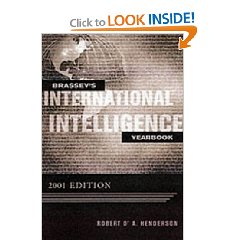
Review: Brassey’s International Intelligence Yearbook, 2002 Edition

3 Star, Intelligence (Government/Secret)
0Shares

Amazon Page
Amazon Page

3.0 out of 5 stars Useful but Incomplete and Does Not Add Original Thinking,

August 6, 2002
Robert D'A. Henderson
I was quite interested to see this book very favorably reviewed in the International Journal of Intelligence and Counterintelligence (IJIC), the top journal in the field, so it was with some disappointment that I found it to be less robust than I expected.At one level, that of a very basis reference, it could be a solid four-star effort, and I give the author and publisher credit for having conceptualized and executed this on-going endeavor. Especially bothersome is its limited coverage–a directory such as this, especially in the aftermath of 9-11, must be comprehensive and include countries like Colombia, Nigeria, Qatar, Saudi Arabia, and the Central Eurasian “stans” to name a number that are not covered.

I found both the updates and the further readings to be a very mixed bag, with too many countries that I am familiar with suffering from what appears to be either an over-reliance on one or two primary sources or somewhat random notation. It is clear to me that this book does *not* benefit from a systematic literature review, nor is it really current with the great web sites that are available, both in general terms as well as with specific country orientations–on top of the limited coverage, less than a third of the world, this really reduces its value.

This book has the potential to be a five-star reference work of enormous value, if it makes the following changes:

1) Create a broader board of advisors. The author performs heroically for one man, but clearly does not have the global network of true experts that is needed to make sure his coverage is world-class.

2) Add a State of Intelligence report to the front of the book, with regional overviews. The emergence of a European intelligence community, the impact of the Kosovo war on this movement as well as NATO, NATO's publication of an open source intelligence handbook, etc., the specific points of failure for 9-11 as well as the Afghan campaign that failed to capture the Al Qada leadership, all should be in there, together with the Homeland Security initiative and new relations among nations now quasi-committed to improved cooperation against terrorism–while decapitating their programs against crime. To be a proper reference work, this book must also take care in the overview to tease out the threads of progress among the varied intelligence communities that exist-national civilian, military, law enforcement, investigative journalism, business intelligence, and academic studies on intelligence. The fact that it does not reference such vital organizations as the Society of Competitive Intelligence Professionals, or the International Association of Law Enforcement Intelligence Analysts, for example, suggests that the book is being put together along very old lines of thinking, and is not yet coming to grips with the dramatic changes occurring in the real world of intelligence.

3) The publisher, or a non-profit foundation, must fund a proper literature review. Even for the United States, the most obvious country, most of the intelligence reform books published between 1999 and 2002 and listed by the Council on Intelligence do not appear in this reference work, nor does it retain the Aspin-Brown Commission Report or the House Permanent Select Committee Report on IC21, as references of continuing relevance.

4) The index must be expanded to include all authors and organizations.

5) The acronyms must be expanded to be truly comprehensive. A one page listing that is mostly military ranks and failed to include the acronyms PfP (Partnership for Peace), OSINT (open source intelligence), or C4I (command, control, communications, and intelligence–a vital aspect of understanding where intelligence fits in the larger picture) is simply not serious.

Bottom line: I will keep this book as a light-weight reference, but I will not buy it again unless the publisher gets serious about producing a quality product that is truly international and reflective of the intelligence reform and intelligence failure lines of inquiry that are well-known to serious professionals who understand that intelligence is the core competency of both governments and organizations in the age of information.

Vote on Review
Vote on Review

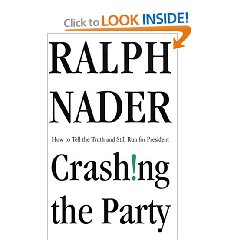
Review: Crashing the Party–Taking on the Corporate Government in an Age of Surrender

5 Star, Biography & Memoirs, Capitalism (Good & Bad), Politics
0Shares

Amazon Page
Amazon Page

5.0 out of 5 stars “Must Read” Indictment of Both Major Parties,

July 31, 2002
Ralph Nader
I was among those who thought Ralph Nader was a “spoiler” and deprived Al Gore of the election. After reading this book, I now realize that Nader is correct-the major premise of his book is that both the Democratic and Republican parties have become so corrupt and so removed from citizen interests as to be identically disqualified from putting forward viable candidates for the future. He puts forth a vision for a new democracy in which the citizens take back the power and demand that third party candidates be allowed to join the Presidential debates and be heard by America.Some will accuse Nader of name-dropping and self-aggrandizing in this book, but that is an unfair charge. He has dedicated 40 years of his life to a quest for fairness in American life. As I went through the book and reflected on his very early efforts on everything from women's rights to product safety to the environment I could not help thinking that the breadth and substance of his accomplishments make the Democratic and Republican candidates look like Johnny-come-latelys who are also bluffing snake oil salesmen. This guy is “the real deal.”

I recommend that two books be read prior to reading this one: Halstead & Lind's “The Radical Center: The Future of American Politics” and Ray & Anderson's “The Cultural Creatives: How 50 Million People are Changing the World”. Two other books could add useful underpinnings to the points Nader makes that I summarize below: Lewis' “LOSERS: The Road to Everyplace but the White House” which immortalizes citizen-businessman Morry Taylor (the “Grizz”); and Williamson's “IMAGINE: What America Could be in the 21st Century.”

A few points about Nader's book that I hope will dispel all the negative reviews and demonstrate that this is required reading:

1) This is the only book that addresses the totality of the challenges and threats to America in a sensible balanced way, without platitudes and upon a foundation of fact.

2) This is the only book representing the new political paradigm in which the citizen-voters take back the power by wiping out the ability of corporations to buy politicians.

3) This is the only book that thoughtfully and convincingly demonstrates that the Democrats have morphed into shadow Republicans, and both parties have completely lost their ethical and popular foundation.

4) This is the only book that bluntly confronts the fact that we get the government we deserve–democracy is hard work and demands citizen time and thought.

5) Among the useful details that should outrage and mobilize citizens, and all according to Nader:

a) the Commission on Presidential Debates is a fraud perpetrated upon the public–it is a wholly-owned subsidiary of the Democratic and Republic parties created explicitly to displace the more honest League of Women Voters and to bar third party candidates from being visible to America in the crucial Presidential debates.

b) there is an incestuous relationship between the media, the polls (most funded by the media) and the Presidential debate and public policy process.

c) global threats are not well-understood by Americans, and a major effort spanning the next generation must be undertaken to restore global or foreign affairs and foreign trade understanding to the public.

d) public budgets are neither public nor honest. They are massively distorted with a “proliferating array of taxpayer subsidies, giveaways, and bailouts (known as corporate welfare) to corporations.” A recurring theme in Nader's book, based on factual legally-viable documentation, is the manner in which corporations are looting the commonwealth with the active connivance of our elected officials. The people need to wise up.

e) the Internet has *not* has the anticipated leveling effect of bringing out citizen-voters to take back the power and stop corporate socialism.

f) the non-profit organizations and popular organizations (e.g. the Sierra Club, the AFL-CIO) consistently misrepresent their members by choosing the “lesser of two evils” in the two traditionalist corporate candidates, not realizing that a) a lesser evil is still evil and b) their members are smart enough to consider third party alternatives and could–if enough such organizations banded together, cause a third party to be instantly visible as a mainstream alternative.

g) the public commonwealth (the airwaves, land, water, etc.) has been taken away from the people. It is time to get it back and demand, as one small example, that those using the airwaves granted by the public provide for free political time for all viable candidates, ending the advertising rip-off that also deprives the people of clear access to all competing views.

h) community building from the neighborhood up is the place to start. We need to focus on empowering and exciting the young people and building a cadre of volunteer civic activists that will sustain progressive public interests for the decades to come.

I would make one personal observation that was inspired by reading this book: I do not believe that any one President, from any party, is viable as a “one click” choice for leading America. In my view, the next President should not be elected without two fundamental changes in how we elect Presidents: 1) instant run-off voting must be enacted, allowing second choice votes to play a role if a third party candidate is not elected (while qualifying the third party for funding in future elections based on the first choice vote); and 2) Cabinets must be announced in advance of the election and be the focus of at least one Presidential debate including at least three but ideally four parties. It is time for a third party candidate to pull together a Cabinet that includes the best choice for key posts irrespective of parties, and specifically including the Pat Buchanan's, Sam Nunns, Colin Powells, and key others like Ross Perot, Morry Taylor, even Jello Biafra (as new Minister of Culture!).

This is really a superb book, in the tradition the Committees of Correspondence that helped bring about the American revolution, and I recommend it to all.

Vote on Review
Vote on Review