
December 10, 2001
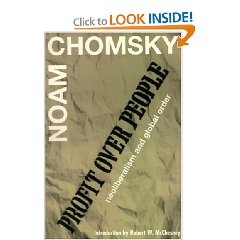
Noam Chomsky
Chomsky is somewhat predictable and irritating in his repetitive condemnation of all past and present U.S. interventions around the world, and he harps heavily on the U.S. being the only country in the world actually condemned for terrorism (against Nicaragua) by the World Court but one has to give him credit–his is one of the few credible voices seeking to enlighten the American people with respect to two major global realities: first, that America is violating others with impunity and regularity; and second, that we have no idea just how hated we are for these actions.There were a couple of tid-bits in this book that made me especially glad to have obtained it for reading and retention. His evaluation of the Sudan situation, and his detailed review of the impact on Sudanese reliant on the low-cost medicines from the factory bombed into oblivion on the now-disputed suggestion of the CIA, provides a perspective that needs more respect.
His lengthy discussion of the contradictory record of the United States on human rights–in favor when it does not interfere with business, actively obstructionist when it takes place in Saudi Arabia or Indonesia where financial equities (generally mining and energy company equities) are great, is disturbingly sensible.
I will always read Chomsky, for he provides a leavening of forthright candor and intellectual honesty that is too often absent from mainstream discussions. Indeed, as I was reading the bit on Sudan, it occured to me that we are long over-due for the next revolution in learned discourse–the digitization of all such books so that a reader can, to take Sudan as an example, see on their screen a “map” of Sudanese issues, and then select from across a range of competing viewpoints on any issue. One has to seek out Chomsky now–in the future it may be salutory to find him automatically served up as a side dish whenever the pundits wax too pontifical.