2001 Oakley (US) The Use of Military & Civilian Power for Engagement and Intervention

Civil Society, Government, Historic Contributions, Military, Peace Intelligence
0Shares
Amazon Page and Steele Summative Review

To the left is the cover of the seminal work by Ambassador Bob Oakley and Col Mike Dziedzic and others, at Amazon.  The National Defense University (NDU) logo leads to the book free online at NDU. This book is long over-due for updating and reissuance, this time including a proper index.

Book Free Online
Book Free Online

Below is Ambassador Oakley's briefing from 2001.

Bob Oakley
Bob Oakley

2001 Porter (US) Tools of the Trade: A Long Way to Go

Historic Contributions, Methods & Process, Technologies, Tools
0Shares
1985 CATALYST Concept

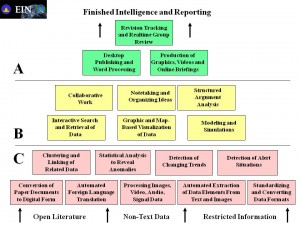
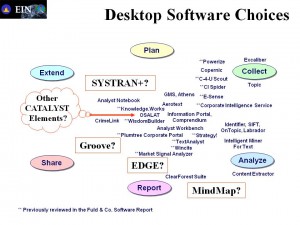
In 1985-1986 an utterly brilliant woman, Diane Webb, working with Dennis McCormich and under the oversight of Gordon Oehler, established the definitive requirements statement for an all-source analytic workstation.  We still do not have such a workstation, and the lack of integrity among intelligence community leaders and vendors is the reason.  No one is willing to sponsor a generic Free/Open Source Software (F/OSS) solution that can be used by both all-source analysts and all external analysts.  DARPA STRONG ANGEL TOOZL is a start, but inadequate to the needs of all-source analysts dealing with multiple complex challenges.  Below is the best slide from a presentation to OSS '01 by Claudia Porter from Austin Information Systems, who totally impressed the audience because unlike all other vendors trying desperately to propose “single-point technology solutions” that are nothing more than a deep hook that shuts the customer off from all other solutions, she examined where specific tools fit on a matrix of need.   Click on the slide to see the entire briefing. Click on Frog Right to see the list of softwares that the US Special Oprations Command J-23 (Open Source Branch) uses today, none of them integrated because the US Government refuses to cooperate with the OMB/GSA efforts–mandated by the White House–to find “common solutions.”  One day, Claudia Porter may get to direct a skunkworks with an anti-turst waiver from the Department of Commerce that achieves what we knew we needed in 1985.

Porter Slide Enhanced
SOCOM SW Cluster and TOOZL

2001 Treverton (US) Reshaping National Intelligence in an Age of Information

Historic Contributions, Methods & Process, Strategy
0Shares
RAND Bio Page
RAND Bio Page

Dr. Greg Treverton has been a mainstay “in-house” thinker from Harvard and the Council on Foreign Relations to many years at RAND and a brief stint as Vice Chairman of the National Intelligence Council (NIC), in which capacity he heard from us on the need for all analysts to be able to do citation analysis and identify and then interact with the top 100 published and unpublished experts in their respective domains.  He has published several books, one of which, Reshaping National Intelligence for an Age of Information, was part of the 2000-2002 effort by many of us to get the US Intelligence Community refocused to where it could produce intelligence (decision-support)  for the President AND everyone else about ALL topics.  Below is his presentation to OSS '01:

Gregory Treverton
Gregory Treverton

2001 Wallach Public Citizen Using Public Intelligence in the Public Interest

Civil Society, Collective Intelligence, Commercial Intelligence, Historic Contributions, Non-Governmental
0Shares
Lori Wallach
Lori Wallach, Director Public Citizen

Lori M. Wallach has been director of Public Citizen's Global Trade Watch since 1995.

Lori Wallach applies public intelligence in the public interest, and is a true leader of the emerging Epoch B community of indigenous peoples and independent citizens who value appreciative inquiry deliberative dialog, and responsible advocacy against those elements that seek to destroy the commonwealth–Earth–for the short-term profit of a few.

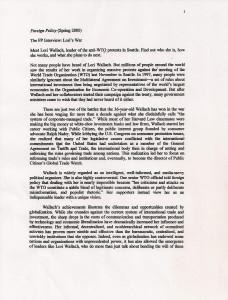
The below text from special coverage of her by Foreign Policy (Spring 2000) came to us courtesy of Moises Naim and was included in the hand-outs received by those attending OSS '01.

Lori's War (Foreign Policy Spring 2000)

Review: Third World War

5 Star, Asymmetric, Cyber, Hacking, Odd War, Peace, Poverty, & Middle Class, Threats (Emerging & Perennial)
0Shares

Amazon Page
Amazon Page

5.0 out of 5 stars Deeply Important to Our Future, Scholarly, Practical, Urgent,

December 15, 2001
Monty G. Marshall
This book is deeply important to our future, for it is the first over-all comprehensive look at the global reality of failed states, spreading non-state violence, and the emergence of complex emergencies where 90% of the casualties are civilian.Drawing on a wide-variety of databases and field studies around the globe, the author focuses the societal groups and their migration toward protracted violence in the context of failed states. He puts forward a theory on the diffusion of insecurity, how this leads to arrested development, and why, for very practical reasons, the more developed nations must devise new means of structured and focused intervention leading to the creation of peace.

The author does not advocate intervention willy-nilly–if anything, he joins Jessica Matthews, William Shawcross, and others in pointing out that incompetent interventions actually make matters worse–external actors and external resources have a way of prolonging internal conflicts rather than resolving them. Military forces, the ones most often used, are also the least effective–new combinations and new capabilities are needed.

He is especially effective at criticizing, in a very gracious but pointed manner, the institutionalist and realist schools that have never moved beyond sovereign states, political boundaries, conventional militaries, and a Euro-centric perspective.

He is much better than Fukiyama at dealing with reality, and the equal of Huntington in considering cultural clashes rooted in social identities and real-world resource difficulties.

I found two major observations in this work that merit broad repetition:

First, and the author gives due credit to the path-finding work of Ted Gurr and the Minorities at Risk project, there is an established pattern, world-wide, in which violent political action is always preceded by a period of nonviolent activity that was either ignored or repressed.

Second, once violence has been inculcated into a social group as the normative condition, there is a distinct loss of capacity to engage in meaningful exchanges, negotiation, etcetera. Outcomes become irrelevant, and as Ralph Peters has pointed out so often, war and conflict become the raison d'être rather than any kind of rational means to a political end.

Throughout the book, and worthy of a focused chapter or future article, there are comments on data, information, and analysis that are extremely valuable when embraced and integrated. Apart from numerous observations on the difficulty of obtaining reliable data on sub-state violence when the state is the normal analytical unit and also the repressor of information; the author has insights into how models drive what data is visible, collected, or accepted; and how the social units in conflict themselves become filters, channels, or barriers to communication.

The concluding recommendations for systemic policy call for a global arms moratorium; a migration from regional collective security arrangements to global normative security arrangements including an international stand-alone range of capabilities for monitoring, facilitating, and imposing non-violent conflict resolution; a general proscription of force by any nation or social group; regional associations or what he called a “complex federalism”; a decentralization of systemic authority, which really means a reduction of U.S. impositions in favor of localized influences with greater legitimacy; and a criminalization of individual acts of violence within war–the ending of war (or state sovereign direction) as an excuse for individual acts of violence and depravity.

If I had one criticism of the book–and in no way does this undermine the brilliance and utility of the work itself–it is that it does not include, either as a preface or as an appendix, a summary of the actual “state of the world” such as the author has helped create in the World Conflict and Human Rights Map project out of Leiden University (PIOOM). A description and enumeration of the 29 complex emergencies, 67 countries with hundreds of thousands of refugees, 59 countries with plagues and epidemics, 27 countries with massive famine–as well as the torture, child soldiers, and other distinct manifestations of the sub-state instability the author studies so well–would have helped the non-academic and policy readers to better grasp the urgent vitality of this seminal work.

The author and his insights deserve the very highest levels of attention, for all that he has done here is call into question the out-dated political science concepts and the policies–including the defense acquisition and force structure policies–of every so-called modern nation. The globe is burning, every President and Prime Minister is fiddling, and the author documents very clearly that this fire is headed straight for our homeland.

Vote on Review
Vote on Review

Review: On Intelligence–Spies and Secrecy in an Open World

5 Star, Intelligence (Government/Secret), Intelligence (Public)
0Shares

Amazon Page
Amazon Page

5.0 out of 5 stars 9/11 is for intelligence what Sputnik was for science,

December 11, 2001
Robert David Steele
This book, the second edition, is an exact copy of the first edition with two changes: the publisher, and a new one-page Publisher's Foreword that itemizes the six intelligence and counterintelligence failures that allowed 9/11 to happen.9/11 is for intelligence what Sputnik was for science. The across-the-board failure of clandestine intelligence (overseas), counterintelligence (at home) and our generally mediocre understanding of the real world (since we lack a properly funded, language-qualified foreign or diplomatic service), all contributed equally.

Henry Kissinger is absolutely right when he laments the lack of any serious consideration of foreign policy in recent presidential and congressional elections, and that is what 9/11 must change–this book is intended to be useful to citizens as well as government and business intelligence professionals. It lays out with great precision (see the index) both $11.6 billion dollars (out of $30 billion a year) in potential savings that could be applied to the new craft of intelligence, and it recommends with great precision all that should be in a new National Security Act of 2002.

Intelligence in the 21st Century is too important to be relegated to a chaotic cluster of secret government agencies. It is time for all citizens to take an interest in intelligence, to migrate the proven process of intelligence (there is a great deal that is good about the U.S. intelligence community) into the business sector as well as over to the sovereign states and their localities, and to demand of our elected representatives a proper accounting for the failure, and measures to prevent future failures.

Less than 2% of the $30 billion a year intelligence has been spent on terrorism–the policy and intelligence leadership over several administrations have given lip-service to the war on terrorism–and there will be no improvements, no matter how much money we pour into intelligence and counterintelligence, unless we change the fundamentals–who's in charge, how we do it, who we do it with, and how seriously we take our responsibilities for protecting America.
Vote on Review
Vote on Review

Review: Inside Sudan–Political Islam, Conflict, and Catastrophe

2 Star, Country/Regional, Diplomacy, Threats (Emerging & Perennial)
0Shares

Amazon Page
Amazon Page

2.0 out of 5 stars Strong on Travel and Chit-Chat, Weak on History and Reality,

December 10, 2001
Donald Petterson
When compared to the other book on Sudan that I read at the same time, “White Nile, Black Blood: War, Leadership, and Ethnicity from Khartoum to Kampala”, this book, while worth reviewing, is extremely disappointing. If this is the best our Department of State can do–if this bland account of endless repetitive meetings and meaningless demarches is the best that America can do in addressing the deep challenges of Sudan–then we need a whole new State Department.It struck me immediately, as I worked through the book, that it is the diary of someone who means well, but has only his personal experience from which to judge the situation. Not only are there no references to learned studies, but the short-sighted thesis of the author is summed up on page 136: “The cumulative combination of factors putting Sudan in such a bad light (with the U.S. Government) began with the military takeover in July 1989.” When one contrasts this statement with the rich 200-year survey provided by “White Nile, Black Blood”, one can only feel a deep sadness for the lower depths of our foreign service.

Early on in the book the author-ambassador confesses to not knowing Arabic and to having had six months training in Arabic before reporting. This demonstrates two things clearly: first, that the Department of State is incompetent in Arabic affairs if it does not have legions of qualified officers fluent in Arabic from whom it can select an Ambassador and second, that obviously the language is not considered critical to the job if six months will suffice–just enough to get to the toilet, not enough to accept directions across town.

This book is a travel diary. I have annotated page 148 with the note: “substitutes travel for thinking.” There is no analysis in this book, no grasp of history, no real grip on the regional realities (other than a passing reference to the fact that water is going to be a cause of war in the future–something well covered in Marq de Villiers “WATER: The Fate of Our Most Precious Resource”. Neither de Villiers nor Michael Klare's “RESOURCE WARS: The New Landscape of Global Conflict” are cited by this book.)

At the very end there was a tiny glimmer of hope as the author began a chapter on working with the United Nations, and made it clear that the UN practice of allowing each of its agencies to appoint independent ambassadors to the same country, rather than subordinating all UN agencies to a single UN ambassador, was a big part of their problem. After three paragraphs, it became clear there was nothing else to be had from this chapter. I have the note “This is not a serious book.”

At one point in the book the author observes that neither Congress nor the U.S. public would allow the Administration to be more pro-active in Sudan. It immediately occurred to me that if this is true, then the Department of State has failed miserably, ignominiously, at informing the U.S. public of the true situation in Sudan, for any informed citizen would be sure to support extremely aggressive action against the (northern) Sudan despots and supporters of terrorism and genocide.

Vote on Review
Vote on Review