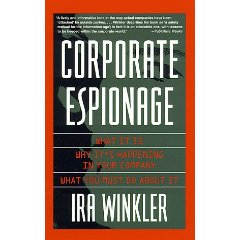
Insider Threat, and Poor Management = Major Losses,
April 8, 2000
Ira Winkler
Ira, a former National Security Agency professional, made a name for himself in his second career as a corporate electronic security specialist by using a combination of common sense and basic work-arounds to penetrate and download millions if not billions of dollars worth of corporate research and development-always at the company's request, and generally with astonishing results. From his antics as a “temp” hire gaining access within two days, to his more systematic attacks using all known vulnerabilities including factory-shipped system administrator passwords that were never changed, he has exposed in a very practical way the “naked emperor” status of corporate America.
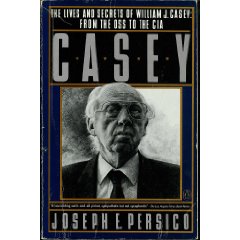
Persico has done a wonderful job of capturing Casey's magnificent complexity and intellectual voraciousness. Oddly enough the best quote in there, part of a really excellent over-all description of why the DO does not succeed, comes from Herb Meyer when he was a special assistant to Casey: “These guys have built a system that shuts them off from any intelligence except what you can steal. These people needed to be reconnected to reality.”
Useful thoughts on deconstructing companies into cells,
April 8, 2000
Larry C. Farrell
Excellent airplane book. Articulates concerns about business schools that disdain real business, for managers that count money instead of making it, and for governments that are complacent about the lack of an entrepreneurial culture within their business ranks. His general approach is to deconstruct companies into smaller units where the management can be close to the actual value-creation, there are simpler more honest relationships, and there is a combined sense of pride and urgency that increases the momentum and productivity of the group.
Great Theory, Misses Mark on Identifying Obstacles,
April 8, 2000
Peter M. Senge
Without a shared vision there can be no shifting of minds, no team leaning, no local initiatives consistent with the shared vision, and so on. This is all really great theory.Taking the U.S. Intelligence Community–which failed spectacularly on 9-11 after resisting change for just over a decade–as an example relevant to both business and the public, one can readily see that great theory simply does not translate into relevant action.
Most helpful would be a new edition of this book, but one that places fully half the book's emphasis on identifying the obstacles to reform and learning, with each obstacle then addressed from both a top-down and a bottom-up perspective.
9-11 demonstrated that the theory of this book is badly needed within the ultimate “learning” community, the U.S. Intelligence Community. Even after 9-11, the leadership of that community refuses to admit it failed, and refuses to propose or acknowledge the substantial changes recommended by over 15 books–a huge critical mass–recommended by the Council on Intelligence. CEOs of multi-billion dollar corporations might choose to reflect on how best to combine the lessons from this book, which are valuable, with the lessons from how a $30 billion a year tax-payer funded community can refuse to change.
Dick is a genius, and he and Bradford Ashton have pulled together a number of very fine contributions in this book. Still, they sum it up nicely in the concluding chapter: “The formal practice of developing technical intelligence in American business is only in its infancy.” They have a nice appendix of sources on scientific and technical intelligence that is missing a few big obvious sources like the Canadian Institute for Scientific and Technical Information (CISTI) and the Defense Technical Information Center (DTIC) as well as the Institute of Scientific Information (ISI) and several smaller sources. On balance, this technical intelligence community is, as Bradford notes, in its infancy. It is U.S. centric, does not yet understand operational security and counterintelligence, is weak of cost intelligence, relies too heavily on registered patents, and has too few practical successes stories. Especially troubling is the recent trend within DIA and the Air Force of cutting off all funding for open source exploitation of Chinese and other foreign S&T sources, combined with a dismantling by many corporations of their libraries and most basic market research functions. This book is an essential reference and I admire its authors greatly-sadly, they are part of a small minority that has not yet found its full voice.
Best book on the market for technical business intelligence,
April 8, 2000
W. Bradford Ashton
Dick is a genius, and he and Bradford Ashton have pulled together a number of very fine contributions in this book. Still, they sum it up nicely in the concluding chapter: “The formal practice of developing technical intelligence in American business is only in its infancy.” They have a nice appendix of sources on scientific and technical intelligence that is missing a few big obvious sources like the Canadian Institute for Scientific and Technical Information (CISTI) and the Defense Technical Information Center (DTIC) as well as the Institute of Scientific Information (ISI) and several smaller sources. On balance, this technical intelligence community is, as Bradford notes, in its infancy. It is U.S. centric, does not yet understand operational security and counterintelligence, is weak of cost intelligence, relies too heavily on registered patents, and has too few practical successes stories. Especially troubling is the recent trend within DIA and the Air Force of cutting off all funding for open source exploitation of Chinese and other foreign S&T sources, combined with a dismantling by many corporations of their libraries and most basic market research functions. This book is an essential reference and I admire its authors greatly-sadly, they are part of a small minority that has not yet found its full voice.
This is a serious general text on competitive intelligence, and Leonard is a master. Having said that, I would note that what Leonard does best is work very hard-the practice of business intelligence still lacks a good set of information technology tools for discovering, discriminating, distilling, and delivering packaged business intelligence, and most firms do not have the tools for managing a broadly distributed network of niche experts who are hired on a day to day basis. Fuld & Company Inc., and to a lesser extent the other companies listed in the Open Source Marketplace, are the first wave in what I believe will be a major line of business to business revenue in the 21st Century.