Journal: Haiti Update 26 January 2010 PM

08 Wild Cards, Collective Intelligence, Cultural Intelligence, Earth Intelligence, Gift Intelligence, Peace Intelligence

Shame on America Especially!

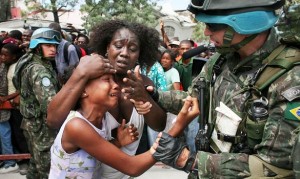
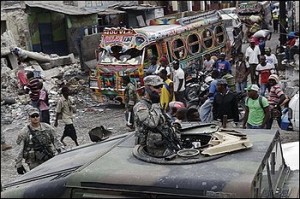
Crowds seeking aid in Haiti met with pepper spray and rubber bullets

Desperate crowds have overwhelmed peacekeepers trying to deliver aid. The World Food Programme says that Port-au-Prince represents the greatest logistical challenge it has ever faced

“They’re not violent, just desperate. They just want to eat,” Fernando Soares, a Brazilian army colonel, said. “The problem is, there is not enough food for everyone.”

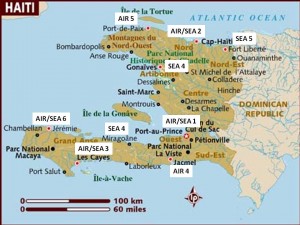
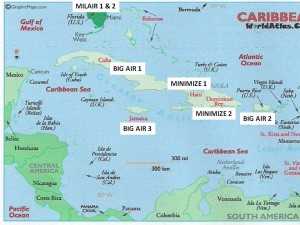
Phi Beta Iota: We are furious at both the lack of decision-support (reliable broad information illuminating the breadth and urgency of the problem) and the lack of decision-makers with gravitas.  Someone needs to reach the Chairman of the Joint Chiefs of Staff (C/JCS) and tell him to pay attention.  Roll the C-130's and carpet bomb the place with water, food, tents, etc.   The National Guard C-130 pilots and crew chiefs know how to do “touch and go” drive-by load delivery without landing–why is our anemic military using just two of the six commercial capable airports and just one of the six commercial capable ports and NONE of the helicopter landing zones across the country?   We agree with William McNulty who has had EYES ON–we need to hold both commanders and their intelligence officers responsible for this massive failure to Observe, Orient, Decide, and Act (OODA).  We also recommend the observations by Dr. Zbigniew Brzezinski and the Italian leaderMr Bertolaso on the pathetic inadequacy of American assistance.  Uninformed, insufficient, a disgrace.

Meteorological Forecast: Rain and Diarrheal Illness

Forecasts for PAP calling for 20-30% chance of rain in the coming days.  Concerned about influence on transmission of gastroenteritis and diarrheal illness.  Monitoring closely.

Diarrheal disease was assessed to be the top priority in the immediate term following the earthquake.  We are now seeing indications of diarrheal disease increasing in the camps, particularly among the children.  We are very concerned about these reports.

Haiti Catastrophe Raises Biosecurity Concerns

As the slow process of recovery begins, re-establishing some normalcy of life will be critical and animals play a role in the lives of people in Haiti as they do around the world. One of the key issues will be focusing on Haiti's livestock and large population of stray animals.
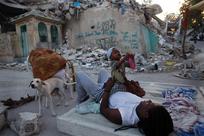
On the Street

The response to these issues raises potential concerns for the U.S. livestock industries, says AASV. There are a number of reportable trans-border diseases endemic or suspected on the island of Hispaniola which, if introduced into the U.S. livestock herd, would have devastating effects on animal agriculture…

Haiti's children on their own on shattered streets

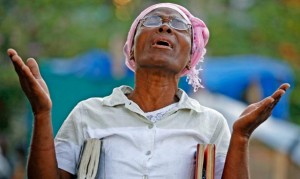
PORT-AU-PRINCE, Haiti — The children with no names lay mute in a corner of the General Hospital grounds Tuesday, three among thousands of boys and girls set adrift in the wake of Haiti's earthquake.
FullStory Online

Clinton: Critics of US Haiti relief misguided

WASHINGTON — Secretary of State Hillary Rodham Clinton said Tuesday she resents criticism of the U.S. effort to help stricken Haiti and pledged to redouble efforts to help survivors of the Jan. 12 earthquake.

“I deeply resent those who attack our country, the generosity of our people and the leadership of our president in trying to respond to historically disastrous conditions after the earthquake,” Clinton said.

Continue reading “Journal: Haiti Update 26 January 2010 PM”

Search: synergy strike force beer clapper

Collective Intelligence, Cultural Intelligence, IO Multinational, IO Sense-Making, Peace Intelligence
Home Page

Sample Cool Dude: Toff Hoffman.

Related project: STAR-TIDES (Sustainable Technologies Accelerated Research/Transformative Innovation for Development and Emergency Support)

Great project allowed to die: STRONG ANGEL

Phi Beta Iota: Including Rand Beer and Jim Clapper is what causes this search to fail.  Dr. Dr. Dave Warner, one of the co-founders of Earth Intelligence Network (EIN), is the originator of this idea.  Dr. Dr. Warner is too much the diplomat to point out the obvious: the concept requires open minds, a shelving of rankism, multinational engagement, and a raft of other minor but vital accommodations that are simply not in the DNA of those now serving.  They are all good people who mean well, but innovation like this is on the margins and receives lip service (much as the Open Government initiative has received lip service).

Continue reading “Search: synergy strike force beer clapper”

Worth a Look: Eight Books on Securing the Peace and the New Meme “Responsibility to Protect”

Peace Intelligence
Amazon Page

Timely and pathbreaking, Securing the Peace is the first book to explore the complete spectrum of civil war terminations, including negotiated settlements, military victories by governments and rebels, and stalemates and ceasefires. Examining the outcomes of all civil war terminations since 1940, Monica Toft develops a general theory of postwar stability, showing how third-party guarantees may not be the best option. She demonstrates that thorough security-sector reform plays a critical role in establishing peace over the long term.

Much of the thinking in this area has centered on third parties presiding over the maintenance of negotiated settlements, but the problem with this focus is that fewer than a quarter of recent civil wars have ended this way. Furthermore, these settlements have been precarious, often resulting in a recurrence of war. Toft finds that military victory, especially victory by rebels, lends itself to a more durable peace. She argues for the importance of the security sector–the police and military–and explains that victories are more stable when governments can maintain order. Toft presents statistical evaluations and in-depth case studies that include El Salvador, Sudan, and Uganda to reveal that where the security sector remains robust, stability and democracy are likely to follow.  [Phi Beta Iota: when rebels win, absent outside subsidies, they generally held the moral high ground to begin with–Saudi Arabia is a good example of a regime ready to fall hard.]

Amazon Page

Virginia Page Fortna has written a compelling and courageous book–compelling in the reinforcing comparisons that it makes between aggregate data and case-based research, and courageous in its first-person interviews, conducted with those who perpetrated as well as ended civil wars. The book bridges the worlds of the high-flying ‘quant' who sees only forests of data, and the ground-based case researcher knee-deep in political leaf litter. Drawing particular strength from the oft-ignored perspective of those on whose behalf peacekeepers do their work, Fortna's convergent analyses advance our understanding not only of how peacekeeping works but why.

Continue reading “Worth a Look: Eight Books on Securing the Peace and the New Meme “Responsibility to Protect””

Journal: Haiti–Italian Agrees with Brzezinki–A Mess

08 Wild Cards, Peace Intelligence

Please God, Send Us a Leader Who Understands Intelligence-Led Emergency Response and Believes Deeply in Stabilization & Reconstruction as a Righteous Multinational Engagement Mission

US criticised over Haiti aid as reconstruction talks begin

After two days of observations Mr Bertolaso told a RAI television interviewer that the relief effort showed that the international community was unable to mount an adequate disaster response and called for the appointment of a civilian international humanitarian co-ordinator.

He said the aid organisations, including United Nations bodies, wrongly thought Haiti was “another humanitarian catastrophe like Cambodia or Rwanda. They thought they could bring something to eat and drink and the problem would be resolved.”.

He added that the US military effort was “inefficient” and that troops were not trained to run an aid or disaster relief operation. “No-one is giving orders,” he said.

Asked by Lucia Annunziata, the RAI interviewer, if the rescue effort had been “a flop”, Mr Bertolaso — who holds Cabinet rank — said that the American decision to send large quantities of troops, cargo planes and aid was commendable. “However, when confronted by a situation of chaos, they tend to confuse military intervention with what should be an emergency operation, which cannot be entrusted to the armed forces. We are missing a leader, a co-ordination capacity that goes beyond military discipline.”

See Also:

Journal: Haiti–Perspective of Georgie Anne Geyer

Journal: Haiti EYES ON Interview with William McNulty

Journal: Haiti Op-Ed, Maps and Data, SOUTHCOM

Journal: Haiti Health Situation, Short-Term View

Journal: Zbigniew Brzezinski BRILLIANT on Haiti Now

Journal: Haiti History, Interim Report, Prognosis

Journal: Haiti Rolling Directory from 12 January 2010

Journal: Haiti–Perspective of Georgie Anne Geyer

08 Wild Cards, Cultural Intelligence, Earth Intelligence, Ethics, Government, Non-Governmental, Peace Intelligence

CAN HAITI SURVIVE?

The United States and many other nations across the globe are sending water, food and troops to benighted Haiti. Charity groups and NGOs from New York to San Francisco are collecting money. The French are calling for a “conference on Haiti's reconstruction and development.” At least in these first few weeks following the horrific earthquake that shook the once-beautiful Caribbean isle, it seems that the world wants to give Haiti everything — except the truth.

Safety Copy of Entire Opinion Below the Line  +  Full Story Online (While It Lasts)
Continue reading “Journal: Haiti–Perspective of Georgie Anne Geyer”

Journal: Haiti History, Interim Report, Prognosis

01 Poverty, 07 Other Atrocities, Communities of Practice, Ethics, Key Players, Methods & Process, Peace Intelligence

To Heal Haiti, Look to History, Not Nature (New York Times)

On Jan. 1, 1804, when Dessalines created the Haitian flag by tearing the white middle from the French tricolor, he achieved what even Spartacus could not: he had led to triumph the only successful slave revolt in history. Haiti became the world’s first independent black republic and the second independent nation in the Western Hemisphere.

Alas, the first such republic, the United States, despite its revolutionary creed that “all men are created equal,” looked upon these self-freed men with shock, contempt and fear. Indeed, to all the great Western trading powers of the day — much of whose wealth was built on the labor of enslaved Africans — Haiti stood as a frightful example of freedom carried too far. American slaveholders desperately feared that Haiti’s fires of revolt would overleap those few hundred miles of sea and inflame their own human chattel.

Haiti Numbers (Daily Gleaner Canada)

* Number of homeless in Haiti: 2 million, European Commission estimate.

* Total death toll roughly 200,000, estimate by the European Union, quoting Haitian officials.

* Other aid: UN World Food Programme has distributed 1.4 million ready-to-eat food rations, says 100 million will be needed over next 30 days to reach three million people in desperate need.

Major aftershock hits Haiti; assessment team making contact (Baptist Press)

The team arrived in Port-au-Prince Wednesday (Jan. 20) after a 17-hour, 160-mile trip in a four-vehicle caravan from Santo Domingo, Dominican Republic.

More than 40 significant aftershocks have hit since the Jan. 12 quake killed an estimated 200,000 people, injured 250,000 and left 1.5 million homeless.

The truck drivers are less and less willing to [drive into the city] as the situation in Port deteriorates.

Officials are concerned that the desperation people feel will boil over into violence. Looters by the hundreds have been fighting each other with broken bottles, clubs and other weapons over whatever goods they can still find in damaged stores.

Haiti DR planning slated Jan. 26 in Miami (Baptist Press)

Another assessment team member, Don Gann, disaster relief director for the Mississippi Baptist Convention, said the situation in Haiti remains fluid, chaotic and difficult. “[T]he traffic in Port-au-Prince is unbelievable,” Gann said. “Today, it took us three hours to go seven miles.

“There are security issues the teams need to be aware of. The situation is still precarious. A medical team or a feeding team could be overrun just because the people here have such great needs.”

Another assessment team member, Don Gann, disaster relief director for the Mississippi Baptist Convention, said the situation in Haiti remains fluid, chaotic and difficult. “[T]he traffic in Port-au-Prince is unbelievable,” Gann said. “Today, it took us three hours to go seven miles. ”

Haiti Earthquake update: cardboard communities

In this Haiti Earthquake update, The Christian Science Monitor reports that Haitians are building new homes after the earthquake with little more than cardboard and plastic in refugee camps. It's estimated that there are 250 such camps in existence.

The rich have left Haiti's capital city of Port-Au-Prince, leaving the poor to fend for themselves. Haiti Earthquake relief efforts are building, but with 3 million people in need of aide and a crumbled infrastructure, it's a challenge.

Update From Haiti: A Little Hope Today

Today felt like we made more progress and were able to create a little hope. We received some food from the United Nations and the Sisters of Charity, but most isn't getting to the people. Most is still in warehouses

Updates on the Crisis in Haiti

The volume of cases was truly overwhelming. We ran 2-3 operating rooms for 12-14 hours at a time, and didn’t even make a dent in the case load.

He added that “it was somewhat unclear” who was in charge of bringing patients injured to the hospital from hte earthquake zone. “

Update on the Progress of the US “Invasion”

Members of the 22nd Marine Expeditionary Unit launched two helicopters to resupply a U.N. distribution site with water.

Then came the earthquake victims, injured one week ago, ferried onboard by several helicopters. In all, the ship took in 19 patients after getting three Tuesday.

Phi Beta Iota Prognosis: In our over-all experience, absent a sea change in how the world community is approaching this, at least half the aid will be stolen or misappropriated; half the remaining aid dollars and materials will never get to the Hiatians at all.  The prospects of a plague, riots, and other human break-downs increase every day.  At this point in time neither the US nor Brazil nor the Cubans appear to have any of the following:

1.  Multinational Information-Sharing and Sense-Making Center

2.  Multinational Strategy, Operations Plan, or Tactical Lines of Engagement

3.  Phase Plan for leveraging every air and sea entry point that makes sense

4.  Phase Plan for actually getting minimal water and food to each of three million people for each of the next 30, 60, 90 days

5.  Strategy, Campaign Plan, or Logistics for applying aid dollars to the bottom-up reconstruction of Haiti in a manner that aggressively relocates 400,000 people not to temporary camps but to permanent opportunities with a virtually infinite supply of building materials aided by every Red Hat, See Bee and Army Engineer unit we can muster.  This needs a Berlin Airlift degree of seriousness, a Marine Expeditionary Force level of complex simultaneous attention to detail, and a Whole of Government Multinational Engagement mind-set that we are simply not seeing.

6.  We know that the US Government is trying to share imagery and other information with selected partners both national and non-governmental but we don't see a coherent island-wide Information Operations (IO)  endeavor, and we see ZERO in the way of “Strategic Communications” outlining in militarily precise terms where the bodies are, what percentage have been fed, etcetera.  The absence of this information causes us great sadness, for it suggests that in all probability the US military is not treating this matter with the deep seriousness that it merits from a multinational public information-sharing and sense-making point of view.

Journal: Haiti Rolling Directory from 12 January 2010

Worth a Look: Books on China in Africa

02 China, 08 Wild Cards, 5 Star, Commercial Intelligence, Communities of Practice, Country/Regional, Cultural Intelligence, Peace Intelligence
Amazon Page

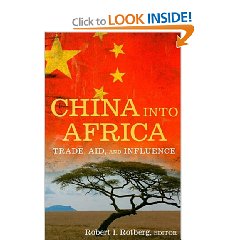
Africa and China are now immersed in their third and most transformative era of heavy engagement, one that promises to do more for economic growth and poverty alleviation than anything attempted by Western colonialism or international aid programs.Robert Rotberg and his Chinese, African, and other colleagues discuss this important trend and specify its likely implications. Among the specific topics tackled here are China's interest in African oil; military and security relations; the influx and goals of Chinese aid to sub-Saharan Africa; human rights issues; and China's overall strategy in the region. China's insatiable demand for energy and raw materials responds to sub-Saharan Africa's relatively abundant supplies of unprocessed metals, diamonds, and gold, while offering a growing market for Africa's agriculture and light manufactures.As this book illustrates, this evolving symbiosis could be the making of Africa, the poorest and most troubled continent, while it further powers China's expansive economic machine.

Amazon Page

One of the most worrying elements to emerge from these pages is a consistent lack of transparency in all these Chinese ventures. “Not a single Chinese official in the region would agree to meet us,” the authors write. Their requests for interviews with African officials and Chinese managers were routinely ignored, access to work sites barred and information on contractual terms withheld. Domestic parliamentarians have been similarly stymied, unable to uncover even basic details of projects they were promised would transform their countries. None of this bodes well on a continent where top-level sleaze and capital flight have already leached away billions of dollars earmarked for development. Opaque, unscrutinized contracts threaten more of the same. Michel and Beuret are admirably even-handed, unsparing in their attacks on the cynical agendas and sad outcomes of past French, British and U.S. intervention.

Phi Beta Iota: Above two on order and will be reviewed soon.

Amazon Page

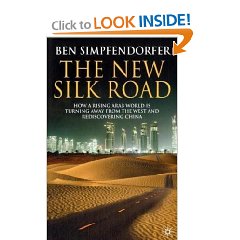
“As the chief China economist for Royal Bank of Scotland in Hong Kong and a former resident of both Beirut and Damascus, Mr Simpfendorfer is well placed to tackle the subject. But although he is a professional economist, what sets Mr Simpfendorfer's book aside from the usual run of publications about the mainland's rise is not his command of macroeconomic statistics, but his grasp of how the expanding relationship between China and the Arab world works at the personal level.”   – Tom Holland, South China Morning Post

“Despite the global economic crisis, the trajectory of the Arab and Chinese economies still match the soaring skylines of Dubai and Shanghai. Furthermore, as Ben Simpfendorfer bracingly illustrates, these are not isolated events but rather the resurrection of a Silk Road symbiosis. For all the region's troubles, this book places the Persian Gulf back where it geographically belongs: at the center of Eurasia and bending towards the overwhelming gravity of China.”   – Parag Khanna, author of  The Second World–Empires and Influence in the New Global Order and Senior Research Fellow at the New America Foundation

Amazon Page

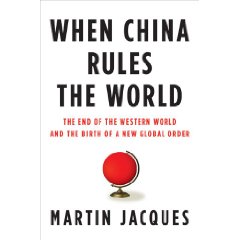
A convincing economic, political and cultural analysis of waning Western dominance and the rise of China and a new paradigm of modernity. Jacques (The Politics of Thatcherism) takes the pulse of the nation poised to become, by virtue of its scale and staggering rate of growth, the biggest market in the world. Jacques points to the decline of American hegemony and outlines specific elements of China's rising global power and how these are likely to influence international relations in the future. He imagines a world where China's distinct brand of modernity, rooted firmly in its ancient culture and traditions, will have a profound influence on attitudes toward work, family and even politics that will become a counterbalance to and eventually reverse the one-way flow of Westernization. He suggests that while China's economic prosperity may not necessarily translate into democracy, China's increased self-confidence is allowing it to project its political and cultural identity ever more widely as time goes on. As comprehensive as it is compelling, this brilliant book is crucial reading for anyone interested in understanding where the we are and where we are going.  Publishers Weekly

For the better part of 15 years, with one tragic interruption, he dug and dug and then transformed his scholarly spadework into accessible, inviting prose. The result is “When China Rules the World,” a compelling and thought-provoking analysis of global trends that defies the common Western assumption that, to be fully modern, a nation must become democratic, financially transparent and legally accountable. Jacques argues persuasively that China is on track to take over as the world's dominant power and that, when it does, it will make the rules, on its own terms, with little regard for what came before.  Washington Post

Continue reading “Worth a Look: Books on China in Africa”

noble gold