While this article was written prior to President Moreno's December 2018 trip to the PRC (securing a new $900 million loan), you may find this article a useful sector-by-sector analysis of the relationship, with a comparison to China's relationship with Venezuela and Bolivia, as well as discussion of President Moreno's attempt to secure more equitable contract terms for his country.
SpiNNaker's spiking neural network mimics the human brain, and could fuel breakthroughs in robotics and health.
Historically, the difficulty in making computers that could mimic the brain largely comes down to connectivity. Neurons — the nerve fibres that travel throughout the body and largely terminate in the brain — each have thousands of inputs and thousands of outputs. Computing systems struggle with anything on a similar scale.
Currently, it models one percent of the human brain, so a SpiNNaker system that could give a robot human-level cognition would require something of an engineering miracle.
This disturbing, sharply rendered account tells how the post-Communist Russian Mafiya has infiltrated American life with tactical intelligence and a rare level of viciousness. Drawing from interviews with top Russian mobsters and police, journalist Friedman (Zealots for Zion: Inside Israel's West Bank Settlement Movement) trenchantly explores the brutal corruption of the U.S.S.R. and the anarchic greed that has flourished since its collapse, incubating a “criminal colossus that has surpassed the Colombian cartels, the Japanese Yakuzas, the Chinese triads and the Italian Mafia in wealth and weaponry.” Friedman, whose reporting on this subject has appeared in Vanity Fair, the Village Voice and other publications, writes of one wise guy responsible for 100 hits and of “Tarzan”Dthe swaggering Miami mobster busted while attempting to tender a Russian submarine to Colombian drug lords. Friedman documents how the mobsters have imported their brand of terror tacticsDshakedowns, kidnappings, bombings and public assassination.
Below the line: senior intelligence officer on what is not in the book.
Phi Beta Iota: They both ignore short-falls in data collection (1%) and data processing (1% of the 1% we collect) and none of them really speak to sense-making tools and collective human intelligence.

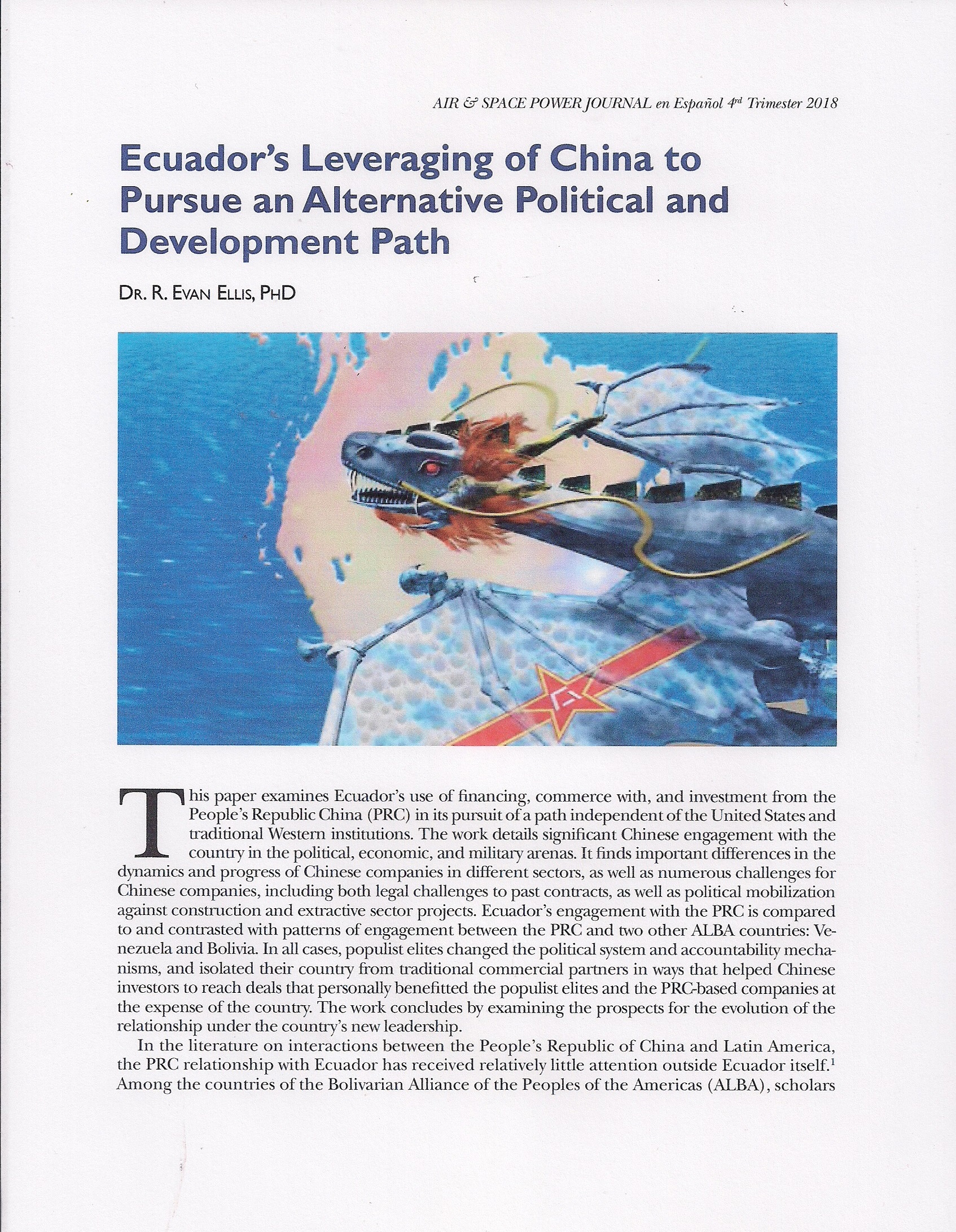 While this article was written prior to President Moreno's December 2018 trip to the PRC (securing a new $900 million loan), you may find this article a useful sector-by-sector analysis of the relationship, with a comparison to China's relationship with Venezuela and Bolivia, as well as discussion of President Moreno's attempt to secure more equitable contract terms for his country.