Jean Lievens: Should We Fight System or Be Change? – Dissent Magazine

Cultural Intelligence
Jean Lievens
Jean Lievens

Should We Fight the System or Be the Change?

By Mark Engler and Paul Engler

Dissent Magazine – June 10, 2014

It is an old question in social movements: Should we fight the system or “be the change we wish to see”? Should we push for transformation within existing institutions, or should we model in our own lives a different set of political relationships that might someday form the basis of a new society?

Over the past fifty years—and arguably going back much further—social movements in the United States have incorporated elements of each approach, sometimes in harmonious ways and other times with significant tension between different groups of activists.

In the recent past, a clash between “strategic” and “prefigurative” politics could be seen in the Occupy movement. While some participants pushed for concrete political reforms—greater regulation of Wall Street, bans on corporate money in politics, a tax on millionaires, or elimination of debt for students and underwater homeowners—other occupiers focused on the encampments themselves. They saw the liberated spaces in Zuccotti Park and beyond—with their open general assemblies and communities of mutual support—as the movement’s most important contribution to social change. These spaces, they believed, had the power to foreshadow, or “prefigure,” a more radical and participatory democracy.

Once an obscure term, prefigurative politics is increasingly gaining currency, with many contemporary anarchists embracing as a core tenet the idea that, as a slogan from the Industrial Workers of the World put it, we must “build the new world in the shell of the old.” Because of this, it is useful to understand its history and dynamics. While prefigurative politics has much to offer social movements, it also contains pitfalls. If the project of building alternative community totally eclipses attempts to communicate with the wider public and win broad support, it risks becoming a very limiting type of self-isolation.

For those who wish to both live their values and impact the world as it now exists, the question is: How can we use the desire to “be the change” in the service of strategic action?

Read full article.

Andrew Garfield: Two New Surveys Suggest Ghani Will Win the Presidency of Afghanistan

08 Wild Cards, Civil Society, Corruption, Cultural Intelligence, Ethics, Government, Peace Intelligence
Andrew Garfield
Andrew Garfield

June 12, 2014

For further information contact

Andrew Garfield, 571 228-4813

Two Surveys in Afghanistan Suggest Ghani Will Win Presidency

Both telephone and face-to-face polls favor Ghani over Abdullah in Saturday’s Election

Continue reading “Andrew Garfield: Two New Surveys Suggest Ghani Will Win the Presidency of Afghanistan”

Jean Lievens: Self-Determination as Anti-Extractivism – Indigenous Resistance is Changing World Politics (and Countering Predatory Capitalism)

Civil Society, Cultural Intelligence, Earth Intelligence, Ethics
Jean Lievens
Jean Lievens

Self-Determination as Anti-Extractivism: How Indigenous Resistance Challenges World Politics

Written by Manuela Picq

Monday, 02 June 2014 19:46

Indigeneity is an unusual way to think about International Relations (IR). Most studies of world politics ignore Indigenous perspectives, which are rarely treated as relevant to thinking about the international (Shaw 2008; Beier 2009).


Unconquerable Peoples

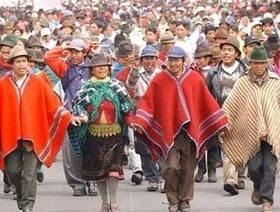
Yet Indigenous peoples are engaging in world politics with a dynamism and creativity that defies the silences of our discipline (Morgan 2011). In Latin America, Indigenous politics has gained international legitimacy, influencing policy for over two decades (Cott 2008; Madrid 2012). Now, Indigenous political movements are focused on resisting extractive projects on autonomous territory from the Arctic to the Amazon (Banerjee 2012; Sawyer and Gómez 2012). Resistance has led to large mobilized protests, invoked international law, and enabled alternative mechanisms of authority.

Continue reading “Jean Lievens: Self-Determination as Anti-Extractivism – Indigenous Resistance is Changing World Politics (and Countering Predatory Capitalism)”

Eagle: Practical Guide to Collapse and Revolution

Civil Society, Collective Intelligence, Cultural Intelligence, Ethics
300 Million Talons...
300 Million Talons…

A Practical Utopian’s Guide to the Coming Collapse

David Graeber

[from The Baffler No. 22, 2013]

What is a revolution? We used to think we knew. Revolutions were seizures of power by popular forces aiming to transform the very nature of the political, social, and economic system in the country in which the revolution took place, usually according to some visionary dream of a just society. Nowadays, we live in an age when, if rebel armies do come sweeping into a city, or mass uprisings overthrow a dictator, it’s unlikely to have any such implications; when profound social transformation does occur—as with, say, the rise of feminism—it’s likely to take an entirely different form. It’s not that revolutionary dreams aren’t out there. But contemporary revolutionaries rarely think they can bring them into being by some modern-day equivalent of storming the Bastille.

At moments like this, it generally pays to go back to the history one already knows and ask: Were revolutions ever really what we thought them to be? For me, the person who has asked this most effectively is the great world historian Immanuel Wallerstein. He argues that for the last quarter millennium or so, revolutions have consisted above all of planetwide transformations of political common sense.

Continue reading “Eagle: Practical Guide to Collapse and Revolution”

Bojan Radej: Social Complexity as Threat

Cultural Intelligence, Peace Intelligence
Bojan Radej
Bojan Radej

Abstract: Society is complex ‘mesocosm’ (Plato). Concept of social complexity is developed from a cross comparison between simple, systemic, chaotic and evolutionary thinking. The most rudimentary category of social complexity is incommensurability of social issues because of their incompatible valuations in vertical and horizontal direction. These two orthogonally organised axes obtain us with Cartesian frame which is further reworked into Leontief’s input-output matrix as each axis is internally differentiated on (at least) three integral domains. These provide a middle ground or meso level where domains are correlated which is fundamental for studying them. To apply mesoscopic logic on social processes one needs first to develop specific set of hybrid or bi-modal categories with dual horizon which are capable of bridging oppositions between pairs of incommensurable comparisons. Hybrid categories radically reinterpret society as a complex and deantagonised. Three practical examples are addressed to illustrate the mesoscopic transcendence of idea of totality as well as of fragmentation. Their conclusions suggest that our common destiny increasingly depends on individual and collective capacity to take a broad insight and constitute as globally responsible, self-restraining but also rigorously autonomous agents.

Key words: Social complexity, Incommensurability of values, Mesoscopic rationality, Hybrid categories, Mutuality.

PDF (54 Pages): Radej, Social Complexity ( JUN 2014)

Robert Young Pelton: Hamid Gul Endorses Abdullah — Does This Make Ghani’s Victory Certain? UPDATE Adds Poll Showing 49 to 41

Cultural Intelligence
Robert Young Pelton
Robert Young Pelton

Given how Afghans feel about Pakistan, this endorsement will probably have the opposite effect and reinforce Ghani's bid.

UPDATE: Just in from Telegraph on 11 June:

Economist may lead Afghanistan after forming alliance with warlord in presidential elections

ORIGINAL POST:

Afghan Election: Endorsement From Pakistan’s Ex-Spy Chief Causes Stir

Fred Bezhan

Radio Free Europe/Radio Liberty, 11 June 2014

Hamid Gul
Hamid Gul

KABUL — In Afghanistan, perhaps no foreign institution is loathed as much as Pakistan's notorious spy agency, Inter-Services Intelligence (ISI).

The ISI trained, armed, and funded Afghan resistance fighters against the Soviet Union. It was credited with forming the Taliban. And to this day Afghanistan accuses the powerful agency of providing safe haven on Pakistani soil to a number of extremist insurgent groups bent on overthrowing the government in Kabul.

So it comes as no surprise that Afghans are venting their anger after former ISI chief Hamid Gul gave a ringing endorsement of Abdullah Abdullah, the front-runner in Afghanistan's runoff presidential election on June 14.

Continue reading “Robert Young Pelton: Hamid Gul Endorses Abdullah — Does This Make Ghani's Victory Certain? UPDATE Adds Poll Showing 49 to 41”

Andrew Garfield: Afghan Government Indicted for Fraud – Ghani Wins Unless International Community Fails to Run Polls and Contest Massive Fraud by Abdullah and Karzai

08 Wild Cards, 09 Justice, 11 Society, Civil Society, Corruption, Cultural Intelligence, Ethics, Government, Peace Intelligence
Andrew Garfield
Andrew Garfield

Afghanistan On The Brink – The Last Chance For A “Correction”

By Andrew Garfield

Foreign Policy Research Institute, June 10, 2014 – 10:03am

PBI Executive Summary: Significant fraud in first round (at least one seventh of the total votes); 3,000 election staff fired, Afghan government indicted for forbidding polls (the major fraud detection measure) and allowing repeat of massive fraud. New polls indicate Ghani wins easily on demographics alone. If normally standard measures do not counter fraud, election will be polarizing, civil war the outcome, and all investment to date made moot.

Continue reading “Andrew Garfield: Afghan Government Indicted for Fraud – Ghani Wins Unless International Community Fails to Run Polls and Contest Massive Fraud by Abdullah and Karzai”

noble gold