Worth a Look: Books on War and Torture Victims, Asylum and Refugee Trauma

Cultural Intelligence, Peace Intelligence, Worth A Look
Amazon Page
Amazon Page

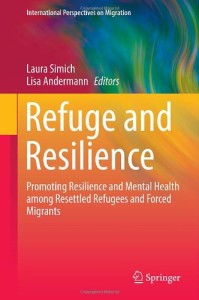
2014 Refuge and Resilience: Promoting Resilience and Mental Health among Resettled Refugees and Forced Migrants

Taking an interdisciplinary approach and focusing on the social and psychological resources that promote resilience among forced migrants, this book presents theory and evidence about what keeps refugees healthy during resettlement. The book draws on contributions from cultural psychiatry, anthropology, ethics, nursing, psychiatric epidemiology, sociology and social work. Concern about immigrant mental health and social integration in resettlement countries has given rise to public debates that challenge scientists and policy makers to assemble facts and solutions to perceived problems. Since the 1980s, refugee mental health research has been productive but arguably overly-focused on mental disorders and problems rather than solutions. Social science perspectives are not well integrated with medical science and treatment, which is at odds with social reality and underlies inadequacy and fragmentation in policy and service delivery. Research and practice that contribute to positive refugee mental health from Canada and the U.S. show that refugee mental health promotion must take into account social and policy contexts of immigration and health care in addition to medical issues. Despite traumatic experiences, most refugees are not mentally ill in a clinical sense and those who do need medical attention often do not receive appropriate care. As recent studies show, social and cultural determinants of health may play a larger role in refugee health and adaptation outcomes than do biological factors or pre-migration experiences. This book’s goal therefore is to broaden the refugee mental health field with social and cultural perspectives on resilience and mental health.
Amazon Page
Amazon Page

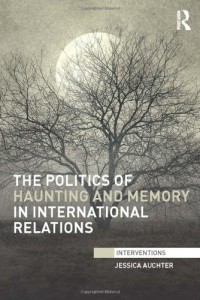
2014 The Politics of Haunting and Memory in International Relations

International Relations has traditionally focused on conflict and war, but the effects of violence including dead bodies and memorialization practices have largely been considered beyond the purview of the field. Drawing on Jacques Derrida’s notion of hauntology to consider the politics of life and death, Auchter traces the story of how life and death and a clear division between the two is summoned in the project of statecraft. She argues that by letting ourselves be haunted, or looking for ghosts, it is possible to trace how statecraft relies on the construction of such a dichotomy. Three empirical cases offer fertile ground for complicating the picture often painted of memorialization: Rwandan genocide memorials, the underexplored case of undocumented immigrants who die crossing the US-Mexico border, and the body/ruins nexus in 9/11 memorialization. Focusing on the role of dead bodies and the construction of particular spaces as the appropriate sites for memory to be situated, it offers an alternative take on the new materialisms movement in international relations by asking after the questions that arise from an ethnographic approach to the subject: viewing things from the perspective of dead bodies, who occupy the shadowy world of post-conflict international politics. This work will be of great interest to students and scholars of critical international relations, security studies, statecraft and memory studies.

Continue reading “Worth a Look: Books on War and Torture Victims, Asylum and Refugee Trauma”

Chris Hedge: The Crucible of Iraq – Best Book from Worst War

04 Inter-State Conflict, 05 Civil War, 07 Other Atrocities, 08 Wild Cards, 11 Society, Corruption, Cultural Intelligence, Government, Idiocy, Military, Officers Call, Peace Intelligence
Chris Hedges
Chris Hedges

The Crucible of Iraq

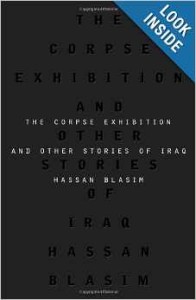
The Corpse Exhibition: And Other Stories of Iraq, by Hassan Blasim, is the most important book to come out of the Iraq War. Blasim, whom I met with last week in Princeton, N.J., has a faultless eye for revealing detail, a ribald black humor and a psychological brilliance that makes every story in his book a depth charge. In this collection of short stories he explores through fiction the culture of violence unleashed under the bloody dictatorship of Saddam Hussein and exacerbated by an American occupation that has destroyed the damaged social cohesion and civil life that survived Saddam's regime. His prose, courtesy of a brilliant translation by  Jonathan Wright, is lyrical, taut, and riveting.

Amazon Page
Amazon Page

Militarism and violence are diseases. It does not matter under what guise they appear. Renegade jihadists, Shiite death squads, Sunni militias, Saddam's Baathists and secret police, Kurdish Peshmerga rebels, al-Qaida cells, gangs of kidnappers and the U.S. Army 101st Airborne are all infected with the same virus. And it is a virus Blasim fearlessly inspects. By the end of this short-story collection the reader grasps, in a way no soldier's memoir or journalistic account from Iraq can explicate, the crucible of war and the unmitigated horror of violence itself. The book is a masterpiece.

“When I was 6, during my first year at school, the Iran-Iraq War erupted,” Blasim told me in a mixture of English and Arabic. “We were living in Kirkuk. We were taught in school to draw tanks or the face of Ayatollah Khomeini as the enemy. The city of Kirkuk was beautiful. There were flowers everywhere. But we were never taught the names of the flowers. Even today I do not know the names of these flowers. I tried to learn their names as an adult.”

“There was a culture of violence that predated the occupation,” he said…

Continue reading “Chris Hedge: The Crucible of Iraq – Best Book from Worst War”

Jean Lievins: To Save our Planet We Must End Wage Slavery and Rebuild the Commons

Commercial Intelligence, Cultural Intelligence
Jean Lievens
Jean Lievens

To Save our Planet We Must End Wage Slavery and Rebuild the Commons

by Gary Engler

Dissident Voice, April 6th, 2014

Who runs your workplace?

For most of us the answer is a boss, who reports to a higher boss, who reports to an even higher boss, who reports to a … all the way up to the “owner” of the enterprise. This is called a chain of command.

Amazon Page
Amazon Page

The words “chain” and “command” are both suggestive of a fundamental truth: Today’s rules about the power of bosses and workers evolved from a time of masters, servants and slaves. While many norms and expectations have changed over the years the fundamental truth that bosses give orders and workers are required to obey remains the same.

This explains the use of the term “wage slavery” by some who oppose capitalism. It suggests that working for wages is similar to being a slave. The Wikipedia entry on wage slavery offers a good introduction to the subject, pointing out the concept is much older than capitalism and that even ancient Romans argued accepting wages for work put one into a slave-like position. The idea that giving up your free will for any reason or length of time makes you a slave is as old as wage work itself.

Interestingly, the usage of the term wage slavery has diminished as a greater and greater proportion of us work for wages. The notion that most of us are effectively slaves is probably too uncomfortable to contemplate. And, of course, not talking about this serves the interests of those who profit from our labour.

But I’d like to suggest there’s another reason as well.

Continue reading “Jean Lievins: To Save our Planet We Must End Wage Slavery and Rebuild the Commons”

Mini-Me: Afghanistan — Multi-Billion Dollar Abandonment — an Opportunity for Funding Peace After ISAF

Cultural Intelligence, Peace Intelligence
Who?  Mini-Me?
Who? Mini-Me?

Huh?

Scrap Heap of War: Billions in equipment being left behind in Afghanistan

How much “stuff” is the United States military leaving behind as it withdraws from Afghanistan after 12 years of war? Try some $6 billion worth.

And much of it may yet end up in a junk pile.

That includes 850 MRAPS (Mine-Resistant Ambush Protected) vehicles which have been credited with saving countless lives from improvised explosive devices (IEDs) on the road, but now will either be given to an allied country (as long as they pay the shipping costs) or for scrap on the Afghan market.

Read full article.

Continue reading “Mini-Me: Afghanistan — Multi-Billion Dollar Abandonment — an Opportunity for Funding Peace After ISAF”

Jean Lievens: Spanish Civil Financial Disobedience – the Story of Enric Duran and the Catalan Integrated Cooperative

Commercial Intelligence, Cultural Intelligence
Jean Lievens
Jean Lievens

With thanks to Stacco Toncoso at P2P Foundation.

Come Back” is a full-length documentary film detailing the aftermath of Spanish activist Enric Duran’s notorious action against 16 major banks. In case you’re not familiar with his act of “financial civil disobedience”, Duran attained roughly half a million Euros in bank loans and subsequently distributed the funds to support anti-capitalist activist movements. This documentary revisits the years-long preparation for the action itself, and interviews the various groups of activists who consequently benefited from the money. The action also led to the foundation of the revolutionary Catalan Integrated Cooperative, a transition-minded post-capitalist community, which is currently thriving. You can read more about Duran and the CIC in this recent interview with Duran, conducted by Michel Bauwens, John Restakis and Neal Gorenflo.

See video (43:42) and read rest of article.

Yoda: Saudi Arabia on Brink of Revolution?

Cultural Intelligence
Got Crowd? BE the Force!

Leftward Shift by Conservative Cleric Leaves Saudis Perplexed

Robert F. Worth

New York Times, 5 April 2014

RIYADH, Saudi Arabia — When this country’s ultraconservative clerics make news, it is often for embarrassing reasons: unleashing fatwas against soap operas, for instance, or declaring Mickey Mouse to be a “soldier of Satan.”

Lately, however, one of the kingdom’s best-known religious figures, Salman al-Awda, has been making a very different kind of trouble.

Mr. Awda had something akin to a conversion moment during the Arab uprisings of 2011, and since then has become a passionate promoter of democracy and civic tolerance. He has more than 4.5 million followers on Twitter and several million on his regular YouTube broadcasts, making him a significant thorn in the side of the Saudi monarchy. He can be dangerously blunt, at least by Saudi standards, and the government has made its displeasure clear, barring him from print media, television and foreign travel.

“The gulf governments are fighting Arab democracy, because they fear it will come here,” said Mr. Awda, a 57-year-old cleric with a reddish henna-dyed beard and an air of slow-moving serenity. “Look what they have done in Egypt — sending billions of dollars right after the coup last summer. This is a gulf project, not an Egyptian project. And the Saudi government is losing its friends. If it continues on this path, it will lose its own people and invite disaster.”

Read full article.

Continue reading “Yoda: Saudi Arabia on Brink of Revolution?”

noble gold