Visit and follow us on Facebook, Twitter & Blog for the latest Anon News. http://cafunonymous.blogspot.com/ @cafunonymous
http://cafunonymous.blogspot.com/
Thanks.
-What are we capable of 2.0-

The truth at any cost lowers all other costs — curated by former US spy Robert David Steele.
Visit and follow us on Facebook, Twitter & Blog for the latest Anon News. http://cafunonymous.blogspot.com/ @cafunonymous
http://cafunonymous.blogspot.com/
Thanks.
-What are we capable of 2.0-
Irish economist David McWiliiams talks about liquidity and false recovery while a graphic artist illustrates his presentation along the way.

A tad preesumptuous but distressingly “in the zone.”
Here are some especially good observations from this article:
“… a certain class of people – sociopaths – are now fully in control of major American institutions. Their beliefs and attitudes are insinuated throughout the economic, political, intellectual and psychological/spiritual fabric of the US. What does this mean to the individual? It depends on your character. Are you the kind of person who supports “my country right or wrong,” as did most Germans in the 1930s and 1940s, or the kind who dodges the duty to be a helpmate to murderers? The type of passenger who goes down with the ship or the type who puts on his vest and looks for a life boat? The type of individual who supports the merchants who offer the fairest deal or the type who is gulled by splashy TV commercials?”
Continue reading “Owl: Ascendence of Sociopaths in US Governance”

Interview with Jean Russell: How to Kickstart your Agency Engine
agency :: the capacity of an agent (a person or other entity) to act in a world
The concepts of individual and group agency are recurring themes around our virtual water cooler discussions of late. As eager change agents, edgeriders, and transitioners to a new world, we’re all more than blessed with big ideas. What many of us lack is the ability to reign in the ever expanding “cone of possibility” into a laser beam, pick a specific actionable project, and execute. Instead of implementing ideas, much time is wasted pitching them at each other, with no discernible path towards action.
How do we break through this inertia and start “getting shift done”??
Continue reading “Worth a Look: The Agency – 21st Century Change Agent”

John Stoehr is the editor of the New Haven Advocate and a lecturer at Yale.
Part II: Selling war from 1917 to 2012
The US has become more accepting of capitalism in the past century, even as economic security has declined.
Al Jazeera, 26 March 2012
New Haven, Connecticut – One day in 1917, US President Woodrow Wilson sat in his office scratching his head. He faced a dilemma. The war in Europe was very good for American business, but he needed to persuade the American public that entering the war was good for democracy.
The problem was that Americans were deeply sceptical of capitalism, far more than today. As John Reed wrote in “Whose War?”, an essay that ran in the socialist magazine The Masses: “The rich has [sic] steadily become richer, and the cost of living higher, and the workers proportionally poorer. These toilers don't want war… But the speculators, the employers, the plutocracy – they want it… With lies and sophistries, they will whip up our blood until we are savage – and then we'll fight and die for them.”
Reed wasn't on the fringe. Six weeks after Congress officially declared war, enlistment totalled over 70,000 recruits. The military needed a million men. Something needed to be done, but initiating a draft alone would only incite rioting in the streets.
VIDEO: NYPD under fire for spying on Muslim students
So Wilson launched an enormous propaganda campaign to turn public opinion around. He sent 75,000 speakers into communities around the country to deliver 750,000 speeches in favour of war. For the unmoved, Congress passed the Espionage Act, which criminalised criticising the government during wartime.
Americans often ascribe to economcis effects that are in fact caused by politics. Before the Espionage Act, for instance, there were hundreds of radical newspapers, many of them socialist or communist – or just sympathetic to the plight of workers. After the war, most disappeared. That wasn't the result of market forces. The US government went to great pains at great expense to persuade Americans to embrace an approved ideology while it silenced dissidents with old-fashioned censorship. The Masses, along with 70 other radical publications, went out of business, because the US Post Office wouldn't deliver it.
Yet they were the lucky ones.
‘A turnkey totalitarian state'
The Wilson era saw 2,000 prosecutions under the Espionage Act. One was Eugene V Debs, the union organiser. He was sentenced to 10 years in prison for giving a speech, lambasting the draft for World War I. Today, the Obama administration hopes to convict Bradley Manning for allegedly leaking documents to WikiLeaks, including a video of an American helicopter gunning down Iraqi children.
The War on Terror has inspired new laws and new ways to decimate civil liberties. The US Department of Justice recently rationalised the killing of Americans abroad. Attorney General Eric Holder twisted himself into knots trying to separate due process from judicial process. The difference apparently means that it was okay to murder an American working for al-Qaeda in Yemen.
Worse is our spying on everyone, including Americans. The National Security Agency (NSA) is building a huge complex in Utah to house server farms that can handle yottabytes of data (a yottabyte equals one septillion bytes, or one quadrillion gigabytes). According to James Bamford, the NSA wants to eavesdrop without needing court orders. As one source said, we are becoming “a turnkey totalitarian state“.
Continue reading “John Stoehr: Selling war from 1917 to 2012”
John Stoehr is the editor of the New Haven Advocate and a lecturer at Yale.
PART I: The myth of freedom in the land of the free
The US touts itself as the land of free, but it has laws which are designed to crush criticisms of the state.
Al Jazeera, 22 March 2012
New Haven, CT – In 1893, a massive financial panic sent demand for the Pullman Palace Car Company into a downward spiral. The luxury rail car company reacted by slashing workers' wages and increasing their work load. After negotiations with ownership broke down the following year, the American Railway Union, in solidarity with Pullman factory workers, launched a boycott that eventually shut down railroads across the US. It was a full-scale insurrection, as the late historian Howard Zinn put it, that soon “met with the full force of the capitalist state“.
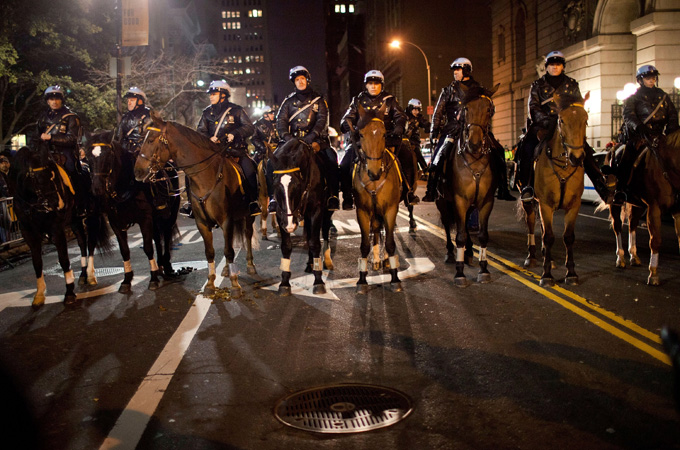
The US Attorney General won a court order to stop the strike, but the union and its leader, Eugene V Debs, refused to quit. President Grover Cleveland, over the objections of Illinois' governor, ordered federal troops to Chicago under the pretense of maintaining public safety. Soldiers fired their bayoneted rifles into the crowd of 5,000, killing 13 strike sympathisers. Seven hundred, including Debs, were arrested. Debs wasn't a socialist before the strike, but he was after. The event radicalised him. “In the gleam of every bayonet and the flash of every rifle,” Debs said later on, “the class struggle was revealed“.
I imagine a similar revelation for the tens of thousands of Americans who participated in last fall's Occupy Wall Street protests. As you know, the movement began in New York City and spread quickly, inspiring activists in the biggest cities and the smallest hamlets. Outraged by the broken promise of the US and inspired by democratic revolts of Egypt and Tunisia, they assembled to protest economic injustice and corrupt corporate power in Washington.
VIDEO Inside Story US 2012 Attacking the Unions
Yet the harder they pushed, the harder they were pushed back – with violence. Protesters met with police wearing body armour, face shields, helmets and batons; police legally undermined Americans' right to assemble freely with “non-lethal” weaponry like tear gas, rubber bullets and sonic grenades. There was no need for the president to call in the army. An army, as Mayor Bloomberg quipped, was already there.
Before Occupy Wall Street, many protesters were middle- and upper-middle class college graduates who could safely assume the constitutional guarantee of their civil liberties. But afterward, not so much. Something like scales fell from their eyes, and when they arose anew, they had been baptised by the fire of political violence.
Continue reading “John Stoehr: Myth of Freedom in Land of the Free”
Saudi Arabia: For the record. European Christian websites have reported Grand Mufti Sheikh Abdulaziz Al al-Shaikh, one of the most influential religious leaders in the Muslim world, issued a fatwa against non-Muslim places of worship last week.
In response to a Kuwaiti lawmaker who asked whether Kuwait could ban church construction in Kuwait, the Sheikh ruled that further church construction should be banned and existing Christian houses of worship should be destroyed.
Comment: Senior European Christian prelates have pointed out the Grand Mufti is contradicting King Abdallah's policy of supporting interfaith dialogue. The King is seeking to build an interfaith center in Austria, taking advantage of freedoms and tolerance not available in Saudi Arabia and most of the Arab world. Foreign Christian minorities make up substantial and significant portions of the working populations of the United Arab Emirates, Qatar, Kuwait, Bahrain, Oman and Yemen.
The Catholic Bishop for the Christians in the UAE, Oman and Yemen warned that some Muslims will be influenced to act on the Grand Mufti's edict. A delayed terrorist reaction against Christian churches is the threat, and has occurred in Iraq and Egypt.
Phi Beta Iota: This is also the best indication that the Assisi Peace Summit sponsored by the Most Holy Father was a clear failure. Although the Pope has done two important pronouncements, one on religion and science both seeking the truth, the second on the cancer of corruption, the Catholic Church — and the various other denominations — lack a coherent strategy for education, intelligence, and research toward inter-faith tolerance. We continue to recommend that an inter-faith campaign against secular corruption be the basis for advances in cultural and spiritual tolerance.
See Also:
