NIGHTWATCH: French with UK Lift & Africans Handle Mali — SOF in Africa at Greater Risk? Islamists and Food Security — Islamists versus Separatists

04 Inter-State Conflict, 05 Civil War, 11 Society, Cultural Intelligence
Click on Image to Enlarge

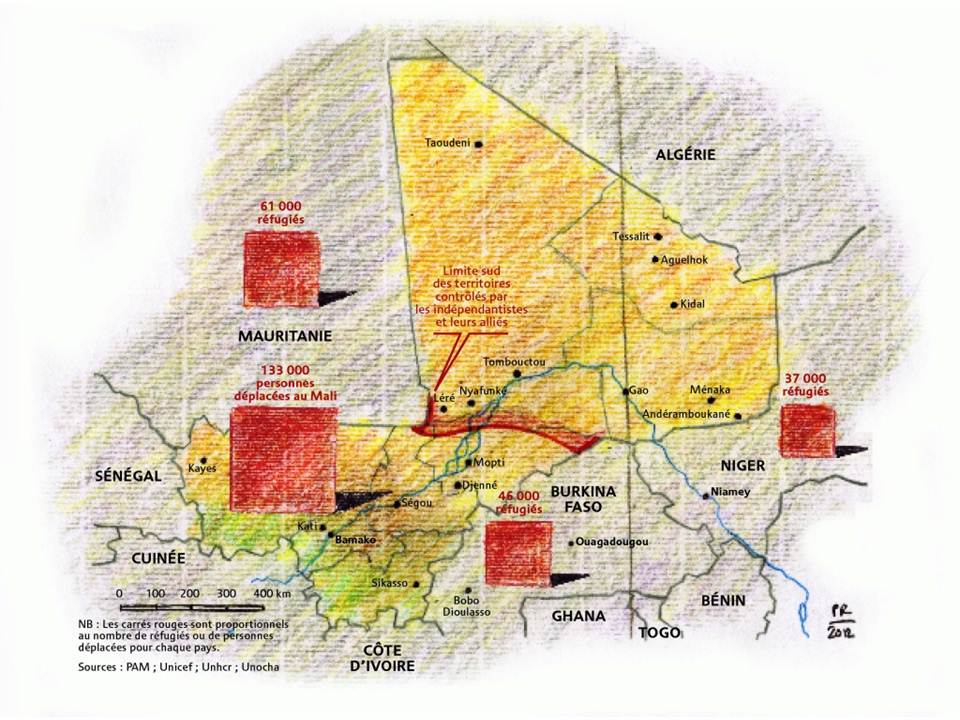
Mali-France: Last Friday, France began its direct intervention in the Malian civil war, at the request of the Bamako government after Islamists, terrorist and jihadis captured a key town on the road from the north to Bamako. The immediate French objective was to stop the jihadis at Konna and to deter them from moving farther south to capture Bamako. Konna had been the boundary between the Islamist and government held regions.

French Rafale fighter jets bombed Islamist rebel targets in central Mali for three days. With French Air Force support, Malian forces – almost certainly with French ground forces –recaptured Konna on Saturday, a day after it was seized by Islamist rebels.

A Malian rebel spokesman said the French also bombed targets in the towns of Gao, Lere and Douentz, over the weekend.

France's Defense Minister Jean-Yves Le Drian said French intervention on Friday had prevented rebels from seizing Bamako itself. He said air raids would continue in the coming days. He also said that France has deployed about 550 soldiers to Mali, split between Bamako and the town of Mopti, 500 km northeast, as part of “Operation Serval” – named after an African wildcat.

The French foreign minister made it clear that France was now targeting Islamist bases in the north of Mali and said Algeria, which shares a long border with Mali, had given permission for its air space to be used for bombing raids “without limit”.

Islamist rebels reportedly were abandoning Timbuktu and other northern towns to try to escape the French air attacks for which they have no defense.

Continue reading “NIGHTWATCH: French with UK Lift & Africans Handle Mali — SOF in Africa at Greater Risk? Islamists and Food Security — Islamists versus Separatists”

Skype with Robert Steele — Individual or Group

Cultural Intelligence
Robert David STEELE Vivas

Individual Skype with Robert $100, Group Skype $250.

You are free to be an entreprenuer, I have no problem addressing a full auditorium you collect $500 or more, donate $250.

My objective is to reach as many as possible across the USA and elsewhere, with a simple message: “the truth at any cost lowers all other costs.”


I will email you a receipt and then we can coordinate directly on timing.

I can speak on any topic across the 98 categories in which I read, and am particularly conscious of the topics covered in the below two lists of lists of books I have reviewed, and of course the discipline of intelligence, which is retarded and corrupt as practiced in the USA.  I also recommend my 6 Star List.

Worth a Look: Book Review Lists (Positive Future-Oriented)

Worth a Look: Book Review Lists (Negative Status-Quo)

Worth a Look: Book Reviews on Intelligence (Most)

6 Star Special (157)

I will say with clarity that I am certain that integrity is coming back into vogue.  Those of us that have been the gold standard for integrity during these dark days will be valued again in the future, and we will reverse the terrible directions imposed on us all by white collar criminals and their self-made political servants.

Available for short and longer-term assignments, globally mobile as a geographic bachelor.  Have brain, will travel.

Who’s Who in Collective Intelligence: Robert David STEELE Vivas

Semper Fidelis,

Robert David STEELE Vivas

See Also:

21st Century Intelligence Core References 2.9

Donate for Books Here Half-Price, Inscription Option

Continue reading “Skype with Robert Steele — Individual or Group”

Theophillis Goodyear: Abstract Wealth Destroying Real Wealth

Cultural Intelligence
Theophillis Goodyear

The Solution is the Systems Perspective—-the Key Component Is Human Compassion—-and Common Sense Tells Us That It's Best to Keep Networks Intact and Change How They Function, Rather Than Destroy Them and Star from Scratch.

Lately I've been thinking about two realities:

1. When the economy crashes, there's no traditional solution to the problem because the scale and complexity of the global interdependence of national currencies is unprecedented.

2. Networks can take a long time to form, so it's generally a bad idea to eliminate them and start from scratch, especially if you try to eliminate all of them at once and start all of them from scratch. That's a recipe for disaster. That's what happened in the Russian Revolution, and look how that turned out. That's what Mao tried to do, and look how that turned out.

So I've been trying to understand this looming crisis from the standpoint of banking, since banks are the institutions that control and manage money. So I'm doing some research so I can understand the problem, when it occurs to me that people who are already in the banking industry could show us all the solution if they had the proper mindset—-the mindset which this blog is devoted to exploring.

If someone in the banking industry could be made to see what you and I can see—-if they could be trained to see humanely, ethically, and holistically, and to start seeing things from the systems perspective and the perspective of complexity—-then they would probably instantly see the solution to the currency and banking problem, because they know the system. And if their creativity was inspired by the same mindset that your creativity and my creativity are inspired by, they could write a better book about it, instantly, than you or I could in a dozen years. And they could see concrete solutions, where you and I would only see abstract solutions.

The Deep Need:

Continue reading “Theophillis Goodyear: Abstract Wealth Destroying Real Wealth”

Chuck Spinney: Arab Spring Act II — Near Enemies Falling First?

Cultural Intelligence, Peace Intelligence
Chuck Spinney
Chuck Spinney

Arab spring, act two

Are the Arab monarchies next?

As the chaotic transition towards democracy continues in North Africa and Yemen, the fighting in Syria is intensifying. And, less noticed, opposition to the Arab monarchies is growing.

by Hicham Ben Abdallah El Alaoui

Le Monde Diplomatique, January 2012

The Arab Spring is not an outcome, it is a process. For those countries at the forefront of regional transformation, the fundamental question is can democracy become institutionalised? Though progress has been uneven and the outcomes of many state-society struggles have yet to be resolved, the answer is a cautious yes. In at least a few countries, we are witnessing the onset of democratic institutionalisation: whether the process of reform and transformation spreads to other parts of the Middle East depends on many factors — religious tensions, political mobilisation, regime adaptations, geopolitics. Meanwhile North Africa provides the most promising preview of the future.

Democratic institutionalisation means the healthy convergence of politics around three arenas of competition: elections, parliaments and constitutions. When these institutions are robust and durable, then the democratic governments they engender are relatively safe from radical groups, reactionary forces and authoritarian backsliding (due to alternation: democracies that uphold the rule of law and hold regular elections require that power alternates between competing parties).

Read full article.

Continue reading “Chuck Spinney: Arab Spring Act II — Near Enemies Falling First?”

Chuck Spinney: Afghan Fraud, Permanent War, VERY Expensive – Robert Steele: $2 Trillion a Year for DoD is Criminally Insane

Commerce, Corruption, Government, Military, Peace Intelligence
Chuck Spinney
Chuck Spinney

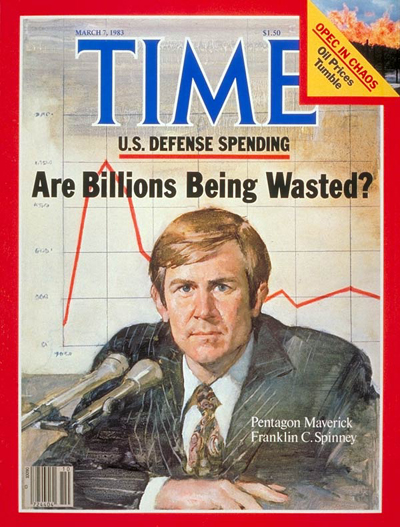
Obama may want out of Afghanistan, but he is under to pressure to stay, and the Military – Industrial – Congressional Complex (MICC) still has a budgetary interest in maintaining perpetual war, be it cold or hot ( for reasons I explained here).

The bloom is off the Karzai rose (as Amy Davidson explained in her 11 Jan New Yorker blog), but when one combines

  • (1) the not-so-zero option explained by Kate Clark  in the very important report attached below, with
  • (2) the no-so-different high-cost plan for waging the American style of high-tech war described by General Barno in Ms. Clark's report (note: contrary to Barno's claim, his is hardly a new idea; in fact, the Pentagon has been flogging this this idea since McNamara's Electronic Line failed so disastrously in Vietnam), and
  •  (3) the possibilities of a new cold war implied by Obama's (really the MICC's) “pivot” to China,
Click on Image to Enlarge
Click on Image to Enlarge $2 T

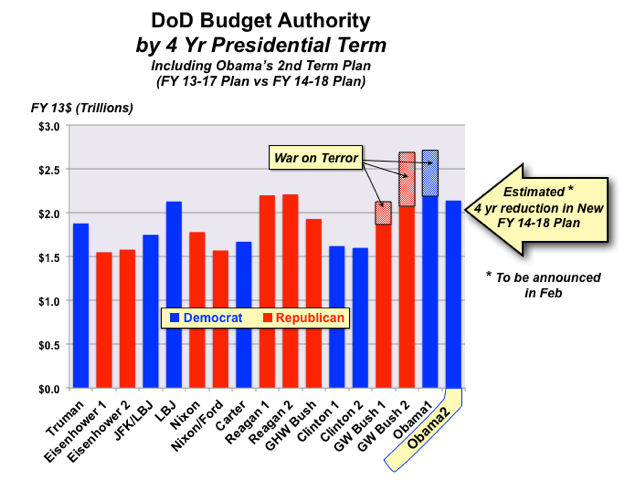
The sum 1+2+3 makes it easy to understand why Obama's new (albeit still unauditable*) budget plan, if executed perfectly, will result in the biggest eight year boom to the defense industry (including foreign military sales) since since the golden years of Ronald Reagan.

And … as indicated this chart (which I explained in latter part of this essay), this measure of the MICC's golden cornucopia would be true out to 2017,* even if a real zero option for the Afghan war and the war on terror, took place tomorrow!

Zero or Zero Plus? US-Afghan negotiations over the war

Presidents Obama and Karzai are due to start the wrangling over their countries’ post-2014 military relationship during the Afghan president’s current visit to Washington. US soldiers, bases, training, equipment, money, immunity all need to be hammered out, although no-one is expecting results just yet. Figures floated in recent days by US government and military officials speak of plans for anything from 20,000 to zero US troops to be left behind after 2014. Talk of the ‘zero option’ on troops might just be a bargaining ploy to put pressure on President Karzai, although as AAN senior analyst, Kate Clark, reports, it needs taking seriously, as does the possibility of a ‘zero plus’ option, ie a full withdrawal of troops which would still leave intelligence agents and military contractors fighting the Taleban. 

Kate Clark, Afghan Analysts Network, 11/01/13

Read full article.

Continue reading “Chuck Spinney: Afghan Fraud, Permanent War, VERY Expensive – Robert Steele: $2 Trillion a Year for DoD is Criminally Insane”

Marcus Aurelius: 2004 Evaluation of Assault Weapons Ban 1994-2003 Bottom Line Irrelevant

Cultural Intelligence
Marcus Aurelius
Marcus Aurelius

Federal Government's assessment of the effectiveness of the ((FIRST)) assault weapons ban. Less than impressive.

2004 NIJ-Assault Weapons Ban Report

Phi Beta Iota:  The US Government lacks a central intelligence (decision-support) agency such as President Harry Truman signed into law.  The Office of Management and Budget (OMB) does not manage and does not have a grip on all relevant information, nor can it use shared decision support to harmonize investments and behaviors across the government — or eradicate the standard 50% waste per federal dollar.

See Also:

Graphic: Top Ten Killers In USA – Guns are LAST

2011 Open Source Agency: Executive Access Point

Michel Bauwens: Economic Value of Nature – Priceless — AND Irreplacable

Earth Intelligence, Resilience
Michel Bauwens
Michel Bauwens

Why the economy needs nature

Nature is not a drag on growth – its protection is an unavoidable prerequisite for sustaining economic development

Tony Juniper

The Guardian, 9 January 2013

One of the greatest misconceptions of our time is the idea that there is somehow a choice between economic development and sustaining nature. The narrative developed by the chancellor, George Osborne, since the 2010 general election provides a case in point. He says environmental goals need to be scaled back to promote more growth.

The reality we inhabit is somewhat different, however. One hundred per cent of economic activity is dependent on the services and benefits provided by nature. For some time, and during the last decade in particular, researchers have investigated the dependence of economic systems on ecological ones, and in the process have generated some striking conclusions. I tell the stories behind their findings in my new book, What has nature ever done for us?

While many mainstream economists suffer from the kind of delusions that make it perfectly rational for them to accept to liquidate natural systems in the pursuit of “growth”, different specialist studies reveal the huge economic value being lost as decisions and policies that are geared to promoting economic activity degrade the services provided by nature.

For example, as we struggle to cut emissions from fossil fuels, one study estimates that the value of the carbon capture services which could be gained through halving the deforestation rate by 2030 is around $3.7 trillion. And the wildlife in the same forests has huge value too – about 50% of the United States' $640bn pharmaceutical market is based on the genetic diversity of wild species, many of which were found in forests. And it's not only the genetic diversity in wildlife that brings economic benefits.

Among other things, wildlife also helps to control pests and diseases. The cost of losing India's vultures has been estimated at $34bn, largely because of the public health costs associated with their demise, including increased rabies infections. The annual pest-control value provided by insectivorous birds in a coffee plantation has been estimated as $310 per hectare while the annual per hectare value added from birds controlling pests in timber-producing forests has been put at $1,500. Great tits predating caterpillars in a Dutch orchard were found to improve the apple harvest by 50%.

The services provided by animals, such as bees, doing the pollination work that underpins about one trillion dollars-worth of agricultural sales has been valued at $190 billion per year.

Read full article.

See Also:

What has nature ever done for us? [Review]

noble gold