WASHINGTON, DC — US Green Party leaders expressed their dismay with the failure of the UN summit in Copenhagen to reach an agreement on international action to curb climate change.
Properly speaking, the Copenhagen dogmata are a farce. In terms of distraction from cleaning up the pollutants that are actually killing people, they are a terrible tragedy.
THE COPENHAGEN Accord arrived at on the weekend is no more a legitimate accord than Pluto is a legitimate planet. At best, it is a statement of intentions or pretensions, not an agreement that will lock the world’s veteran and up-and-coming polluters into fixed orbits.
Despite compromises by countries like India and China over the issue of monitoring review and verification and the US pledging funds for poor countries, there was no agree ment on fundamental issues like the fate of the Kyoto Pro tocol and the Bali Action Plan after Copenhagen.
As I watched the last three days of the Copenhagen Climate Fiasco, I kept thinking of the Tower of Babel. The Copenhagen Summit was the “largest gathering of world leaders in recent history.” It was not, however, unprecedented, still less a “turning point in human nature,” as Colin Blakemore in the Guardian opined. It was, rather, another instance of the human propensity for self-aggrandizement and hubris.
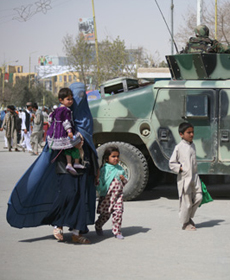
One of the main arguments made by self-proclaimed “liberal humanitarian interventionists” in support of President Obama's escalation of the Afghan War is that a return of the Taliban to power will condemn women to conditions approaching slavery. It is true that women's rights in Afghanistan are almost medieval in character, but the central question of humanitarian intervention is fundamentally one of whether the US escalation will improve things or make matters worse.
The United States has a sorry track record in this regard, and we bear a heavy moral burden for the current state of affairs, including the dismal state of woman's rights.
Chuck Spinney.
Full Story Online
The U.S. intervention has never been and won't become a force for humanitarianism.
ANN FRIEDMAN | December 22, 2009
American Prospect
In the spring of 2008 I wrote a column, “Listening to Iraq,” in which I lamented the lack of access that most Americans had to the voices and opinions of the people most affected by the ongoing war. This made it difficult, I wrote, “for even the best-intentioned anti-war American to see Iraqis as partners, rather than as a political project.”
I was reminded of that column after Obama's speech announcing his Afghanistan strategy, In it, he declared, “For the Afghan people, a return to Taliban rule would condemn their country to brutal governance, international isolation, a paralyzed economy, and the denial of basic human rights to the Afghan people — especially women and girls.” But he made very clear that he does not see our involvement in Afghanistan as a humanitarian mission. As the American left debates, I'm struck by a desire to know what Afghan women, who have been living under the U.S. occupation for roughly eight years now, think would be best for their country.
The Afghan politician and activist Malalai Joya has warned that “Obama's military buildup will only bring more suffering and death to innocent civilians.” Another woman, who goes by the pseudonym Zoya, has appeared in various U.S. media calling for “withdrawal of the troops immediately.” She is a member of the Revolutionary Association of the Women of Afghanistan, a Kabul-based political group that has fought for human rights and social justice since 1977. And Sakena Yacoobi, who founded a network of underground schools for Afghan women and girls, says “most foreign troops are not primarily focused on protecting women and children. Their focus is on beating the enemy, which is very different, and ordinary citizens become collateral damage in the process.” At least Obama and Yacoobi are in agreement: This mission is not about human rights and democracy. It's about defeating an enemy.
Below the Fold: Balance of Spinney Commentary and Links to Relevant Book Reviews
Scott Atran, an anthropologist at the National Center for Scientific Research in Paris, John Jay College and the University of Michigan, is the author of the forthcoming ‘Listen to the Devil.'
Confidence is important, but we also have to recognize that the decision to commit 30,000 more troops to a counterinsurgency effort against a good segment of the Afghan population, with the focus on converting a deeply unpopular and corrupt regime into a unified, centralized state for the first time in that country's history, is far from a slam dunk. In the worst case, the surge may push General McChrystal's ”core goal of defeating Al Qaeda” further away.
What binds these groups together? First is friendship forged through fighting: the Indonesian volunteers who fought the Soviet Union in Afghanistan styled themselves the Afghan Alumni, and many kept in contact when they returned home after the war. The second is school ties and discipleship: many leading operatives in Southeast Asia come from a handful of religious schools affiliated with Jemaah Islamiyah. Out of some 30,000 religious schools in Indonesia, only about 50 have a deadly legacy of producing violent extremists. Third is family ties; as anyone who has watched the opening scene from ”The Godfather” knows, weddings can be terrific opportunities for networking and plotting.
Understanding these three aspects of terrorist networking has given law enforcement a leg up on the jihadists.
In the latest of many shameful lapses, the federal agency in charge of securing the nation’s transportation system approved background checks for a dozen illegal immigrants working in sensitive areas of a busy U.S. airport.
The illegal aliens, from Central America and Mexico, worked in operational areas of Stewart International Airport, a 2,400-acre facility located about 60 miles north of New York City. Stewart is a major passenger airport for the state’s mid-Hudson region that also handles large quantities of cargo and serves as a military field.
The illegal aliens all had security badges approved by the Transportation Security Administration (TSA), the agency created after the 2001 terrorist attacks mainly to protect airlines. The TSA’s national background check failed to detect the fake Social Security numbers and other bogus documents provided by the illegal immigrants to obtain clearance.
So the embattled 43,000-member Homeland Security agency, which has received hundreds of millions of dollars from Congress to fulfill its mission, granted the undocumented aliens “trusted agent” security badges.
Global warming con men hoping to bag windfall profits from the climate change scam are wincing today after carbon trading markets nose dived following the failure at Copenhagen to secure legally binding targets on restricting CO2 emissions.
As criticism of the emissions trading scheme grows bolder after the fractured Copenhagen summit, AGL has labelled the administration of the the renewable energy target a fraud.
Mired in a struggle for money and power, the 2009 Copenhagen Climate Conference collapsed under the weight of its own greed without a substantive agreement. The multi nation participants left the gathering generally unfulfilled and lacking the commitments for additional revenue that had been sought by the poorer countries.
How Osama bin Laden slipped from our grasp: The definitive account.
PeterBergen
I am convinced that Tora Bora constitutes one of the greatest military blunders in recent U.S. history. It is worth revisiting now not just in the interest of historical accuracy, but also because the story contains valuable lessons as we renew our push against Al Qaeda in Afghanistan and Pakistan. Continue reading “Journal: Tora Bora Revisited by Peter Bergen”