Phi Beta Iota: The above requires an honest informed legislature and an honest informed executive, both committed to the public interest. Mike Nelson described the problem in 1994: “1970's technology and 1950's mind-sets struggling with 1990's opportunities.” It has gotten worse, not better. Cyber Commands are retarded — they destroy productivity, do not protect anything at all, and generally cost vastly more than they are worth across multiple forms of accounting.
Fraudsters are surprisingly successful at convincing call centre staff they are someone else, until their voiceprints are compared against the genuine article
I am supporter of Elizabeth Warren; she is one of the few people in the Congress, Bernie Sanders is another, who actually speaks truth to power in a rational way. I hope she is a harbinger of a new trend to end the vampire capitalism which dominates the American economy.
Here is the counter-movement to Warren's socially progressive policies. The Theocratic Right is toxic and dangerous, and very well funded. The following is an excerpt from Crucifying America: the unholy alliance between the Christian Right and Wall Street by CJ Werleman (Dangerous Little Books, 2013).
Phi Beta Iota: The extreme left is stupider and less wealthy. One bird, two wings, same shit. It is time to reject the two-party tyranny and demand electoral reform. Sadly, the smaller parties are if anything, less well endowed and just as challenged morally and intellectually. The independents have not found their voice, in part because they have been subverted and mis-directed by various Bloomberg entities.
The American Gulag grows like tumor in the body of our society, and we are in nearly complete denial. Worse privatization is spreading in the incarceration industry and corporations are requiring 92 per cent occupancy. It is not that way in every country. In Sweden, for instance, things are going in the opposite, and healthier, direction. Why isn't this happening here?
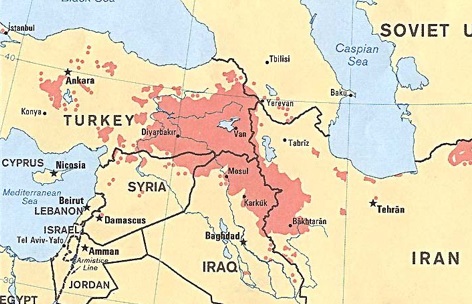
The below Reuters report describes one of the emerging regional complexities being unleashed by the Syrian civil war. At issue is Syria's Kurdish Question — yet another legacy of the dissolution of the Ottoman Empire that continues to haunt the Middle East and the world after almost 100 years. President Wilson's reckless promises of nationhood to all minorities in his 14 Points were not fulfilled by the machinations and back room deals of the Versailles Peace Conference in 1919. Today the Kurds, with a population of about 25 million, are the world's largest ethnic group without a state. But this population sits astride the modern borders Turkey, Iraq, Iran, and Syria, as the map below shows. And so, the Kurdish Question is grounded in the tectonic fault lines of (1) Turkish-Arab-Persian-Kurdish cultures, (2) the shared Fertile Crescent water resources of the Tigris/Euphrates watershed, (3) the larger Sunni-Shia religious schism (most Kurds are Sunni, but some Kurds in Iran are Shia), (4) the wealth and poverty of the northern tier of the Persian Gulf oil basin, and (5) the toxic legacy of Western colonialism (including the Israeli poison pill inserted into the region by an opportunistic then guilt ridden West). In recent years, most of the world's attention has been focused on the Kurdish subquestions in Turkey and Iraq, and to a lesser extent in Iran (don't forget the US sellout of the Iraqi Kurds with the help of the Shah of Iran, who had his own Kurdish problem), while Syria's Kurds have been the most forgotten of these minority questions — but as the attached report shows, the Syrian civil war has unleashed a new dimension to active Kurdish separatism that greatly complicates an already complicated regional situation.
(Reuters) – With a string of military gains across northeastern Syria, a Kurdish militia is solidifying a geographic and political presence in the war-torn country, posing a dilemma for regional powers.
Long oppressed under Syrian President Bashar al-Assad and his father before him, Kurds view the civil war as an opportunity to gain the kind of autonomy enjoyed by their ethnic kin in neighboring Iraq.
But their offensive has stirred mixed feelings, globally, regionally and locally, even among some fellow Kurds, who say the Kurdish fighters have drifted into a regional axis supporting Assad, something they deny.
How do you grow vegetables in arid areas? Reverse the trend of desertification, the Sahara Forest Project proposes.
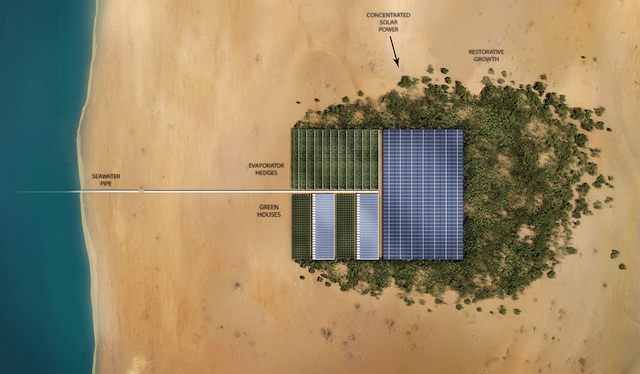
The project combines existing technologies — such as the evaporation of saltwater to create fresh water along with solar thermal energy tech — to utilize what we have (saltwater, CO2) to produce what we need (food, fresh water and energy).
This week, the project, which is supported by fertilizer companies, reached a milestone. Its Qatar pilot plant produced 75 kilograms of crops (like cucumbers) per square meter annually while consuming only sunlight and seawater, Science reports. That’s comparable to commercial farms in Europe.
At the center of the project is a saltwater-cooled greenhouse, Science explains:
At one end, salt water is trickled over a gridlike curtain so that the prevailing wind blows the resulting cool, moist air over the plants inside. This cooling effect allowed the Qatar facility to grow three crops per year, even in the scorching summer. At the other end of the greenhouse is a network of pipes with cold seawater running through them. Some of the moisture in the air condenses on the pipes and is collected, providing a source of fresh water.
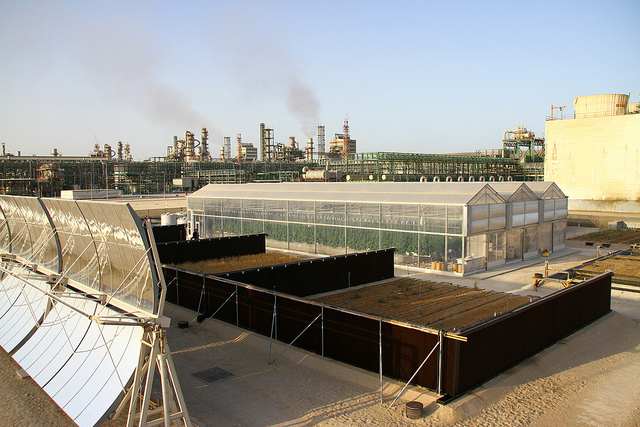
One surprising side effect is how the cool, moist air that was leaking out encouraged plants to grow spontaneously outside. By reducing exterior air temperatures with “evaporator hedges” (pictured), the plant was able to grow crops like barley and salad rocket (arugula), along with useful desert plants around the seawater greenhouse.
Another key element of the facility is the concentrated solar power plant:
This uses mirrors in the shape of a parabolic trough to heat a fluid flowing through a pipe at its focus. The heated fluid then boils water, and the steam drives a turbine to generate power. Hence, the plant has electricity to run its control systems and pumps and can use any excess to desalinate water for irrigating the plants.
The project has also experimented with culturing heat-tolerant algae, growing salt-tolerant grasses for fodder or biofuel, and evaporating the concentrated saline the plant emits to produce salt, Science reports.
The Qatar plant is 1 hectare with 600 square meters of growing area inside. Next up: a 20-hectare test facility near Aqaba, Jordan.
Freedom of Speech – Zacqary Adam Green: “What is everyone complaining about? This is a free service, and [large corporation] can do whatever they want with it!” That’s true. Also wrong. Please stop saying it.
There’s always outrage whenever a popular online service like YouTube, Google, Facebook, Twitter, Tumblr, Flickr, or Whatevr makes some kind of unpopular change, or when unscrupulous business practices come to light. And in return, there’s always outrage at the outrage. “The service is free,” they say, “and it’s owned by a private company. Go use something else if you don’t like it.”
This is usually code for “I disagree with your complaint, and I get insecure and anxious when people have opinions that aren’t mine, because it reminds me of how alone I am in the universe. Therefore I am lashing out rather than attempting to explore my capacity for empathy.” It’s also a pretty weak argument.