Penguin: Our Oath to the Constitution — and Our Failure to Honor that Oath…

Cultural Intelligence, Ethics, Government, Military, Peace Intelligence
Who, Me?
Who, Me?

The old guard, with a touch of guilt and and what remains of integrity, is trying to call a halt to the rape of the Army. The neo-con dead-enders and Obamites feel their wings getting clipped and are enlisting the Barnos to sharpen their beaks.

U.S. war decisions rightfully belong to elected civilian leaders, not the military

By David W. Barno,September 12, 2013

David W. Barno, a retired Army lieutenant general, is a senior adviser and senior fellow at the Center for a New American Security. He commanded U.S. and coalition forces in Afghanistan from 2003 to 2005.

A war the Pentagon doesn’t want

By Robert H. Scales,September 05, 2013

Robert H. Scales, a retired Army major general, is a former commandant of the U.S. Army War College.

Continue reading “Penguin: Our Oath to the Constitution — and Our Failure to Honor that Oath…”

Marcus Aurelius: US Effectiveness in Providing Security and Emergency Relief to Diplomatic Facilities

Peace Intelligence
Marcus Aurelius
Marcus Aurelius

FYI.  Includes Benghazi.

PDF (149 Pages): (U) Responding to Diplomatic Security Needs & Crises

EXTRACTS:

As a result of several gaps in reporting by the DOS and modifications to the Department’s reporting criteria, the researcher was unable to obtain the total number of attacks that targeted U.S. missions between 1979 and 2012.

. . . . . . .

This thesis detailed the general security environment within Tehran, Islamabad, Beirut, Nairobi, Dar es Salaam, Jeddah, Damascus, Sana’a, and Benghazi at the time the U.S. diplomatic missions located in those cities were attacked. Particularly relevant to this thesis were the details that made it possible to assess the receiving nation’s capability and willingness to protect the U.S. mission in their country when it was attacked; factors that this thesis has revealed to be key to the outcome of an attack being significantly more positive. Regarding the U.S. Government’s response to attacks on its diplomatic missions, the researcher noted three themes of particular concern: (1) inadequate existing DOS physical security standards, (2) inadequate funding in the DOS budget, and (3) inadequate consideration of site selection for diplomatic missions.

Winslow Wheeler: US Military is NOT the Best in the World…

Cultural Intelligence, Peace Intelligence
Winslow Wheeler
Winslow Wheeler

As Congress bumbles on with 2014 budget limits and appropriations, the narrative of American armed forces as “the best in the world” continues as the de rigueur and foppish test of patriotism at House Armed Services Committee hearings. Being what passes for “pro defense” requires blindness, and lots of money, in the current political system we endure.

In a second article on the less than first rate performance of the US military and the high cost/lesser performance of some of its most vaunted equipment, author Roger Thompson addresses the the training and hardware of the US submarine force. Congress is blind to the problems, but others are not. Find this article at http://www.pogo.org/our-work/straus-military-reform-project/weapons/2013/take-her-deep-reforming-the-us-silent-service.html.

Second article? Find the first, on pilot training and aircraft at http://www.pogo.org/our-work/straus-military-reform-project/military-reform/2013/reforming-americas-overhyped-airpower.html.

Continue reading “Winslow Wheeler: US Military is NOT the Best in the World…”

NIGHTWATCH: Pakistan is NOT Talking to the Taliban (Yet) — Misleading the International Community

08 Wild Cards, Government, Peace Intelligence

Pakistan: Update. Prime Minister Sharif said Thursday that talks with the Pakistani Taliban have started. He provided no details, however, on participants, venues or agendas. Sharif's comments came during a meeting in London with the British deputy prime minister and were released in a statement by the Pakistani High Commission.

Interior Minister Chaudhry Nisar Ali Khan, briefing Pakistani lawmakers Thursday, said details of the agenda and the location of government-Taliban talks are being finalized.

Comment: Sharif's assurances to his foreign audiences seem ahead of the facts told his domestic audiences. Talks are not yet taking place, mainly because the Pakistani Taliban have not agreed to them. That is the message of the Interior Minister.

Gordon Duff: Energy Used to Create and Dissipate Typhoons

Advanced Cyber/IO, Earth Intelligence, Peace Intelligence
Gordon Duff
Gordon Duff

Mysterious Energy Pulse Threatens Typhoon “Business”

By Gordon Duff, Senior Editor

This week, one typhoon and one tropical storm simply vanished while heading toward Japan.  They were abruptly turned northward, sparing Japan and then simply vanished.

The MSM has responded with a news blackout.  There are no explanations.
YouTube – Veterans Today –

Days before, the events were predicted in an article on Veterans Today, citing plans by a defense group to use a Tesla based energy system to disrupt the storms.

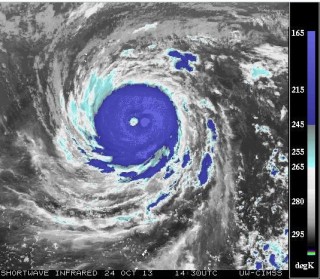
Majestic Super Typhoon LEKIMA. SW-IR satellite image recorded at 14:30UTC on October 24, 2013. Temperature of the patch located to the right of the typhoon’s eye measures about 150ºK (< minus 123ºC) making it the coldest place on or near planet Earth. Image sourced from: CIMSS/SSEC/WISC.

The website announced in advance when they were beginning operations and reported results as things transpired.

As to whether they were successful or that the two storms mysteriously disappeared, a freak of nature, will never be proven.

The group announced they are willing and able to cause another mysterious freak of nature when needed.

SmartPlanet: 10 Best Places to do business…

Commercial Intelligence, Cultural Intelligence, Peace Intelligence

smartplanet logoTop 10 best and worst places to do business

By | October 29, 2013

If you’re a small or mid-sized business it will be easiest to do business if you’re based in Asia — places like Singapore, Hong Kong, and Malaysia.

A new report from the World Bank, says that Asia has about half of the top economies in the world for their ease of doing business. The report ranks 189 world economies based on 11 indicators for how easy it is to start a small or mid-sized business, from access to credit and electricity to ease of employing workers to ability to trade across borders.

“A better business climate that enables entrepreneurs to build their businesses and reinvest in their communities is key to local and global economic growth,” said World Bank Group President Jim Yong Kim. “Doing Business shows that economies with better business regulations are more likely to empower local entrepreneurs to create more jobs – another step in the right direction toward ending extreme poverty by 2030.”

Here are the report’s 10 most business-friendly economies in the world:

Continue reading “SmartPlanet: 10 Best Places to do business…”

Marcus Aurelius: CSA Interview + AWC SSI Reminder — Answers from the 1990’s Long Ignored…

Ethics, Military, Officers Call, Peace Intelligence, Strategy
Marcus Aurelius
Marcus Aurelius

PDF (1 Page): (U) CSA Interview (Defense News, 28Oct13)-1

Interview

GEN. RAY ODIERNO

US Army Chief of Staff

Defense News 10/28/2013

Click on Image to Enlarge

At last week’s Association of the United States Army annual meeting and exposition in Washington, thousands gathered to hear senior leaders explain where the service is headed in this era of austerity. And the message from Gen. Ray Odierno, Army chief of staff, was one of frustration with uncertain budgets and automatic and inflexible defense cuts that are gutting readiness, with only two of his brigades ready for combat. The Army has been cutting personnel at a breakneck pace to save as much money as possible, given additional budget cuts are likely.

The Army is headed from a force of 570,000 soldiers, just a few years ago, down to 490,000. That number could get smaller, given sequestration is likely to continue and deeper reductions are expected over the coming months as part of a broader debt and spending deal.

Q. What is the real impact of past and future budget cuts on the force? Why are you so alarmed? And what is the way out of it?

Continue reading “Marcus Aurelius: CSA Interview + AWC SSI Reminder — Answers from the 1990's Long Ignored…”

noble gold