Berto Jongman: US Spends 7.4 Billion a Year on Bio-Defense, to Zero Effect

07 Health, Commerce, Corruption, Earth Intelligence, Government, Ineptitude
Berto Jongman
Berto Jongman

Bio-Terror & Infectious Disease Outbreak: Detection Technologies and Global Markets – 2012 Edition

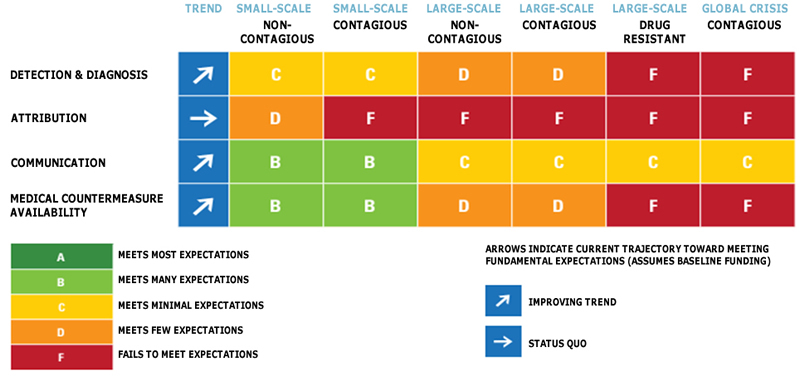
The US Bipartisan Bio-Detection 2011 Report Card Status Evaluation
(Source: The US Bipartisan WMD Terrorism Research Center, October 2011 Bio Response Report Card)

Events of the recent decade confirm that the threats of bio-terrorism and infectious disease outbreaks are real. Attacks such as the 2001 Anthrax scare, the 2004 Ricin letters, the 2003 SARS and 2009 H1N1 outbreaks have driven governments to increase their bio-surveillance budgets. Public healthcare and HLS agencies' urgent need to establish an early and reliable bio-surveillance detection infrastructure will drive the market onto a much higher trajectory than ever before. We forecast that the cumulative 2012-2016 market (including: systems sale, consumables, upgrades and service) will reach $22.8 billion.
Click on Image to Enlarge

The recent year that saw the seventh review round of the Biological and Toxic Weapons Convention, demonstrated that demand for biosecurity remains high. As developed countries continue to refine their organizational and technological approach to potential bio-terror and disease outbreak threats, many key emerging markets are also ramping up programs to acquire solutions that provide early outbreak-attack detection. These will require the shortening of bio-attack alarm response time and the proliferation of 3rd generation cost-effective bio-detection technologies and reagent-less detection assays.

In contrast to the US colossal spending of $67 billion on biodefense programs during the 2001-2011 period, the US bipartisan WMD Terror Response Center report card (September 2011) graded the world's leading “US bio-detection and attribution programs” as the Achilles heel of the US BioWatch program. It received a score ranging from “meets minimal expectations” to a catastrophic “fails to meet expectations” (see table above). It stated that “Although naturally occurring disease remains a serious threat, a thinking enemy armed with these same pathogens, or with multi–drug resistant or synthetically   engineered pathogens could produce catastrophic consequences“.

Over the next five years, we forecast that, led by the US, Germany, France, China, Japan and India, the global bio-detection market (including systems sale, service, upgrades and consumables) will reach $5.6 billion by 2016.

Continue reading “Berto Jongman: US Spends 7.4 Billion a Year on Bio-Defense, to Zero Effect”
Berto Jongman: US to Fund Rare Earths Institute — Doing the Wrong Thing Righter Once Again

Academia, Commerce, Corruption, Earth Intelligence, Government, Ineptitude
Berto Jongman
Berto Jongman

US to build $120m rare earth research institute

By Katia Moskvitch

BBC News, 11 January 2012

The US Department of Energy is giving $120m (£75m) to set up a new research centre charged with developing new methods of rare earth production.

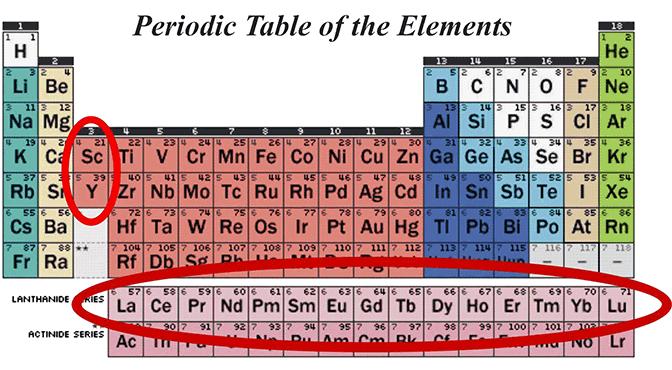
Rare earths are 17 chemically similar elements crucial to making many hi-tech products, such as phones and PCs.

Click on Image to Enlarge

The Critical Materials Institute will be located in Ames, Iowa.

The US wants to reduce its dependency on China, which produces more than 95% of the world's rare earth elements, and address local shortages.

According to the US Geological Survey, there may be deposits of rare earths in 14 US states.

Besides being used for hi-tech gadgets, the elements are also crucial for manufacturing low-carbon resources such as wind turbines, solar panels and electric cars, said David Danielson, the US assistant secretary for renewable energy.

“The Critical Materials Institute will bring together the best and brightest research minds from universities, national laboratories and the private sector to find innovative technology solutions that will help us avoid a supply shortage that would threaten our clean energy industry as well as our security interests,” he said in a statement.

Rare earth elements are also used for military applications, such as advanced optics technologies, radar and radiation detection equipment, and advanced communications systems, according to a 2011 research report by the US Government Accountability Office.

Recycling issue

Read full article

Phi Beta Iota:  An Open Source Agency (OSA) at IOC $125M and FOC $3B, would be a vastly better investment.  Once again pork finds a home and a new stove-pipe is being built.

See Also:

21st Century Intelligence Core References 2.9

Rare earths

Continue reading “Berto Jongman: US to Fund Rare Earths Institute — Doing the Wrong Thing Righter Once Again”

Yoda: South Korea Slams Google Evil in Privacy Violations

Commerce, Corruption, IO Impotency
Got Crowd? BE the Force!

Korean DPA Faults Google's TOS Changes: Global Privacy Implications?

By  Graham Greenleaf, Whon-il Park (Privacy Laws & Business International Report, Issue 119: 22-25, October 2012)

Abstract:

The first decision of Korea’s Personal Information Protection Commission (PIPC) has borne out the perception that Korea’s new Personal Information Protection Act (PIP Act) is ‘Asia’s toughest data privacy law’ (Greenleaf and Park, Privacy Laws & Business International Report, Issue 117: 1, available at http://ssrn.com/abstract=2120983). The PIPC has decided that Google’s changes to the Terms of Service (TOS) of over 60 of its services, unifying them in a single TOS, may be in breach of various provisions of the Act.

Google’s TOS changes are considered by the Commission to likely to breach these laws in three ways: (i) they do not specify the purpose of collection clearly enough, and cannot comply with the requirement that personal information may only be collected and used to the minimum extent necessary for the purpose for which it is collected; (ii) they do not comply with the requirement that where personal information is to be used for purposes other than the purpose for which it was collected, it is necessary to obtain additional consents for such uses; and (iii) they do not specify that that personal information will be erased immediately upon the expiration of its retention period or on request from a data subject.

This article analyses this decision, considering the PIPC’s reasoning, and the terms of the Korean legislation, in order to determine whether the PIPC’s findings (and the potential remedial action) are a result of features which are unique to the Korean law, or are they features which are common to at least some other countries’ data privacy laws.

Read full paper.

Continue reading “Yoda: South Korea Slams Google Evil in Privacy Violations”

Rickard Falkvinge: Nokia (Microsoft) Wire Tapped All of Its Own Encrypted Cell Phones Including Bank Transfer Information

03 Economy, 09 Justice, 10 Security, 11 Society, Commerce, Corruption, IO Impotency, Officers Call
Rickard Falkvinge
Rickard Falkvinge

Death Twitches: Nokia Caught Wiretapping Encrypted Traffic from Its Handsets

Nokia, the cellphone manufacturer, has been listening in to all encrypted communications from its handsets. Every connection advertised as secure – banking, social networks, dating, corporate secrets – has been covertly wiretapped by Nokia themselves and decrypted for analysis.

Security researcher Gaurang posted an article on January 5 about some unexpected behavior with their Nokia handset. It would appear that the browser traffic from the handset would get diverted through Nokia’s servers.

Then, a followup article on January 9 dropped the bomb, and the article goes into quite technical detail: It wasn’t enough that Nokia diverted all traffic from its handsets through its own servers, it also decrypted the encrypted traffic, re-encrypting it before passing it on, issuing HTTPS certificates on the fly that the Nokia phone has been instructed to trust as secure.

This means that Nokia has deliberately been wiretapping all traffic that has been advertised as encrypted on Nokia handsets – including but not limited to banking, dating, credit card numbers, and corporate secrets – and looking at your secrets in cleartext.

This means that Nokia puts itself between your bank and you, and presents itself as YourBank, Inc. to your phone. This wouldn’t normally be possible, if it weren’t for the fact that the phone had been specifically designed for this deceptive behavior, by installing a Nokia signing certificate on the phone.

Nokia has confirmed this behavior in correspondence with TechWeek Europe (my highlights):

Read full article.

SmartPlanet: Half of All Food Wasted

01 Agriculture, 03 Economy, 06 Family, 07 Health, 09 Justice, 11 Society, Commerce, Corruption, Government, Idiocy

smartplanet logoHalf of all food wasted

By | January 10, 2013

The world throws away up to half of its food according to an alarming report that blames consumers’ fussy preference for cosmetically appealing produce, supermarket promotions that encourage overbuying, and deficient storage, transportation and agricultural practices.

Between 1.2 billion and 2 billion metric tons of food – out of the 4 billion produced annually – never reaches a human stomach, the UK’s Institution of Mechanical Engineers says in Waste Not Want Not – Global Food Waste: Feeding the 9 billion.

“The amount of food wasted and lost around the world is staggering,” says Tim Fox, IME’s head of energy and environment. “This is food that could be used to feed the world’s growing population – as well as those in hunger today. It is also an unnecessary waste of the land, water and energy resources that were used in the production, processing and distribution of this food.

“The reasons for this situation range from poor engineering and agricultural practices, inadequate transport and storage infrastructure through to supermarkets demanding cosmetically perfect foodstuffs and encouraging consumers to overbuy through buy-one-get-one-free offers.”

Continue reading “SmartPlanet: Half of All Food Wasted”

Marcus Aurelius: The Four Business Gangs That Run (Loot) the US + 4 Books

Commerce, Corruption, Government, Military
Marcus Aurelius
Marcus Aurelius

The four business gangs that run the US

Ross Gittins

Sydney Herald, December 31, 2012

IF YOU'VE ever suspected politics is increasingly being run in the interests of big business, I have news: Jeffrey Sachs, a highly respected economist from Columbia University, agrees with you – at least in respect of the United States.

In his book, The Price of Civilisation, he says the US economy is caught in a feedback loop. ”Corporate wealth translates into political power through campaign financing, corporate lobbying and the revolving door of jobs between government and industry; and political power translates into further wealth through tax cuts, deregulation and sweetheart contracts between government and industry. Wealth begets power, and power begets wealth,” he says.

Sachs says four key sectors of US business exemplify this feedback loop and the takeover of political power in America by the ”corporatocracy”.

First is the well-known military-industrial complex. ”As [President] Eisenhower famously warned in his farewell address in January 1961, the linkage of the military and private industry created a political power so pervasive that America has been condemned to militarisation, useless wars and fiscal waste on a scale of many tens of trillions of dollars since then,” he says.

Second is the Wall Street-Washington complex, which has steered the financial system towards control by a few politically powerful Wall Street firms, notably Goldman Sachs, JPMorgan Chase, Citigroup, Morgan Stanley and a handful of other financial firms.

Continue reading “Marcus Aurelius: The Four Business Gangs That Run (Loot) the US + 4 Books”

Matt Taibbi: Lies of the Bailout — US Government Ponzi Scheme

Commerce, Corruption, Government
Matt Taibbi
Matt Taibbi

Secret and Lies of the Bailout

The federal rescue of Wall Street didn’t fix the economy – it created a permanent bailout state based on a Ponzi-like confidence scheme. And the worst may be yet to come

Matt Taibbi

Rolling Stone, 17 January 2013

It has been four long winters since the federal government, in the hulking, shaven-skulled, Alien Nation-esque form of then-Treasury Secretary Hank Paulson, committed $700 billion in taxpayer money to rescue Wall Street from its own chicanery and greed. To listen to the bankers and their allies in Washington tell it, you'd think the bailout was the best thing to hit the American economy since the invention of the assembly line. Not only did it prevent another Great Depression, we've been told, but the money has all been paid back, and the government even made a profit. No harm, no foul – right?

Wrong.

It was all a lie – one of the biggest and most elaborate falsehoods ever sold to the American people. We were told that the taxpayer was stepping in – only temporarily, mind you – to prop up the economy and save the world from financial catastrophe. What we actually ended up doing was the exact opposite: committing American taxpayers to permanent, blind support of an ungovernable, unregulatable, hyperconcentrated new financial system that exacerbates the greed and inequality that caused the crash, and forces Wall Street banks like Goldman Sachs and Citigroup to increase risk rather than reduce it. The result is one of those deals where one wrong decision early on blossoms into a lush nightmare of unintended consequences. We thought we were just letting a friend crash at the house for a few days; we ended up with a family of hillbillies who moved in forever, sleeping nine to a bed and building a meth lab on the front lawn.

CONCLUSION:

Continue reading “Matt Taibbi: Lies of the Bailout — US Government Ponzi Scheme”

noble gold