Nuclear energy is clearest example we have of profit for the few trumping the wellbeing of the many. There is no need for this technology. When its true costs are calculated it is absurdly expensive and, nothing about it is unique except its exceptional danger and toxicity. Logically this technology should have been abandoned with the end of the cold war. But ! zombie-like it endures.
According to reports from plane-spotters, Israel has an identical Malaysia Airlines Boeing 777-200 in storage in Tel Aviv since November 2013. The only visible difference between the missing plane and the one in Tel Aviv would be its serial number. What do the Israelis have planned with the twin Malaysia Airlines plane?
A little publicity might stop any nefarious plans they may have.
Click on Image to Enlarge
Are the Israelis Planning Another 9-11 Using the Missing Boeing 777?
Why would Israel have a plane identical to the missing Malaysia Airlines plane in storage in Tel Aviv? The plane in this photo is Boeing 777 2H6(ER) – 28416/155, an identical twin of the missing plane, which has been in Israel since November 2013. What are the Israelis doing with this plane in a hanger in Tel Aviv? Could it be part of a false-flag terror plot in the making? Where is this plane today?
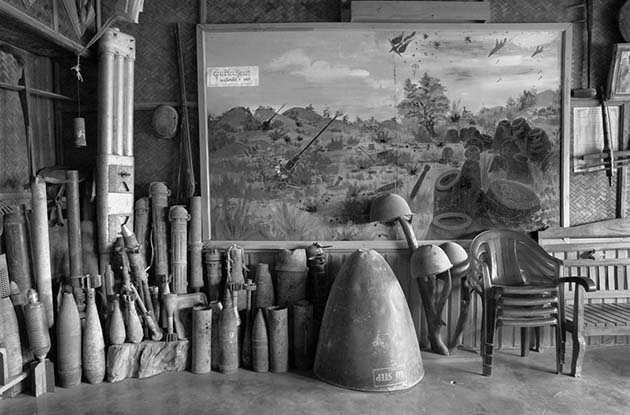
Between 1964 and 1973, the United States dropped around 2.5 million tons of bombs on Laos. While the American public was focused on the war in neighboring Vietnam, the US military was waging a devastating covert campaign to cut off North Vietnamese supply lines through the small Southeast Asian country.
The nearly 600,000 bombing runs delivered a staggering amount of explosives: The equivalent of a planeload of bombs every eight minutes for nine years, or a ton of bombs for every personin the country—more than what American planes unloaded on Germany and Japan combined during World War II. Laos remains, per capita, the most heavily bombed country on earth.
The map above, created by photographer Jerry Redfern, provides another view of the massive scale of the bombing. Each point on the map corresponds to one US bombing mission starting in October 1965; multiple planes often flew on missions.
Click on Image to Enlarge
The unfinished aftermath of the air campaign is the subject of Redfern and Karen Coates' new book, Eternal Harvest: The Legacy of American Bombs in Laos. This stunning book, seven years in the making, documents how the secret air war is still claiming lives more than four decades after it ended.
More than 100 Laotians fall victim to unexploded cluster bombs annually, delayed casualties of Operation Barrel Roll and Operation Steel Tiger, which dropped 270 million cluster bomblets. Packed by the dozens or hundreds in canisters, cluster bombs are designed to open in midair, scattering small explosives across a wide radius. Yet not all of them detonated, and today, 80 million live bomblets lurk under Laos' soil.
Cleaning up the unexploded ordnance (UXO) has been agonizingly slow. In January, Congress approved $12 million for UXO clearance and related aid in Laos. In comparison, the bombing cost the United States spent $17 milliona day in inflation-adjusted dollars.
Below, a selection of Redfern's photographs from Eternal Harvest. Learn more about his and Coates' work at their website.
I know that the article “Sinkhole of Bureaucracy” is an example of a single case example. Nevertheless, the write up tickled my funny bone. With fancy technology, USA.gov, and the hyper modern content processing systems used in many Federal agencies, reality is stranger than science fiction.
This passage snagged my attention:
inside the caverns of an old Pennsylvania limestone mine, there are 600 employees of the Office of Personnel Management. Their task is nothing top-secret. It is to process the retirement papers of the government’s own workers. But that system has a spectacular flaw. It still must be done entirely by hand, and almost entirely on paper.
One of President Obama’s advisors is quote as describing the manual operation as “that crazy cave.”
Bottom Line: Peter Dale Scott gets it right. The “deep state” consists of individuals across all elements within and external to the government, who in the aggregate are able to leverage government capabilities while violating, with impunity, all Constitutional checks and balances. Related to this is the matter of funding and reach — if you follow the money, where do you end up? From New York banks to Texas energy to global drugs, there is a criminal network that is above the law and above the state.
The indicators invented in the twentieth century were among the most important innovations of their time. But in a world where anyone with a smartphone can access more data than a team of statisticians could in 1950, governments, businesses, and individuals must embrace the power to design their own bespoke indicators. The questions need to be specific, and the answers must take into account the limits of any data. But the result would be a welcome liberation from abstract and misleading notions about the economy.
Minsky had a theory, the “financial instability hypothesis”, arguing that lending goes through three distinct stages. He dubbed these the Hedge, the Speculative and the Ponzi stages, after financial fraudster Charles Ponzi. In the first stage, soon after a crisis, banks and borrowers are cautious. Loans are made in modest amounts and the borrower can afford to repay both the initial principal and the interest. As confidence rises banks begin to make loans in which the borrower can only afford to pay the interest. Usually this loan is against an asset which is rising in value. Finally, when the previous crisis is a distant memory, we reach the final stage – Ponzi finance. At this point banks make loans to firms and households that can afford to pay neither the interest nor the principal. Again this is underpinned by a belief that asset prices will rise.
In Crimea, Russia May Have Gotten a Jump on West by Evading U.S. Eavesdropping
EXTRACTS:
U.S. military satellites spied Russian troops amassing within striking distance of Crimea last month. But intelligence analysts were surprised because they hadn't intercepted any telltale communications where Russian leaders, military commanders or soldiers discussed plans to invade.