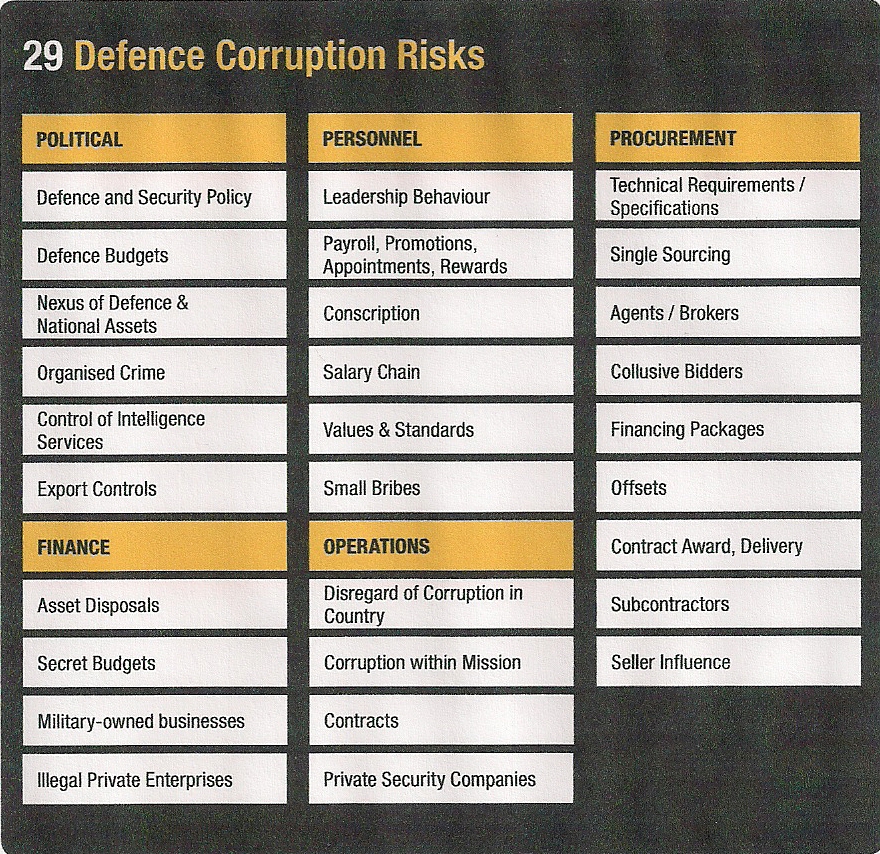
Phi Beta Iota: A good first effort but spectacularly off on the USA and completely lacking in total life cycle costs and in operational test & evaluation — most systems cost far more than they should, do not work as advertised, have huge logistics tails and intelligence needs that are rarely met, and so on. A good start, a long way to go.
This Government Defence Anti-Corruption Index is the first ever review of corruption risk and corruption vulnerability in Defence Ministries and Armed Forces. It offers governments, armed forces, civil society organisations, and citizens detailed knowledge and understanding of the corruption risks in their national defence and security establishments. This Index is novel, as it is open to governments providing information and reviewing results. We have been encouraged by how many governments have provided input, and welcome further engagement to help us correct inaccuracies in the research, and work with us to develop reform plans. There are many countries whose defence ministry remains secretive and closed, and where it can be dangerous even to ask questions about corruption. Bringing transparency to this sector, and accountability to citizens, is another main purpose of this Index. Many of these countries are important players on the world stage, and major exporters and importers of arms. It is to the benefit of the whole world that they be more open and accountable
about their defence establishments.
As Esam Al-Amin explained here, Mohamad Morsi made some colossal blunders during his one year rule of Egypt, as its democratically elected president. He was elected in what most observers regard as a reasonably fair election.
But the exclusive report by Al Jazeera (also attached below) reveals that the United States — which claims to support democracy in the Middle East and elsewhere — has been actively involved in bankrolling Morsi's opposition, and in so doing has continued its long policy of subverting Islamist democratic victories when they win fair elections (Hamas in 2006) or threaten to win fair elections (Algeria 1991).
Al Jazeera reveals how stark contradictions continue to rip through the three legs of the moral triangle that is US foreign policy — i.e., the contradictions between (1) the values we profess to to the world that we uphold, (2) the values we actually hold as demonstrated by our actions abroad as well as at home (don't forget the neo-fascist, non-accountable, hidden hand the emerging American deep state exemplified by the NSA scandal) and (3) the world we have to deal with deal with (in this case epitomized by the changing conditions of the Arab Spring).
Below is a translation from As-Safir, a Lebanese newspaper, July 6, 2013, by Arabic-English translator Eric Mueller. As the translator was not present at the Group of Eight meeting, he cannot vouch for the accuracy of the report, only for the accuracy of the translation. The report by Dawud Rimal does reflect Putin's no-nonsense manner of speaking. The report from As-Safir contrasts with the US coverage.
Diplomatic sources: Putin tells G8 “You want Asad to resign. Look at the leaders you've made in the Middle East.”
Long time financial management reporter Scot Paltrow and his colleague Kelly Carr have written a series, now beginning to appear at Reuters, on the incredible, continuing story of the Pentagon's gross incompetence in managing its own books. The first two pieces of the series follows. The first article is long, but I urge you to read every word. If you think financial management is a green eyeshade-only subject or if you think the Pentagon is making a meaningful, or even good faith, effort at fixing the problem, read on. The anecdotes and the callous DOD incompetence are truly magnetic.
In the story, the Pentagon's CFO (Comptroller Robert Hale) is quoted saying, “We’re not out to screw our own people. The military pay system is just very complex.” He should have added: “But we do sit around and let it happen. We think we have more important things to do”
Indeed, it has been happening since the early 1990s when Congress passed legislation to require DOD to fix all this–legislation that DOD purposefully circumvents.
Today, DOD asserts it has a plan to fix all this: in 2014 it will produce an “audit ready” statement of budgetary resources and by 2017 (close to three decades after the original legislative direction) it will produce an audit of assets. However, it has already been made pretty clear DOD will blow, yet again, the first deadline, and in fact neither of those all too modest goals would fix the horrendous problems that Paltrow and Carr describe below.
After decades of banal rhetoric from Capitol Hill and cynical excuses from DOD, what could possibly fix this? Perhaps these people need some incentives. I would recommend putting all of Capitol Hill and the White House on the DFAS payroll system that this fascinating Reuters series describes below.
Unaccountable: The high cost of the Pentagon's bad bookkeeping
The New York Times pointed out that the Fisa court had become a “parallel supreme court“. It catered to a mirror universe beyond the reach of Congress or normal courts, servicing a new and burgeoning realm of government and private securocrats. When asked about this world, NSA bosses merely said they could not “jeopardise American security“.
Twitching, rumpled and passionate, Max Keiser explains the deeper significance of Edward Snowden’s recent intelligence leaks. It’s not about national security. Keiser implies that Snowden has revealed evidence of a fascist market-rigging operation that’s ultimately funding America’s secret government–a corporate plutocracy.
This article is a compilation of a number of pieces I’ve written about Ed Snowden and the NSA. It doesn’t replace them, but it hits the high points…
EXTRACT
For years ATS [substitute NSA] had been using its technological superiority to conduct massive insider trading. Since the early 1980s, the company had spied on anyone and everyone in the financial world. They listened in on phone calls, intercepted faxes, and evolved right along with the technology, hacking internal computer networks and e-mail accounts. They created mountains of ‘black dollars’ for themselves, which they washed through various programs they were running under secret contract, far from the prying eyes of financial regulators.
Those black dollars were invested into hard assets around the world, as well as in the stock market, through sham, offshore corporations. They also funneled the money into reams of promising R&D projects, which eventually would be turned around and sold to the Pentagon or the CIA.