PENTAGON: One of the longest-running debates between the Air Force and the Army centers on close air support. Historically, the Air Force hates supplying CAS and doesn't like buying or maintaining the planes that do it. But the white scarf boys wouldn't let the Army do the job either, since it involved fixed-wing aircraft and shooting and that's what the Air Force does.
So when the Air Force announced it was scrapping a large chunk of the current A-10 Warthog fleet and the pilots who go with it — five squadrons worth — the Pentagon's back channels quickly filled with disgusted comments about how “there goes the Air Force again.” Every time they need to cut money from the budget the first thing they do is cut the A-10s, which have provided superb close air support ever since they started flying in the mid-70s, critics said. Two things make the A-10 especially fine at CAS: its amazing 30mmm cannon which can destroy a tank with ease; and the titanium bucket within which the pilot sits. The armored aircraft provides pilots with great protection, allowing them to be almost cavalier as they operate in dangerously kinetic environments.
The War of Independence, the Six-Day War, the Yom Kippur War, the Iran War. That's the sequence Defense Minister Ehud Barak laid out at the Herzliya Conference on Thursday in a speech on Israel's fateful decision.
All for the better, it has been suggested, that behind the wheel as successor to David Ben-Gurion in 1948, Levi Eshkol in 1967 and Golda Meir and Moshe Dayan in 1973 is military leader Barak and his assistant on prime ministerial matters, Benjamin Netanyahu. Barak has been quoted as saying, ignoring the law and the cabinet, that “at the end of the day, when the military command looks up, it sees us – the minister of defense and the prime minister. When we look up, we see nothing but the sky above us.”
The immunity zone that Iran is constantly moving closer towards is meant to limit the possibility of a strike against its fortified and dispersed nuclear infrastructure. The Israeli argument is a global innovation in the theoretical justification for preemptive wars. The intended victim usually strikes preemptively when hostile preparations to act are discovered.
The precedents of Iraq in 1981 and Syria in 2007 teach us that the desire for wider security margins made Israel attack while a nuclear capability was still being acquired. Barak's comments suggest an argument for acting even earlier, at the phase of developing a capability to acquire a capability.
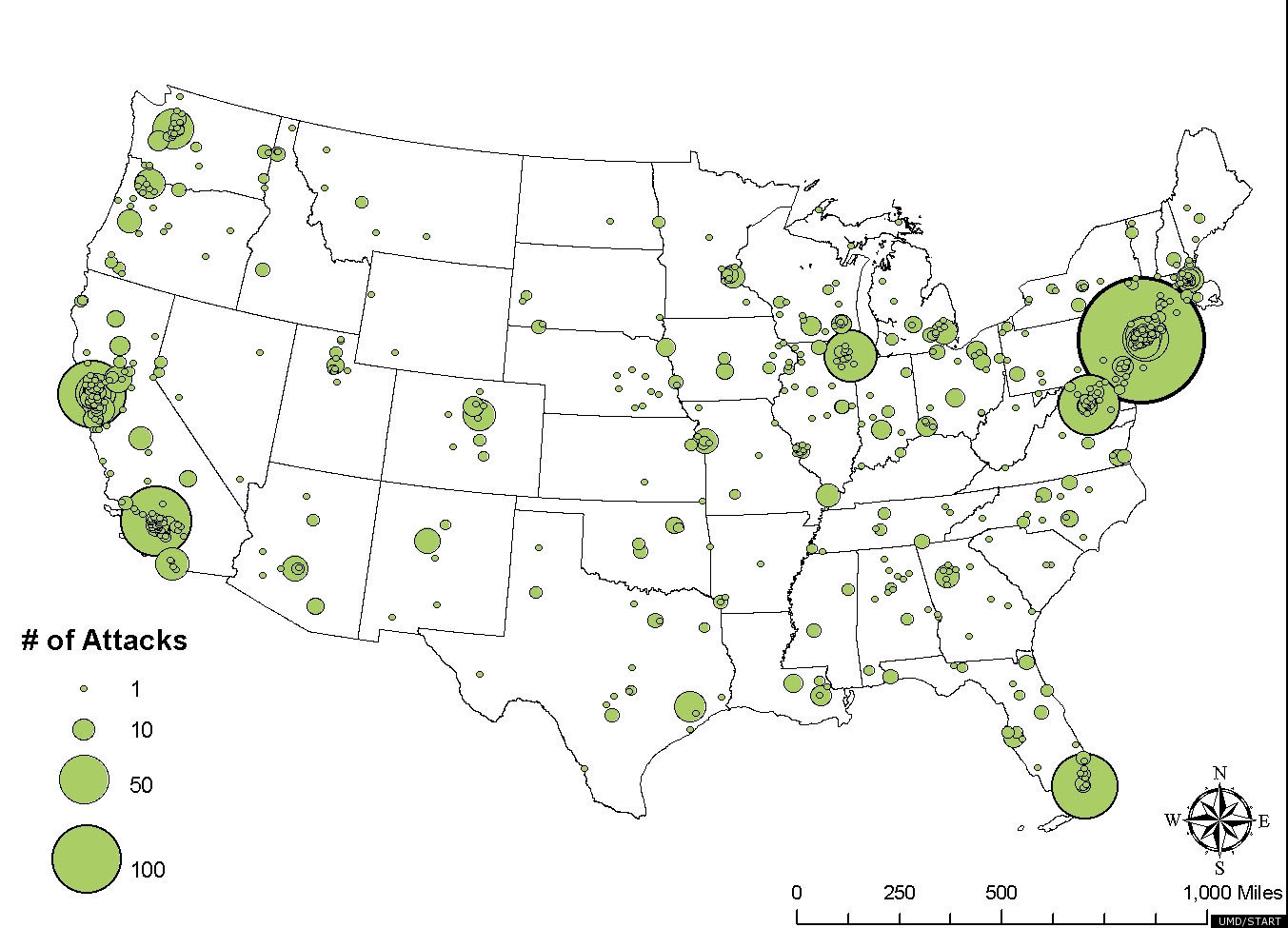
Can science predict where terrorists will strike? Not quite. But researchers at the University of Maryland (UMD) and the University of Massachusetts, Boston (UMB) have created a detailed map of where terrorism attacks have occurred since 1970 – and it reveals some big surprises.
The map's accompanying study, conducted at the UMD's National Consortium for the Study of Terrorism and Responses to Terrorism (START), found that while certain areas (those surrounding Manhattan and Los Angeles, for example) have endured as terror ‘hot spots' throughout the study, others have come and go. In the 2000s, for example, there has been a higher-than-average rate of attacks in Maricopa County, AZ, Phoenix's county. King County, WA, on the other hand, was a terror hot spot in the 1970s and 1980s, but has been largely quiet since.
Click on Image to Enlarge
The START researchers called 65 of the nation's 3,143 counties hot spots, although that only means that these counties experienced higher than the national average of 6 attacks from 1970-2008.
The study, which looked at all 3,143 U.S. counties, also found that terrorism hot spots and motivations have changed dramatically from decade to decade. Where do terrorists come from? In the last decade, many politicians have conjured the image of Islamic fundamentalists from the Middle East. But in the 1970s, many attacks classified as ‘terrorist' came from left-wing groups in Berkeley, San Francisco and surrounding areas.
The research showed a strong association between the county in which a terrorist attack occurred and its motivation. “For example,” a University of Maryland statement notes, “Lubbock County, Texas, only experienced extreme right-wing terrorism while the Bronx, New York, only experienced extreme left-wing terrorism.”
Similarly, particular ideologies' inclination to terrorist attacks varied over the years.
“The 1970s were dominated by extreme left-wing terrorist attacks,” co-author Bianca Bersani, assistant professor of sociology at UMB, said. “Far left-wing terrorism in the U.S. is almost entirely limited to the 1970s with few events in the 1980s and virtually no events after that.” Perhaps unsurprisingly, domestic left-wing terrorism overwhelmingly took place in the San Francisco Bay area during the Vietnam War.
Other interesting findings include the fact that “religiously motivated attacks occurred predominantly in the 1980s, extreme right-wing terrorism was concentrated in the 1990s and single issue attacks [‘e.g., anti-abortion, anti-Catholic, anti-nuclear, anti-Castro'] were dispersed across the 1980s, 1990s and 2000s.”
The researchers hope that the insights from the study can be used to determine the relationship between terrorism and ordinary crime, which has historically been much easier to predict.
Hacking network Anonymous has released a recording of a conference call between the FBI and UK police in which they discuss efforts against hacking.
The call, said to have taken place last month, covers the tracking of Anonymous and similar groups, dates of planned arrests and evidence details.
Anonymous also published an email, apparently from the FBI, showing the email addresses of call participants.
The FBI confirmed the intercept and said it was hunting those responsible.
The loose collective Anonymous have targeted a number of big institutions in recent years
“The information was intended for law enforcement officers only and was illegally obtained. A criminal investigation is under way to identify and hold accountable those responsible,” it said in a statement.
London's Metropolitan Police's central e-crime unit said the matter was being investigated but that no operational risks had been identified.
A comment on one of the Twitter accounts linked to Anonymous, AnonymousIRC, said: “The FBI might be curious how we're able to continuously read their internal comms for some time now.”
Phi Beta Iota: This is too funny for words. Hackers and Phi Beta Iota have been very clear for over 20 years that most law enforcement systems are easy to hack into, especially now that they are all digital and controlled by a server where no one has had the brains to change the factory installed root password. What is really happening now is that government incomtence in security is being “outed.” CIA has worked overseas for decades, pretending to be clandestine when in fact all case officers have been known to local liaison. Similarly, government “security” is an oxymoron. On the one hand, it does not exist, and on the other we are spending tens of billions on the well-intentioned but ignorant threatics of the Transportation Security Agency (TSA) and the world's most expensive coffee klatch, the National Counter-Terrorism Center (NCTC). This is what you end up with when a government of arrogant “experts” and even more arrogant politicians refuse to listen to both insider iconoclasts and outsider “loyal opposition” minds that actually know what they are talking about and see these things 20 years before the “leaders” at the top, who are really nothing more than clerks fighting for budget share, without a strategic bone in their bodies.
Somalia: For the record. India, China and Japan have begun coordinated naval patrols off the Horn of Africa with the assistance of counter-piracy mechanism Shared Awareness and Deconfliction (SHADE), Indian navy sources said. This is the first time that these three have coordinated in this fashion, though all have been engaged in anti-piracy operations for several years.
Phi Beta Iota: The old US model, of a very expensive and now unsustainable “forward presence” including over 1000 “locations” outside the USA, all prime targets for asymmetric attack, can be contrasted with the new Chinese model, of coordination, using shared information as the “loose glue” for building trust. The US has refused to entertain these notions since they began in force from 1988. The U.S. military is not thinking seriously about the future — for example, Hawaii as an autonomous state (if not a free Republic) that evicts all US forces as part of an internationalization and conversion to a Pacific “neutral” zone such as China has been thinking about for at least fifty years. Boneheads will label this idea insane. The more intelligent will plan for it. Put bluntly, the US Navy does not have a clue how to be influential in a sustainable (cost effective) manner in the Pacific or anywhere else, absent big bases, hundreds of billions, and tolerance for zero strategic smarts.