IC Virtual Career Fair: Priority Languages by Agency
Phi Beta Iota. Below the line is the actual priority chart. The FBI is fishing for everything but probably not serious. CIA and NSA are still focused on Priority 1 and ignoring everything else.
Pentagon officials took to PBS and the Pentagon press room to warn Wednesday about the impending sequester’s impact on military spending.
“We’re really trying to keep on protecting the country and delivering the defense under these circumstances,” Deputy Defense Secretary Ash Carter said on the PBS NewsHour Wednesday evening. “In some cases, that’s not going to be possible.” On March 1, assuming no White-House-congressional deal on a $1.2 trillion deficit reduction package over the coming decade, more than $500 billion in Pentagon cuts will kick in automatically, including a $46 billion cut between March 1 and October 1.
“Two-thirds of the Army active combat brigade teams, other than those that are currently deployed, would be at below acceptable levels of readiness,” Pentagon money chief Robert Hale said. “It could affect their ability to deploy to a new contingency, if one occurred, or if this goes on long enough, even to Afghanistan.”
Yet slightly more than an hour before Carter appeared on television, the Air Force slipped Lockheed Martin a little something extra to keep their fleet of F-22s flying:
Students and alumni at Yale University are organizing against a proposed campus center to train special operations forces in interview techniques. The center would be funded by a $1.8 million grant from the Pentagon and could open as early as April. Dubbed an “interrogation center” by critics, the facility would be housed at the Yale School of Medicine and led by Charles Morgan, a professor of psychiatry who previously conducted research on how to tell whether Arab and Muslim men are lying. We speak to two students at Yale who co-authored an editorial titled “DoD Plans are Shortsighted, Unethical,” and with Michael Siegel, professor of community health sciences at Boston University School of Public Health and a 1990 graduate of the Yale School of Medicine. “Yale has now crossed a line,” Siegel says. “Using the practice of medicine and medical research to help design advanced interrogation techniques, or even just regular civilian intelligence-gathering techniques, interviewing techniques, is not an appropriate use of medicine. The practice of medicine was designed to improve people’s health. And the school of medicine should not be taking part in either training or research that is primarily designed to enhance military objectives.” [includes rush transcript]
FORT LAUDERDALE, Fla. — Data scientists are the most in demand job for the military, according to Reggie Brothers, the deputy assistant secretary of defense for Research.
The military has a problem with “big data” — the problem being that it collects too much of it. The infatuation with unmanned vehicles and the sensors mounted onto them has spurred a wave of data collected on the battlefield.
Using that data has caused military leaders headaches. Brothers said here at the Association of the U.S. Army’s Winter Symposium on Wednesday that the Army and the other services have placed their focus on PED, or processing, exploitation, and dissemination.
He used the ARGUS-IS as an example of the major advances being made in the world of intelligence sensors. The ARGUS-IS can stream up to a million terabytes of data and record 5,000 hours of high definition footage per day. It can do this with the 1.8 gigapixel camera and 368 different sensors all housed in the ARGUS-IS sensor that can fly on an MQ-9 Reaper.
Phi Beta Iota: The naive and the unscrupulous emphasis external threats and internal vulnerabilities while glossing over the FACT that this threat was clearly articulated by Winn Schwartau, among others, in 1990, and clearly articulated, in a letter delivered in 1994 to Marty Harris at the National Information Infratructure (NII) reporting to Al Gore, that put together in one place the best possible starting point for securing the entire US cyber-infrastructure with a starting budget of $1 billion a year.
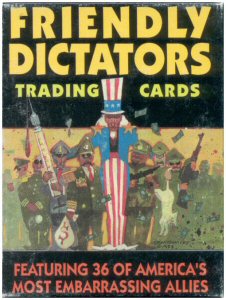
Back in 1989 Bill Sienkiewicz illustrated a deck of cards designed to bring to light some of the sleazier folks that the U.S. government had done deals with. The text on each card was written by Dennis Bernstein and Laura Sydell. I wish there was an updated version covering the last 17 years, but in the meantime I’ve prepared a giant post with the images and text from the pack of cards. (This is an egregious copyright violation, but since these cards have been out of print for more than 15 years, I’m hoping no one will call me on it. If they did, I would–of course–take this down.) This will be a very image-intensive post–as usual, the little pictures are links to the bigger versions.
Here’s the cover from the box:
And this is the “about the creators” text (looking at the current bios for the creators, there has been some interesting career progression since they did this):
DENNIS BERNSTEIN is the Executive Producer of “Undercurrents,” heard daily on WBAI in New York, and nationally on the Pacifica Radio Network. His articles have appeared in The New York Times, The Village Voice, New York Newsday, Spin Magazine, In These Times, Extra!, and others.
LAURA SYDELL has a law degree and is a phi beta kappa graduate of William Smith College. She has reported for National Public Radio’s “All Things Considered”, “Crossroads”, and for the Pacifica Radio Network.
BILL SIENKIEWICZ’s work in Brought to Light has garnered rave reviews from Publisher’s Weekly, The American Library Association Booklist, and The Village Voice. His award-winning artwork can be seen in such comics as Moon Knight, Elektra Assassin, Stray Toasters, and Real War Stories.