I agree the two parties have become virtually indistinguishable in many respects. But the Republican Party is far more dangerous, in my opinion. And I think Democrats kowtow to big business interests and the Military Industrial Complex mainly because they are more or less forced to if they want to be able to consistently challenge Republican Party dominance. That's no excuse, of course. But I think it's very misleading to portray both parties are essentially opposites sides of the same coin. Anyway, this article points out some important differences between the two parties.
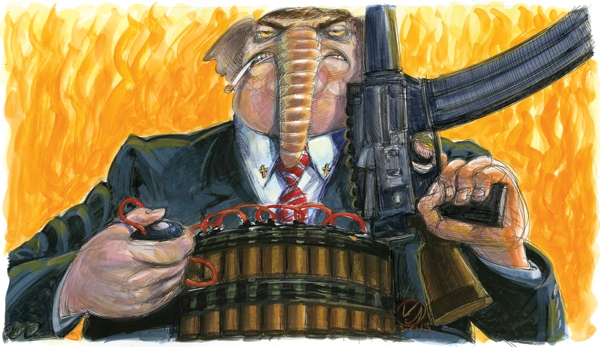
Since last fall, Republicans have pretended to be more moderate – but their politics are harsher and more destructive than ever
After watching voters punish the GOP in the 2012 elections, Republican elites have been talking a brave game about reforms that would make the party less repulsive to Latinos, women and gay-friendly millennials. Florida Sen. Marco Rubio, the GOP's hip-hop-quoting young standard-bearer, is pressing conservatives to back an amnesty for undocumented immigrants. Dozens of party stalwarts, headlined by former Utah Gov. Jon Huntsman, renounced their opposition to gay marriage in a Supreme Court brief. GOP bigwigs have even launched New Republican – a group modeled after Bill Clinton's centrist Democratic Leadership Council – which seeks to rebrand the party as “colorblind,” “not anti-government” and dedicated to “ending corporate welfare.”
Don't be fooled. On the ground, a very different reality is unfolding: In the Republican-led Congress, GOP-dominated statehouses and even before the nation's highest court, the reactionary impulses of the Republican Party appear unbowed. Across the nation, the GOP's severely conservative agenda – which seeks to impose job-killing austerity, to roll back voting and reproductive rights, to deprive the working poor of health care, and to destroy agencies that protect the environment from industry and consumers from predatory banks – is moving forward under full steam.
Over a decade during which the US economy was decimated by jobs offshoring, economists and other PR shills for offshoring corporations said that the US did not need the millions of lost manufacturing jobs and should be glad that the “dirty fingernail” jobs were gone.
America, we were told, was moving upscale. Our new role in the world economy was to innovate and develop the new products that the dirty fingernail economies would produce. The money was in the innovation, they said, not in the simple task of production.
As I consistently warned, the “high-wage service economy based on imagination and ingenuity” that Harvard professor and offshoring advocate Michael Porter promised us as our reward for giving up dirty fingernail jobs was a figment of Porter’s imagination.
Over the decade I repeated myself many times: “Innovation takes place where things are made. Innovation will move abroad with the manufacturing.”
This is not what corporations or their shills such as Porter wanted to hear. Corporations were boosting their profits by getting rid of their American employees and replacing them with lowly paid foreigners. Porter’s job was to reassure the sheeple so that no outcry would materialize against the greed that was hollowing out the US economy.
As bad as sequestration is now and is going to be — and that's much worse than some of you have told me you think — in the interest of truth, everyone should remember that the Chairman, before he was Chairman, before he was even Chief of Staff, Army, was railing, picking up the ADM Mullen line that deficits were the worst threat to national security and that DoD should be a part of deficit reduction. That, IMHO, undercuts his moral authority to do anything other than embrace sequestration, which is having impacts you wouldn't believe if we were allowed to discuss them with you. Folks, on a day to day basis, every day gets “suckyer” than the previous day. Sequestration is creating monumental diversions of key leader and staff attention from the real business of national defense. Most of the specifics are classified and/or “predecisional.”
Military officials are reassessing the national defense strategy in light of spending cuts that will force the Pentagon to reduce its budget by $500 billion over the next decade, the chairman of the Joint Chiefs of Staff says.
Decades of class war leaves most Americans nearing retirement woefully unprepared.
Since the mid-1970s, real wages haven’t kept pace with inflation. Benefits steadily eroded. High-paying jobs disappeared. Improved technology forces wage earners to work harder for less.
So-called “free” markets work only for those who control them. A handful of winners benefit at the expense of most others. Conditions get progressively worse.
Wealth disparity extremes are unprecedented. Neoliberal harshness force-feeds austerity when stimulus is needed. Public needs go begging.
American inequality is institutionalized. Bipartisan complicity assures it. Class war rages. America’s social contract is targeted for destruction.
Both sides agree. They support giving bankers, war profiteers, other corporate favorites, and super-rich elites greater wealth at the expense of most others.
A template for the story of our mis-steps as it will be told for generations.
Phi Beta Iota: The complete story has been posted below. Technology is not a substitute for thinking. US policymakers, driven by the arm sales imperative and its 5% kick-backs, have refused to be educated by intelligence professionals that do know what they are doing, but cannot be heard. It is time we begin serving the public with public intelligence — an Open Source Agency (OSA) whose finished decision-support cannot be ignored precisely because it is public.
For the United States and its allies, the tribes across the Muslim world remain a mystery. Because they were outside the realm of globalization, they were easy to see as natural allies of al Qaeda. Without an understanding of these tribes' social and religious values, writes Akbar Ahmed, the U.S.-led war on terror will not end in any kind of recognizable victory.
Drone launched from the USS Lassen in September 2010. Credit: Roberto Ruvalcaba/US Navy-Flickr (CC BY 2.0)
By 2012, the United States, in a move typical for its propensity to opt for excess in any matter of security, had commissioned just under 20,000 drones. About half of these are in use.
Ignoring the moral debate, drone operators are equally infatuated with the weapon and the sense of power it gives them. It leaves them “electrified” and “adrenalized.” Flying a drone is said to be “almost like playing the computer game Civilization,” a “sci-fi” experience.
A U.S. drone operator in New Mexico revealed the extent to which individuals across the world can be observed in their most private moments. “We watch people for months,” he said. “We see them playing with their dogs or doing their laundry. We know their patterns, like we know our neighbors' patterns. We even go to their funerals.”
Another drone operator spoke of watching people having sex at night through infrared cameras. The last statement, in particular, has to be read keeping in mind the importance Muslim tribal peoples give to notions of modesty and privacy.
The victims of all drone attacks are, in effect, treated like insects. That description is not my invention, but a reflection of the military slang for a successful strike. The victim that is blown apart on the screen in a display of blood and gore is called “bug splat.”
Muslim tribesmen were reduced to bugs or, as David Ignatius put it in a Washington Post op-ed, cobras to be killed at will. Any compromise with the Taliban in the Tribal Areas of Pakistan, officially designated as the Federally Administered Tribal Areas (FATA), is “like playing with a cobra,” he wrote. And do we “compromise” with cobras? Ignatius rhetorically asked. “No, you kill a cobra.”
Bugs, snakes, cockroaches, rats — such denigration of minorities has been heard before, and as recent history teaches, it never ends well for the abused people.
WARNING NOTICE. The latest printer update for HP OfficeJeg J4680 All-In-One immediately decommissions perfectly good, full, and genuine HP print cartgriges as being “incompatible” with your printer. It FORCES you to go buy a new one and start fresh.
Recommendation if this happens to you: pull the cartridge that has been incorrectly blocked, go buy an exact replacement, and work with the store to do an instant switch out. Staples etc loses nothing, and they can return it to HP for full credit. We need to FLOOD HP with the fruits of their ineptitude.
There really ought to be a quality control center outside of HP, they have lacked integrity on printer cartridges for over a decade. Generally when HP says your cartridge is low, you still have a third of the ink left.
Last year, DC District Judge Richard W. Roberts ordered the U.S. Trade Representative to disclose a classified document to a FOIA requester because, he said, the classification of the document was not properly supported. That ruling in Center for International Environmental Law v. Office of the U.S. Trade Representative was a startling judicial rebuff to executive classification authority of a sort that had not been seen in many years, and the government quickly appealed.
In oral arguments in the DC District Appeals Court last month, government attorneys all but declared that a court has no power to overrule an executive branch classification decision. The transcript of that February 21 hearing has just become available.
Judge Roberts’ “substitution of [his] judgment about likely harm to foreign relations [that could ensue from disclosure] fails to give the deference that’s due to the Executive in this sensitive area of foreign relations and national security, and is entirely inconsistent with this Court’s consistent case law over many decades that emphasizes the need for such deference,” argued H. Thomas Byron, III, on behalf of the U.S. Trade Representative.
Circuit Court Judge Brett Kavanaugh asked Mr. Byron whether there were any circumstances in which a court could reject a classification claim.
“When do you think a Court could ever disagree with the Executive’s determination in this kind of case?” Judge Kavanaugh asked.
Mr. Byron that if the agency’s declarations in support of classification are logical and plausible, then the agency is entitled to judicial deference.
“Isn’t that going to cover 100 percent of the cases?” Judge Kavanaugh asked.
“I certainly think, Judge Kavanaugh, that the Executive would not submit a declaration that was not logical or plausible,” Mr. Byron replied.
Then he went even further and suggested that the executive branch has exclusive constitutional authority over classification policy.
Judge Kavanaugh was inquiring how the government would respond to an argument made in an amicus brief filed by media organizations contending that Congress had mandated judicial review of classification when it amended the FOIA in 1974 in order to enable Courts to review executive classification judgments. Not only that, but when President Ford vetoed the measure, Congress overrode the veto.
Mr. Byron said, “The question is whether those changes [i.e. the 1974 amendments] altered the constitutionally required deference to the Executive in this area under the Separation of Powers Doctrine,” suggesting that the congressional override of President Ford’s veto was meaningless and without effect.
“That’s interesting,” said Judge Kavanaugh. “You don’t think Congress could put the courts in the position of second guessing” the executive?
“Well, when it comes to predictive judgments about harm to national security and foreign relations I think that’s a very difficult question,” Mr. Byron said.
“I agree,” Judge Kavanaugh replied.
Cogent arguments to the contrary were made by attorney Martin Wagner on behalf of the Center for International Environmental Law at the hearing and can be found in the transcript. An account of the hearing from the Reporters Committee on Freedom of the Press is here.