Finally, we may have some good news about the bees. It's not a done deal yet, but it looks possible. It appears that whereas the American Congress, captured as it is by corporate forces, cares nothing for facts concerning the crisis of the bees, the EU has begun to recognize officially what is happening with these small creatures upon whom our wellbeing depends. And they are seem to be willing to do something about it — ban the insecticides that a growing body ! of research say are at least a major cause of the problem.
The point of a false flag is to frighten the population of any given nation into relinquishing freedom in the name of safety, which in the process gives the central government even more control. In the wake of the Boston attack, the establishment is having a field day…
ROBERT STEELE: I have been watching with growing concern as Phi Beta Iota has posted a string of relatively radical posts on the Boston bombing and Texas fertilizer explosion. As most know, I lean toward transparency, truth, and trust, and the last thing I would want to do is marginalize these voices for truth and trust as I have been marginalized these past six years. My focus now that my clearances have been justly reinstated is to get out of town — to find the toughest job in the darkest corner and vanish. Have brain will travel. Having said that, this search is important and merits a broad response that ties everything together in context.
The short answer, if you accept my pioneering concept of the “fifteen slices,” as cleared by CIA and DoD and offered up in Human Intelligence: All Minds, All Languages, All the Time (US Army Strategic Studies Institute, June 2010), is that clandestine Human Intelligence (HUMINT), one of the four secret slices, is 6.6% of the totality of HUMINT and should receive 13.2% of the budget. In my view, HUMINT has failed miserably on two fronts: leveraging Open Source Intelligence (OSINT) for spotting and assessing as well as post-recruitment vetting and validation; and in pointedly questioning the value of the technical disciplines that produce so little — that compare very poorly with HUMINT/OSINT in relation to the investments made and the processing not done.
Here below is the original graphic I created after being interviewed for DISL HUMINT at DIA (not selected or I would be invisible), the central graphic for the above monograph — I post the clearance letters above because there are still too many that fail to understand my deep commitment to doing the right thing.
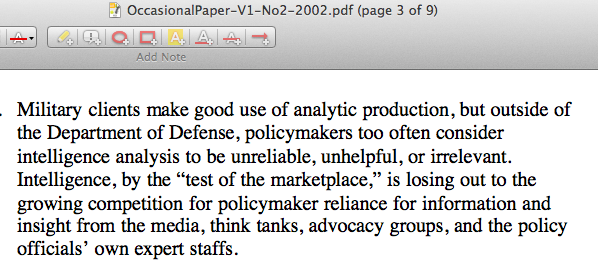
“Intelligence must accept the end of its special status in the American government, and take on the task of informing the public of its nature and its activities as any other department or agency. . . . By far the most effective manner of accomplishing the task . . . is by letting the public benefit directly from the products of intelligence, its information and assessments. ”
The Democratic Study Group was a 150 staff member legislative service organization(LSO) that had as customers all of the Democratic members of Congress and a good number of Republicans. This internal think tank analyzed policy proposals, serving as an in-house ‘brain’ for Congress. The “Republican Revolution” of 1994 would lead to the defunding of this entity in 1995, functionally turning over control of domestic policy making to the likes of the Heritage Foundation and the American Enterprise Institute. This has result, in my opinion, in an unmitigated policy making disaster that has ended the American empire and that endangers the stability of our nation. The construction of Progressive Congress News was a halting attempt to reverse this trend.
Click on Image to Enlarge
Our intelligence community was more resilient, due to their structure and duties. The outing of Valerie Plame, a twenty year CIA veteran and the head of our counter-proliferation operation, for failure to support the Bush administration’s desire for an adventure in Iraq, ought to have resulted in the prosecution of Dick Cheney and Karl Rove. Instead we limp forward with this crime unpunished, lugging a variety of other attendant baggage of our decay.
Having seen the problems at the domestic level and having a good idea of how they’ll be resolved, I decided I would turn my attention to foreign policy issues. I have gone through the Quadrennial Diplomacy & Development Review, the State Department’s companion to the Defense Department’s Quadrennial Defense Review, I spent the first three months of the year surveying the foreign policy discussion space, and I have my own short list of openings in the area.

 Finally, we may have some good news about the bees. It's not a done deal yet, but it looks possible. It appears that whereas the American Congress, captured as it is by corporate forces, cares nothing for facts concerning the crisis of the bees, the EU has begun to recognize officially what is happening with these small creatures upon whom our wellbeing depends. And they are seem to be willing to do something about it — ban the insecticides that a growing body ! of research say are at least a major cause of the problem.