Each session has a Cisco WebEx link for remote participation: enter your First Name, Last Name (surname), e-mail address, and the password: wsis – For technical problems, send a message to: assistance.wsis@gmail.com or call or text +33 (0)7 88 56 94 00.
Yahoo Business & Human Rights Program, Friday, September 28th, 2012
Change Your World (Cambia Tu Mundo), Yahoo!’s Business & Human Rights Summit that took place on September 12th and 13th in Mexico City is an excellent example of what I mean. For a day and a half, women from different countries, backgrounds and experiences in Latin America shared their dreams, lives, challenges and proved that new technologies and the Internet are incomparable tools of empowerment.
I won´t go over the event’s program nor the participants. (Links to them are available here and here). What I want to do is highlight the wonderful lessons I learned after participating in Change Your World.
1. Women are a driving force towards equality in the world. Yes, women represent not only 50% of the world population, they represent half of the idea and proposal creators. Many don´t know it, but new technologies can help them be heard and allow their proposals and ideas to be included in the development and prosperity of their communities, countries…. and therefore… of the planet.
2. Digital literacy of women in Latin America must be considered a priority for policy makers. Even though Spanish is the third most important language on the Internet with 182,379,220 users, there is lack of content created and written in it. If you add the lack of women´s voices as content creators in the region, the figures are worrisome. We cannot allow nor permit the addition of this marginalization to the many other kinds of marginalization women face (education, health, financial, justice and so on).
3. Women and the Internet can be a creative explosion. Throughout the sessions one thing was absolutely clear: the participants demonstrated in various and creative ways how the Internet can be used to support not only good causes, but very practical economic, social and political outcomes. The Internet can be a democratization tool to help build and consolidate new realities where women´s interests and needs can be not only expressed but included.
My Harvard/MIT colleague Todd Mostak wrote his award-winning Master’s Thesis on ”Social Media as Passive Polling: Using Twitter and Online Forums to Map Islamism in Egypt.” For this research, Todd evaluated the “potential of Twitter as a source of time-stamped, geocoded public opinion data in the context of the recent popular uprisings in the Middle East.” More specifically, “he explored three ways of measuring a Twitter user’s degree of political Islamism.” Why? Because he wanted to test the long-standing debate on whether Islamism is associated with poverty.
So Todd collected millions of geo-tagged tweets from Egypt over a six month period, which he then aggregated by census district in order to regress proxies for poverty against measures of Islamism derived from the tweets and the users’ social graphs. His findings reveal that “Islamist sentiment seems to be positively correlated with male unemployment, illiteracy, and percentage of land used in agriculture and negatively correlated with percentage of men in their youth aged 15-25. Note that female variables for unemployment and age were statistically insignificant.” As with all research, there are caveats such as the weighting scale used for the variables and questions over the reliability of census variables.
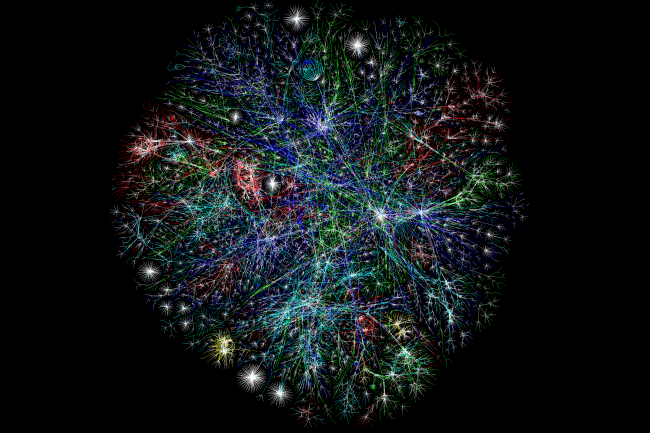
Like the myth that every Hollywood actor is somehow linked to Kevin Bacon by no more than six people, websites are also limited in how far they are apart.
A Hungarian physicist has found that every website on the internet is connected by 19 clicks or less.
Click on Image to Enlarge
Like the myth that every working actor is connected somehow to the Hollywood star Kevin Bacon by no more than six people, websites are also limited in how far they are apart.
Smithsonian reported that the findings by Albert-László Barabási were based on a computer model that mapped out 14 billion websites with about one trillion pages (see image).
Most of those pages are ill-connected according to the research.
Here's some idle thinking for a sunny afternoon at the end of winter.
To access it, let's make a simple assumption that economics, politics, and warfare are all a function of the dominant technological substrate.
A technological substrate is the family of related technologies that we rely upon. In the 20th Century, we were clearly reliant on an industrial substrate.
The challenges posed by industrial age technologies dictated the development of two management forms: bureaucracy and markets. Bureaucracies and markets are both decision making systems. These management forms dominated economics, politics, and warfare for centuries.
Neither system of management is sufficient as a solution for industrial economics, politics, or warfare.
1. Threat to This Idea. The Central Intelligence Agency (CIA) has fought against this idea, despite the fact that it originated within the CIA in 1969, and has been championed by multiple commissions including the 9/11 Commission (pages 23 and 413) and the WMD Commission. Both CIA and the Director of National Intelligence (DNI) appear to fear the impact on the secret world’s budget if an Open Source Agency (OSA), as a sister agency to the Broadcasting Board of Governors (BBG), were to demonstrate that 95% of what the Secretaries of State, Defense, and Homeland Security need to do strategy, policy, and acquisition, can be obtained ethically, legally, and inexpensively. This idea was sent to your predecessor via four separate channels, including from Lawrence Lessig to Alec Ross in the office for Public Diplomacy, and directly to a member of Hillary Clinton’s personal staff, and blocked all four times by INR acting on behalf of CIA. If is for this reason that I humbly and respectfully route this idea to you via your brother and my long-time colleague Jock Gill, a member of President Clinton’s communications staff.
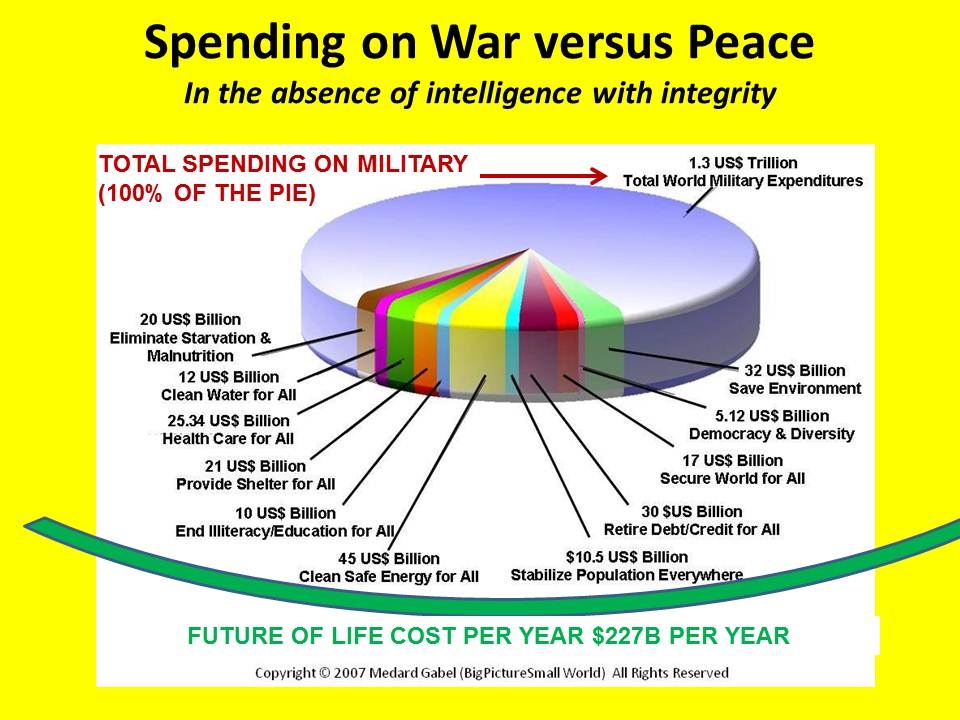
2. Essence of the Idea. The OSA would provide to the Secretary of State, the Secretary of Defense, the Secretary of Commerce – and to all their Assistant Secretaries and desk officers – completely unclassified Open Source Intelligence (OSINT) tailored to their needs in detail and in a timely fashion. Being unclassified, this intelligence (decision-support) could be provided at the same time to the Congressional committees, the media, the public, and foreign stake-holders. Stated in relation to the President’s needs at this time, the Open Source Agency would enable the Secretary of State to contribute immediately and forcefully to Open Government, Citizen Engagement, Participatory Budgeting, Global Engagement, and more tangibly, to the rapid creation of a Whole of Government planning, programming, and budgeting process that is rooted in ethical evidence-based decision-support that leverages unclassified decision-support such that the Secretary of State can lead a redirection of how the US Government spends money, toward peace and commerce instead of war.
Click on Image to Enlarge
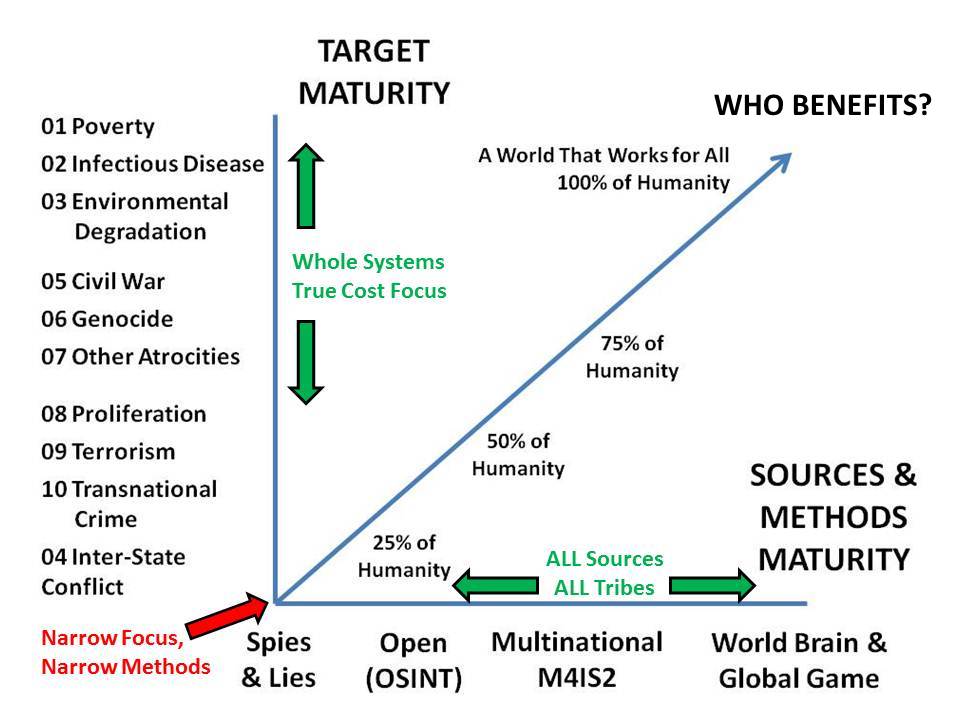
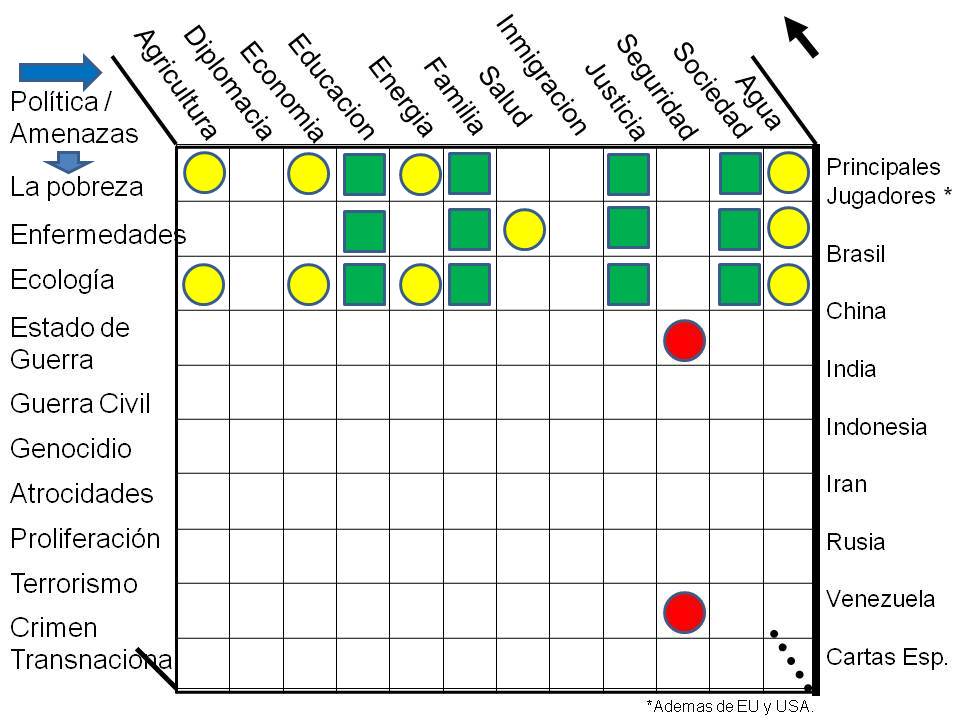
3. Harmful Gaps Today. At a time when LtGen Dr. Brent Scowcroft and other members of the UN High-Level Panel on Threats, Challenges, and Change have identified and prioritized the ten threats shown here, the USA and its military-industrial complex persist in obsessing on inter-conflict and terrorism, the latter a tactic, not a threat. Meanwhile the secret intelligence world is spending over $75 billion a year on secret collection, most of which is not processed, and producing what General Tony Zinni, USMC (Ret) has said is “at best” 4% of what a major commander or Cabinet official requires – to which I would add, “and nothing for everyone else.”
Click to Enlarge
4. Strategic Value of the Idea. The greatest casualty of the Cold War and the Global War on Terror has been the truth. America has become morally and intellectually disengaged from reality.
The truth at any cost lowers all other costs.
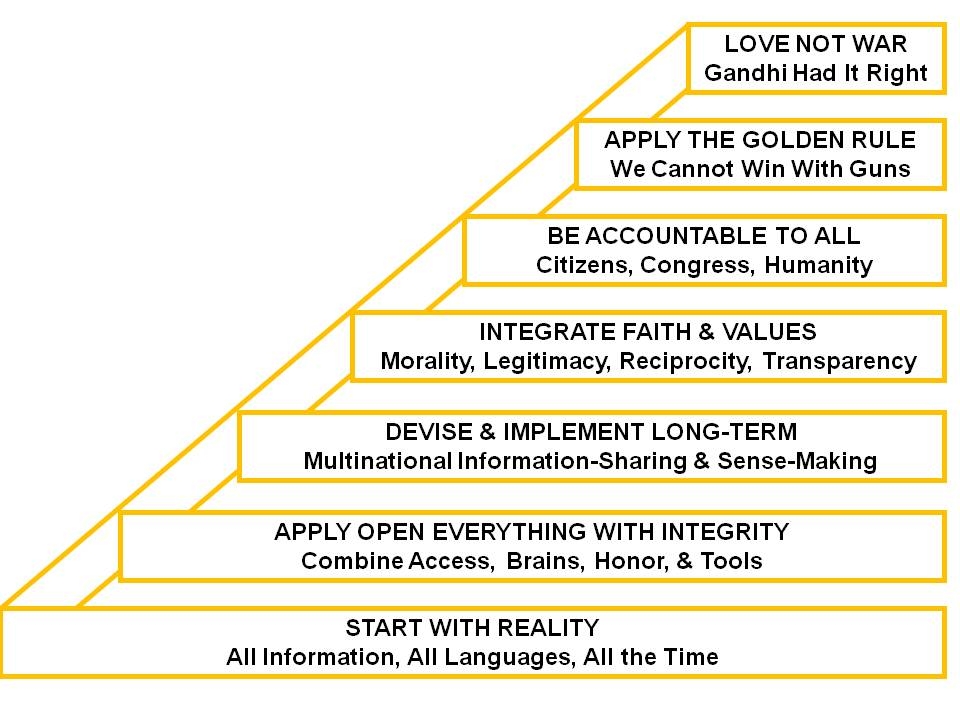
The most advanced thinking – far beyond the current concepts of any element of the US Government or any think tank – has converged on the combination of two ideas: Open Source Everything (OSE), and Multinational, Multiagency, Multidisciplinary, Multidomain Information-Sharing and Sense-Making (M4IS2).
Click on Image to Enlarge
5. Operational Implementation of the Idea. The Office of Management and Budget (OMB) has twice before agreed that an OSA is needed, and also agreed that it should be under diplomatic auspices rather than an element of the secret world. The first time the idea was approved was in 2000 by Sean O’Keefe, then Deputy Director of OMB, who felt it appropriate as a Presidential Initiative to be funded at $125M Initial Operating Capability (IOC), toward $2B at Final Operating Capability (FOC). In 2010 Kathleen Peroff, the Associate Deputy Director for National Security, and her colleagues responsible for Program 50 (Military) and Program 150 (International Affairs) reiterated their agreement in principle with the idea, contingent on a Cabinet officer sponsoring the idea. Now we are in severely constrained budget circumstances, and it may be appropriate to start with a smaller pilot project, perhaps $25M for year one, but the idea is so powerful that it should quickly demonstrate that it merits funding as a means of helping the President decide of both cuts and redirections of funding.
Click on Image to Enlarge
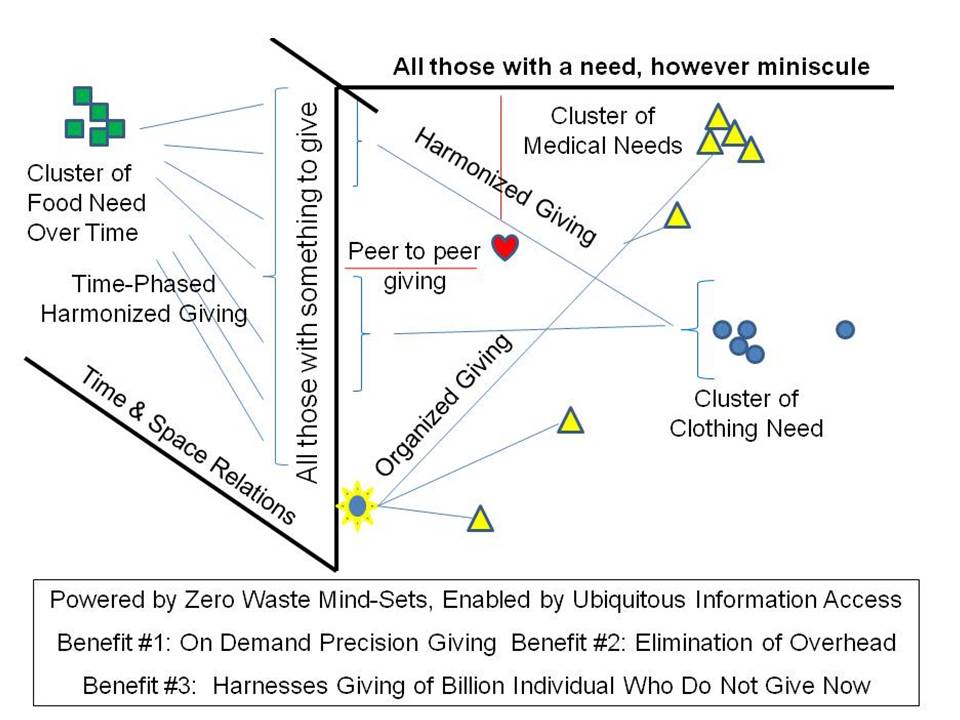
The OSA offers the additional advantage of being able to create a Global Range of Needs Table and a transparent fulfillment dashboard capable of both inspiring donations from the 80% of the one billion rich that do not contribute to charity today; and also capable of holding accountable the Specialized Agencies of the United Nations (UN), the International Committee of the Red Cross (ICRC), and all other non-governmental organizations – as the public “sees” that many of them deliver less than 20% of their total budget to those in need, the Secretary of State will have increased influence over funding from others.
6. Tactical Implementation of the Idea. The original budget, when the OSA was proposed as a Global Engagement capability, was suggested by Keith Hall, then Director of the National Reconnaissance Office (NRO), and former director of the budget staff for the Senate Select Committee on Intelligence. Mindful that the secret world does not do “Global Coverage,” Mr. Hall suggested $10M a year for each of 150 countries and topics not reliably covered – if at all – by the secret world. Congressman Rob Simmons (R-CT-02) and myself added $30M per year for each of the 50 states, to create Community Intelligence Networks that would also help integrate education, intelligence (decision-support) and research across America, creating a Smart Nation. A one-page summary of the Smart Nation Act is attached. At the tactical level we can address three distinct advantages for the Secretary of State of sponsoring the OSA.
Haga clic para ampliar
a. Whole of Government Planning, Programming, and Budgeting. OMB does not manage in the grand strategic sense. The OSA can restore the Secretary of State as the senior Cabinet officer with a mastery of decision support that is as valuable here at home as it is abroad. For the first time, the OSA will provide ethical evidence-based decision-support that treats poverty, infectious disease, and environmental degradation – as well as genocide, trade in women and children, proliferation, and all forms of organized crime – as legitimate intelligence challenges. Decision support that can be shared will mobilize consensus.
Click on Image to Enlarge
b. Common Technical Solutions – Open Source Everything (OSE). Open Government and Open Data are not achievable nationally – nor scalable globally – without an “all in” approach to all the opens. Especially important are Open Cloud, Open Hardware, Open Science, Open Software, Open Spectrum, and Open Standards. A prior endeavor funded by DARPA, STRONG ANGEL, created a suite of collaboration tools on a flash-drive that could be shared with anyone – called TOOZL, it is the first step toward being able to do secure collaboration world-wide with an infinite number of constantly changing information partners.
Click on Image to Enlarge
c. Real Estate – A Once In A Lifetime Opportunity. Congress approved a privately funded Potomac Plaza over the mess of roads between the South-Central Campus and the river. Lauded as a transformative project that would reconnect the city to the river in this sector, the project could be combined with a publicly funded endeavor on the South-Central Campus, putting the OSA there, and funded by the OSA, the other five national educational, intelligence (decision-support) and research endeavors. This will be a tangible manifestation of the Secretary of State’s legacy, a legacy certain to last over a 100 years.
7. Select Planning Group Available. A select group of independent minds are available to discuss this.
Proposed Legislation: The Smart Nation Act
• Within the Department of State, expands the capabilities for Open Government, Citizen Engagement, Participatory Budgeting, Global Engagement and Whole of Government planning, programming, and budgeting, by providing the Secretary of State with oversight authority of the Open Source Agency (OSA) and the Office of Information Sharing Treaties and Agreements.
• Creates an Open Source Agency (OSA), redirecting the necessary funds on a non-reimbursable basis from Program 50 to Program 150, as a sister-agency to the Broadcasting Board of Governors (BBG), with the same arms-length independence that Congress wisely mandated to assure journalist independence, but in this case, to assure the integrity of public intelligence in the public interest across Whole of Government and in all exchanges with foreign and non-governmental entities. The small Headquarters will be constructed on the South-Central Campus, adjacent to both the U.S. Institute of Peace (USIP), which could serve as a partner in global information peacekeeping, and to George Washington University as well as the John F. Kennedy Center conference and parking facilities. All information obtained by open means will be a public good and a copy also provided as acquired to the Director of National Intelligence (DNI), who shall make no claim on the disposition of original open sources and methods. The OSA will be the national proponent for Open Source Everything (OSE) across the education, intelligence (decision-support) and research sectors.
• Creates an Office of Information Sharing Treaties and Agreements, to negotiate no-cost information sharing treaties with Nations, and no-cost information sharing agreements with non-governmental and private sector organizations including universities world-wide, while also adopting OSE standards facilitating both sharing and semantic web sense-making across all languages (33 initially, 183 at full operating capability).
• Creates a Multinational Warning & Decision-Support Center (MWDC) and related global information-sharing and sense-making network.
• Creates a Multinational Multiagency Conference Center to serve as a foundation for local to global outreach and cross-fertilization across all education, intelligence, and research topics.
• In partnership with academic, civil society, and non-profit organizations, creates the World Brain Institute and the Global Game to foster whole systems true cost economics thinking.
• Creates, in partnership with a university providing accreditation and administrative services, a School of Future-Oriented Hybrid Governance, a Horizons College, and a Multidisciplinary Research Consortium.
• Support the Broadcasting Board of Governors (BBG) with an Internet dissemination capability that offers free universal access to all unclassified information acquired by the OSA, with a robust man-machine translation capability that offers free online education in at least 33 major languages and 12 dialects of Arabic as an important new foundation for public diplomacy and information peacekeeping.
• Supports the roles of the Office of Management and Budget (OMB) and the General Services Administration (GSA) as executive level partners of the Open Source Agency, with priority on decision-support from the OSA in support of all federal needs of common concern.
• Expands and enhances the role of the Congressional Research Service (CRS) and the General Accountability Office (GAO) with direct access to all available information, advanced analytic processing tools, and sufficient personnel to provide each jurisdiction of Congress with unclassified decision-support that can be shared with constituents and the media. –o–
RM 130212 Cybernetics Management and Security Policy
I think the U.S. may be on the verge of making an important strategic mistake in science and in management education. Here are three stories to illustrate the historical background.
1. The Macy Foundation conferences in 1948-1953 led to founding the field of cybernetics. See http://en.wikipedia.org/wiki/Macy_conferences The Am. Society for Cybernetics was founded in 1964, about 50 years ago, at the Cosmos Club on Mass. Ave. There was some government money, perhaps CIA, behind it. A man named Jack Ford, who worked at the CIA, was involved. At the time there was concern about a “cybernetics gap” with the Soviet Union. Recall JFK's “missile gap” during the 1960 campaign. At the time the Soviets thought cybernetics would tell them how to manage their centrally planned economy. About this time Soviet Cybernetics Review was created to translate key Russian articles into English and make them available to US scientists. As late as the early 1980s, when I first went to Moscow, I was asked privately by one scientist if prices were set by a big computer in the basement of the Dept. of Commerce. For a history of Soviet cybernetics, see Slava Gerovitch From Newspeak to Cyberspeak. Although some courses and research centers in cybernetics were set up on university campuses, such as the Bio. Computer Lab at the U of Ill., on the whole cybernetics was widely discussed but did not take root as a separate discipline in the US. Also, cybernetics needed support from the govt. Research was funded mostly by AFOSR and ONR. The Mansfield Amendment unintentionally ended support for fundamental cybernetics research in the US and greatly boosted research on the electronic battlefield and robotics. See http://www.gwu.edu/~umpleby/recent_papers/2003_Heinz_von_Foerster_and_Mansfield_Amendment.pdf