“In November 2009, boyd traveled to New York City to deliver what she expected to be a major address at the Web 2.0 Expo, one of the year’s most important gatherings of Internet professionals. Her topic was what she terms “living in the stream,” or how not to drown in the flood of information that comes at us all the time. Teens, she believes, are especially good at this. The most web-savvy of them manage to stay open to all the digital stuff without having to process everything. They take what they can handle and remain untroubled that much may elude their grasp. It’s a kind of cyber-Zen. “The goal is . . . to be peripherally aware of information as it flows by, grabbing it at the right moment, when it is most relevant and valuable, entertaining or insightful,” she said at the Expo. “It is about a sense of alignment, of being aligned with information.” She talked about the high some Twitter users get “feeling as though they are living and breathing with the world around them, peripherally aware and in tune, adding content to the stream and grabbing it when appropriate.””
For 3 days in late February, Russian businessman Dmitry Itskov gathered 500+ futurists in Moscow for a “Global Future 2045 Congress” – the latest manifestation of his “Russia 2045” movement. The Congress featured an impressive roster of Russian scientists, engineers and visionaries, along with American and West European futurist leaders like Ray Kurzweil, Randal Koene and John Smart.
As Kurzweil noted when I asked him about the conference, “The reference to ‘2045’ comes from my date for the Singularity. The conference was forward looking and was based on my ideas.“
The occurrence of a conference like this in Russia is no big shock, of course. Russia has a huge contingent of great scientists in multiple directly Singularity-relevant areas; and it also has an impressively long history of advanced technological thinking . My dear departed friend Valentin Turchinwrote a book with Singularitarian themes in the late 1960s, and the Russian Cosmists of the early 1900s discussed technological immortality, space colonization and other futurist themes long before they became popular in the West.
On the other hand, the overall social atmosphere in Russia is not so optimistic these days. In fact Russia is seeing a brain drain of sorts – around 1.25 million Russians have left the country in the last decade, including a large number of educated individuals. This is fairly dramatic for a country of 142 million with a death rate significantly higher than its birthrate.
The global economic crisis of 2008 reduced Russia’s GDP to a persistent 3% or so per year, compared to 7-8% beforehand. Russian polling agencies estimate that 20% of Russians are thinking of leaving, with the figure nearly 40% in the 18-25 age bracket.
So on the one hand there’s a struggling economy and brain drain; and on the other hand, a massive brain trust of brilliant scientists and a long tradition of visionary futurist thinking. Taken together, quite an interesting backdrop for Itskov’s event….
And, like the Russian Cosmists before him, Itskov has no lack of grand ambitions. As he told Sander Olsen in an interview last year:
[T]he most important thing is that we want to eliminate death and disease for all—to overcome the limitations of our protein-based body; to find a way out of the chain of various crises our civilization is facing.
As regards the Avatar project … this is a project to create a robot copy of a human that can be operated through the brain-computer interface.
We just talked about the Body B project, which is to create a brain life support system in order to extend human life by 100-200 years.
The Re-Brain project is a purely Russian project to create a computer brain model and a model of the human psyche using the method of reverse engineering, and to develop a way to transfer personality to an artificial carrier.
And Body D is our vision of the evolution of a personality carrier: a body that is like a hologram. This technology is not yet able to be made, but that is how we envision future human bodies.
Exciting visions indeed!
I’m splitting my time between Hong Kong and DC these days, so I’m fairly aware of Singularitarian happenings in the US and China (see e.g. my 2010 article, The Chinese Singularity, and followup comments in this interview). But Russia is largely unknown territory for me – so the Global Future 2045 conference piqued my interest particularly, and I regret I was too busy with work to attend. But I did my best to keep up to speed on the proceedings from a distance.
ROBERT STEELE: I thought F/OSS had merged as a meme. Now I understand you to mean that while both have practical similarities in outcomes, the underlying ethics are completely different.
RICHARD STALLMAN:
Nothing has changed. The free software movement remains what it has always been since 1983: an ethical and political campaign for freedom for computer users.
Open source remains what it has been since 1998: a practical recommendation to let users change and redistribute source code.
I still champion free software, and disagree with the ideas of open source because they omit the most important idea.
INSERT: A program is free software if the program's users have the four essential freedoms:
The freedom to run the program, for any purpose (freedom 0).
The freedom to study how the program works, and change it so it does your computing as you wish (freedom 1). Access to the source code is a precondition for this.
The freedom to redistribute copies so you can help your neighbor (freedom 2).
The freedom to distribute copies of your modified versions to others (freedom 3). By doing this you can give the whole community a chance to benefit from your changes. Access to the source code is a precondition for this.
“FOSS” and “FLOSS” are ways of talking about both free software and open source without choosing between them. If you want to talk about the community's development practices, for instance, that sort of neutrality between the two philosophical camps may be useful.
Nearly all open source software is free software. The two terms describe almost the same category of software, but they stand for views based on fundamentally different values. Open source is a development methodology; free software is a social movement. For the free software movement, free software is an ethical imperative, because only free software respects the users' freedom. By contrast, the philosophy of open source considers issues in terms of how to make software “better”—in a practical sense only. It says that nonfree software is an inferior solution to the practical problem at hand. For the free software movement, however, nonfree software is a social problem, and the solution is to stop using it and move to free software.
“Free software.” “Open source.” If it's the same software, does it matter which name you use? Yes, because different words convey different ideas. While a free program by any other name would give you the same freedom today, establishing freedom in a lasting way depends above all on teaching people to value freedom. If you want to help do this, it is essential to speak of “free software.”
We in the free software movement don't think of the open source camp as an enemy; the enemy is proprietary (nonfree) software. But we want people to know we stand for freedom, so we do not accept being mislabeled as open source supporters.
INSERT: Beyond Software
Software manuals must be free, for the same reasons that software must be free, and because the manuals are in effect part of the software.
The same arguments also make sense for other kinds of works of practical use — that is to say, works that embody useful knowledge, such as educational works and reference works. Wikipedia is the best-known example.
Any kind of work can be free, and the definition of free software has been extended to a definition of free cultural works applicable to any kind of works.
Phi Beta Iota: Proprietary may be powerful in isolation, but it does not scale. Only infinite human intelligence applied as an open (free) collective is capable for creating infinitely scalable software. Those who suggest that machine intelligence will scale faster than we can imagine are missing the difference between linear and non-linear / intuitive scaling. IOHO.
Thanks for posting that. I have one small correction to suggest, though. That Guardian article from 2008 does not represent my latest thinking. Shortly after that, I realized that the term “cloud computing” is too broad — it includes many totally different practices. So I concluded that it is a mistake to formulate any statement using that term. Some of those practices are bad, and some are ok. So I do not say, “cloud computing is bad”. Rather, I say “the term ‘cloud computing' is too broad — let's talk about a specific topic.”
Robin Good: If you are curating a specific topic you may find yourself often wading through tons of useless content and wondering where you can find some good stuff.
One option is to start using some good news discovery tools which can greatly help you filter out some of the useless spammy content that fills in most unfiltered searches and feed streams.
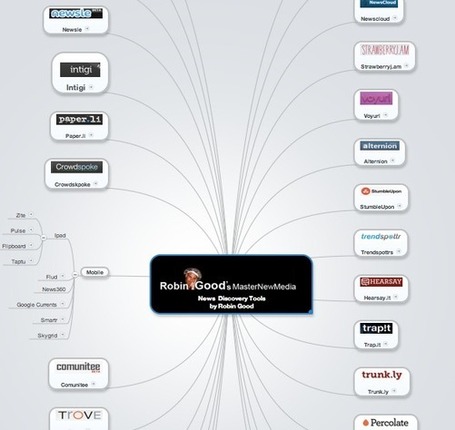
Here is my mindmap on news discovery tools which can help you in finding your best crop of interesting stories on the specific topic you are interested in.
It contains over 30 news discovery tools and services all with a direct link.
Groofer makes finding and sharing online information easier.
Instead of having to visit multiple web sites, Groofer let’s you and your team share search results and links directly from your browser so that they can be discussed and archived as needed.
You can also subscribe to, read and discuss your favorite feeds as a group and collectively stay informed on what’s important to you.
Making Search Social
Groofer makes searching and bookmarking social within your organization. You can easily rate or leave comments on links, search results and feeds in one secure private social network. Members of your team or work group can view the same results, see your comments, and add their thoughts too.
Sharing and Discussion
Groofer is built for sharing search results, links, news and blog articles, and group messages. It is the ability to add comments and context to search results that sets Groofer apart.
Collective Intelligence
Groofer automatically stores discussions and comments from group members and displays them as you search or read. You don’t have to do anything different. Work groups can also save relevant information on topics or research projects for easy access.
Your Own Private Social Network for Free
Groofer can also work as a private social network for your team or work group. You can create groups, send messages, share links and store information in folders aligned with your projects or interest areas. Try it now!
The Open World Forum is the leading global summit meeting bringing together decision-makers, communities and developers to cross-fertilize open technological, economic and social initiatives, in order to build the digital future.
The event was founded in 2008 and now takes place every year in Paris. With over 160 speakers from 50 countries and an international audience of 1,400 delegates in 2010, Open World Forum has grown very fast. The Forum is governed by steering group that brings together the leading international technological communities (Apache Software Foundation, Linux Foundation, Open Source Initiative, OW2 Consortium, Qualipso Consortium), and the main Open Source software associations from the French-speaking world (Adullact, AFUL, CNLL, PLOSS, Silicon Sentier), with support from major European and French institutions (the European Commission, the Paris City authorities, and the Ile-de-France regional council and regional development agency) (Agence Régionale de Développement).
The Forum’s partners include 70% of the key global players from the IT world.
The Open World Forum is being organized this year by the Systematic competitiveness cluster based in the Paris region, supported by a Forum Committee which brings together the main partners and contributors to the OWF (AF83, Alter Way, Bull, Systematic’s Open Software Special Interest Group and Smile).
Open Source Bridge is a conference for developers working with open source technologies and for people interested in learning the open source way.
Open Source Bridge is not a typical technical conference:
It’s entirely volunteer-run, by developers, for developers.
Session tracks are technology agnostic; the conference content is based around shared community experiences and similarities between projects, not differences.
Proposals are public from the start, and we welcome community comments before our content team selects the featured talks.
A hacker lounge is an integral part of the conference for code sprints, bug bashes, session deep dives, bouncing ideas, starting new projects or just mingling with other geeks.
As developers, we find ourselves in many roles; we are users, creators, and leaders. The Open Source Bridge team believes that our role as open source citizens informs our work whether we are conscious of it or not. Open Source Bridge is intended as a call to action to become better citizens, by sharing our knowledge with each other.
Open Source Bridge will take place June 26-29, 2012 in Portland, OR, with five tracks connecting people across projects, languages, and backgrounds to explore how we do our work and share why we participate in open source. The conference structure is designed to provide developers with an opportunity to learn from people they might not connect with at other events.
Outside of the conference, Portland offers many attractions for visiting geeks: Powell’s technical books, dozens of local brewpubs, countless great places to eat, and large green-spaces like Forest Park, all accessible by mass transit.
Open Source Bridge is a 100% volunteer-run, non-profit conference. Find out how to get involved now.