More than three years ago, the CIA dispatched a stealth surveillance drone into the skies over Iran.
The bat-winged aircraft penetrated more than 600 miles inside the country, captured images of Iran’s secret nuclear facility at Qom and then flew home. All the while, analysts at the CIA and other agencies watched carefully for any sign that the craft, dubbed the RQ-170 Sentinel, had been detected by Tehran’s air defenses on its maiden voyage.
“There was never even a ripple,” said a former senior U.S. intelligence official involved in the previously undisclosed mission.
CIA stealth drones scoured dozens of sites throughout Iran, making hundreds of passes over suspicious facilities, before a version of the RQ-170 crashed inside Iran’s borders in December. The surveillance has been part of what current and former U.S. officials describe as an intelligence surge that is aimed at Iran’s nuclear program and that has been gaining momentum since the final years of George W. Bush’s administration.
In September of 2010, a group of the Friends of the Freer and Sackler Museums of Washington DC were visiting Iran. As a former member of the board of these museums, I naturally extended an invitation for the group to visit the Malek Public Library and Museum in Tehran, an institution that was endowed by my grandfather to the Shrine of the Eighth Imam. To coincide with this visit, the Malek Library had organized a small exhibition of religious texts—Islamic, Christian, Zoroastrian and Jewish—at the center of which stood a magnificent 18th century Torah scroll. The scroll had been recently donated to the Malek Library by the Chief Rabi of one of Tehran’s synagogues, and the exhibition was meant to honor this donation. The donors of the scroll were therefore invited to attend the opening of the exhibition.
The Chief Rabi, or Khakham as they are called in Iran, was accompanied by a junior Rabi who spoke English and served as his interpreter. When one of the visitors asked the Chief Rabi “for how long have you lent the scroll to the Library?” he jokingly answered that “contrary to the general belief that Jewish people cannot depart with their precious belongings, this was not a loan but a donation.” Furthermore, the junior Rabi revealed that he taught two days a week at the Holy City of Ghom, at a seminary of Talmudic studies organized for Shiite theology students. To the American visitors, it looked surreal: while the official propaganda in the US portrayed Iran as a country bent on exterminating the Jews, in Iran proper, Rabis were donating gifts to an institution that operated under the aegis of a Shiite shrine, joked around, and taught the Talmud to theology students in Ghom.
When this was related by my sister to Eugene Schulman, an antiquarian and bibliophile friend in Geneva, he took it upon himself to complement the Rabis’ generous gift with one of his own: he donated to the Malek Library a most rare volume, a copy of the first edition of the first translation of the Koran into English by George Sale, published in 1734.
Today, there are of course those who, like Eugene Schulman, despite being of Jewish faith, see through Israeli propaganda and prefer a cordial approach to animosity. There are also those who like the Freer and Sackler visitors—one third of whom were also of Jewish faith—want to have a first-hand opinion and visit Iran. But for a vast majority of the population at large, who remain at the mercy of the virulent Israeli propaganda machine, Iran has been so demonized that the threat of bombing, and the killing of thousands of innocent civilians, almost seems to be an accepted right of Israel!
Phi Beta Iota: While Israel may still attack Iran after the November 2012 elections, Iran is not a nuclear threat and both Israel and the USA know this. Right now the primary purpose of the Iran “threat” is to drive oil prices up so really evil bets made on oil futures pay off, and to distract the world from the dramatic expansions of the settlements–not that we oppose them, but in the absence of a legitimate coherent Palestinian state with no ghettos and no walls, we do not believe the US taxpayer should be paying a single cent for anything having to do with Israel (or Arab militaries).
“The article begins with a definition: media literacy is the ability to access, analyse, evaluate and create messages across a variety of contexts. This four-component model is then examined for its applicability to the internet. Having advocated this skills-based approach to media literacy in relation to the internet, the article identifies some outstanding issues for new media literacy crucial to any policy of promoting media literacy among the population. The outcome is to extend our understanding of media literacy so as to encompass the historically and culturally conditioned relationship among three processes: (i) the symbolic and material representation of knowledge, culture and values; (ii) the diffusion of interpretative skills and abilities across a (stratified) population; and (iii) the institutional, especially, the state management of the power that access to and skilled use of knowledge brings to those who are ‘literate’.”
Phi Beta Iota: There are TWO new media / ICT literacies. This deals with the second, access. The first, Open Data Access, is still in a very retarded state for lack of standards, compliance, and commitment to actually making all information in all languages accessible via direct digital pathways or via human-enabled call centers. Media literacy among the five billion poor (whose annual aggregate income is four time that of the one billion rich) will be of little relevance in the absence of media literacy among the eight communities of information and intelligence (academy, civil society, commerce, government, law enforcement, media, military, non-governmental / non-profit).
Quito, Apr 2 (Prensa Latina) Latin America is the only region with capacity to propose innovative initiatives at the World Conference on Sustainable Development Río+20 in the context of today's global crisis, said Mario Ruales, advisor for Environmental Affairs.
Ruales told Prensa Latina they are taking to the event the agreements of the Ministerial Meeting in Quito.
He added there has been consensus on basic environmental issues at the heart of the Bolivarian Alliance for the Peoples of Our Americas (ALBA) and from the Community of Latin American and Caribbean Community (CELAC).
Among them he mentioned regional support to Ecuador's initiative to promote a Universal Declaration on the Rights of Nature, matching human rights'.
“The foundations needs to be removed, noted the expert, since Ecuador and the subcontinent agree that the economy is part of a bigger natural system.Exceeding its limits may bring irreversible damage on the planet”, he added.
“We need to warn on this situation and achieve a global pact to revert the process,” notes Ruales, but that demands renewed efforts to further build common platforms to hold successful global negotiations, “but individual initiatives will hardly be enforced.”
Negotiations are complicated, he adds, but they have proven it is possible to advance towards what should become the future of humanity relaying on savvy proposals.
Phi Beta Iota: A great deal appears to be happening south of the US border, the most obvious attribute of which is the absence of the US — and one supposes — the obliviousness of the US. Hybrid governance is emergent, and it is routing around the US Government. Others doing the same thing include the African Union (behind the scenes, while they play Africa Command as a “useful idiot”), the Paris-Berlin-Moscow axis, the rapidly evolving Iran-Turkey-Pakistan axis, and of course the continuing global — and highly nuanced as well as xtremely well-informed — Chinese advances across all domains. For the many who are unaware of CELAC, it is OAS without the US and Canada.
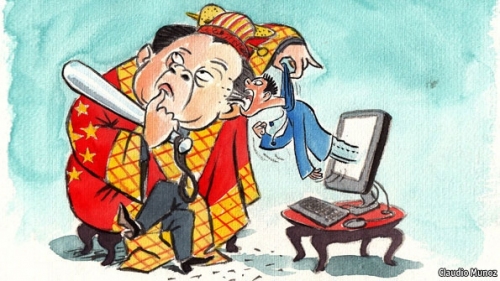
The Economist recently published a brilliant piece on China entitled: “The Power of Microblogs: Zombie Followers and Fake Re-Tweets.” BBC News followed with an equally excellent article: “Damaging Coup Rumors Ricochet Across China.” Combined, these articles reveal just how profound the digital disruption in China is likely to be now that Pandora’s Inbox has been opened.
The Economist article opens with an insightful historical comparison:
“In the year 15AD, during the short-lived Xin dynasty, a rumor spread that a yellow dragon, a symbol of the emperor, had inauspiciously crashed into a temple in the mountains of central China and died. Ten thousand people rushed to the site. The emperor Wang Mang, aggrieved by such seditious gossip, ordered arrests and interrogations to quash the rumor, but never found the source. He was dethroned and killed eight years later, and Han-dynasty rule was restored.”
Click on Image to Enlarge
“The next ruler, Emperor Guangwu, took a different approach, studying rumors as a barometer of public sentiment, according to a recent book Rumors in the Han Dynasty by Lu Zongli, a historian. Guangwu’s government compiled a ‘Rumors Report’, cataloguing people’s complaints about local officials, and making assessments that were passed to the emperor. The early Eastern Han dynasty became known for officials who were less corrupt and more attuned to the people.”
In present day China, a popular pastime among 250+ million Chinese users of microblogging platforms is to “spread news and rumors, both true and false, that challenge the official script of government officials and state-propaganda organs.” In Domination and the Arts of Resistance: Hidden Transcripts, James Scott distinguishes between public and hidden transcripts.
WASHINGTON — Law enforcement tracking of cellphones, once the province mainly of federal agents, has become a powerful and widely used surveillance tool for local police officials, with hundreds of departments, large and small, often using it aggressively with little or no court oversight, documents show.
The practice has become big business for cellphone companies, too, with a handful of carriers marketing a catalog of “surveillance fees” to police departments to determine a suspect’s location, trace phone calls and texts or provide other services. Some departments log dozens of traces a month for both emergencies and routine investigations.
With cellphones ubiquitous, the police call phone tracing a valuable weapon in emergencies like child abductions and suicide calls and investigations in drug cases and murders. One police training manual describes cellphones as “the virtual biographer of our daily activities,” providing a hunting ground for learning contacts and travels.
March 28, 2012 — CIO — Federal cybersecurity officials on Wednesday gave lawmakers a sobering warning about the vulnerabilities of critical information technology systems across the public and private sectors, describing a laundry list of threats and the challenge of keeping up with hackers who are continually seeking new methods of attack.
Appearing before a House subcommittee, cybersecurity authorities from the Department of Homeland Security, the Federal Communications Commission and other government arms testified to the work their agencies are undertaking in response to the ongoing threats, both internally and in concert with the private sector, but acknowledged that the challenges remain formidable and appealed for expanded government authority to shore up the nation's digital defenses.
“Cybersecurity threats are a real and present danger to our current economy and well being,” retired Adm. James Barnett, chief of the FCC's Public Safety and Homeland Security Bureau, told members of the Energy and Commerce Committee's Subcommittee on Communications and Technology. “No one would tolerate the level of criminality, thievery, vandalism or invasion of privacy if it were done in the physical world, and we really can no longer afford to tolerate it in cyberspace.”
Barnett and other witnesses described a wide range of threats and vulnerabilities that imperil communications networks, including weaknesses in the domain name system, or DNS, man-in-the middle attacks, route hijacking and weak spots in the supply chain.
But while there is broad agreement that the threats are severe and constantly evolving, deep divisions arise in the policy debate over what role the federal government should play in developing and overseeing the nation's digital defenses.
The Department of Homeland Security is at the center of that discussion. In the Senate, competing bills have emerged to address the cybersecurity challenge. One proposal, backed by Sens. Joe Lieberman (I-Conn.) and Susan Collins (R-Maine), would grant DHS new authorities to oversee private-sector digital infrastructure that was deemed critical. A competing bill takes a far more limited approach, focusing instead on facilitating the sharing of information about cyber threats among public and private entities. The Republicans backing that measure, the SECURE IT Act, have been sharply critical of DHS' performance on many security fronts, including cybersecurity.
Those same suspicions were on display in Wednesday's House hearing. Rep. Mary Bono Mack (R-Calif.), who yesterday introduced the companion bill to the SECURE IT Act in the lower chamber, cited the department's handling of the Chemical Facility Anti-Terrorism Standards program, which she said has squandered hundreds of millions of dollars without measurably improving the infrastructure of the chemical sector. How, then, could DHS be trusted to oversee cybersecurity?
Phi Beta Iota: The US Government is incompetent and does not represent the public interest. The only thing dumber than giving billions of dollars to the US Army and the Potemkin Village called “Cyber-Command” is to give any amount of money to the Department of Homeland Security (DHS) which is the lowest common denominator across the board. The fact is that the US Government is irrelevant to cyber-security–what expertise there is exists outside the government, and the government is the last to know anything, with nothing to contribute except hype and inflated printed money. Absent a non-violent revolution in governance, one that restores intelligence and integrity to the how of governance, what the US Government does in the cyber world is generally going to be part of the problem, not the solution.