…synthetic fuels would be a good interim option, especially if they could be cleanly produced — as Sunfire GmbH has done. The Dresden-based cleantech company has unveiled a rig — the first of its kind — that uses what it calls “Power-to-Liquid” technology to convert H2O and CO2 into liquid hydrocarbons — synthetic petrol, diesel and kerosene
Cooling eats up 15 per cent of the energy used by humans. A huge factor in making the transition out of the carbon era. As this report explains a new technology may change that game fundamentally. This is potentially very good news.
There is nothing rational about rebellion. To rebel against insurmountable odds is an act of faith. And without this faith the rebel is doomed. This faith is intrinsic to the rebel the way caution and prudence are intrinsic to those who seek to fit into existing power structures. The rebel, possessed by inner demons and angels, is driven by visions familiar to religious mystics. And it is the rebel alone who can save us from corporate tyranny. I do not know if these rebels will succeed. But I do know that a world without them is hopeless.
In the last section of my recent eight-part interview on the website The Real News with professor Sheldon Wolin, the author of “Politics and Vision” and “Democracy Incorporated,” I asked him whether it was time to begin to consider revolution.
I read a pretty darned amazing article “Is Free Enterprise Search a Game Changer?” My initial reaction was, “Didn’t the game change with the failures of flagship enterprise search systems?” And “Didn’t the cost and complexity of many enterprise search deployments fuel the emergence of the free and open source information retrieval systems?”
Many proprietary vendors are struggling to generate sustainable revenues and pay back increasingly impatient stakeholders. The reality is that the proprietary enterprise search “survivors” fear meeting the fate of Convera, Delphes, Entopia, Perfect Search, Siderean Software, TREX, and other proprietary vendors. These outfits went away.
The non carbon energy trend is gathering momentum at a surprising rate, and it is very good news. Here is The New York Times view, which I consider an establishment perspective and all the more surprising for that.
The cost of providing electricity from wind and solar power plants has plummeted over the last five years, so much so that in some markets renewable generation is now cheaper than coal or natural gas.
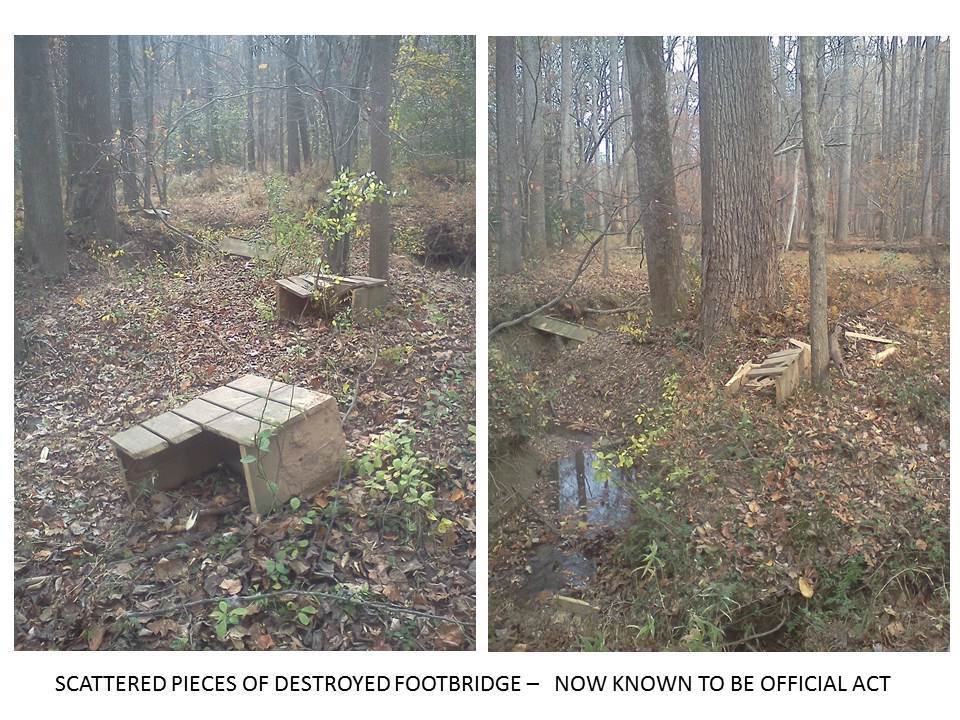
Three weeks ago the Fairfax County Park Authority destroyed a perfectly good footbridge built by the Miller Heights Neighborhood Association over a decade ago, one of three that enabled hundreds of people and their dogs to walk the full length of the stream trail, with views of running water and birds, including our neighborhood heron, that are priceless.
Today that bridge is being rebuilt by the Park Authority and we have temporarily brought to a half the destruction of all footbridges across the County. The old policy still in force considers footbridges built by citizens (peasants with no standing under the old mind-set) to be encroachments as well as potential safety and legal liabilities.
Below, with photographs, I tell the story of how nineteen citizens, aided by interest from the Boy Scouts of America, were able to get their footbridge back and stop — at least for a time — a very destructive policy. This is a story about re-inventing democracy. How the story ends for the County at large is not yet clear but right this minute, the Chairman (Sharon Bulova), the Park Authority, the Scouts, and our engaged citizens all look good — if this goes as I hope, we will create a new national standard in hybrid governance for stream trails, anchored in a new Scout Trailkeepers Program and perhaps even a new Eagle Scout merit badge, while taking Homeowner Associations (HOA) on a political test drive, focused on substance and divorced from the two-party duopoly that could care less about citizen grass roots rights and concerns.
Raphael Hörler from Zurich’s ETH University has just completed his thesis on the role of crowdsourcing in humanitarian action. His valuable research offers one of the most up-to-date and comprehensive reviews of the principal players and humanitarian technologies in action today. In short, I highly recommend this important resource. Raphael’s full thesis is available here (PDF).