Michael S. Rozeff: Is the US a Failed State?

Cultural Intelligence
Michael S. Rozeff
Michael S. Rozeff

The U.S. Is a Failed State: Dissolve It

By

July 23, 2013

America is a very sick patient with a curable cancer that, if left alone, will cause death. The cancer is the Union or the state known as the U.S.A. More commonly, the Union and the U.S.A. are referred to as the U.S. government, the federal government or simply the government. It is the body established by the Constitution that administers the powers described in that Constitution. Phasing out and dissolving the U.S. government, which can be done by constitutional means, will remove the cancer and restore a degree of health.

Ending the Union will certainly not cure all of America’s ills, because they trace back to wrong and false ideas. These are like bad habits, genetic and environmental factors that cause cancer. If they are not changed, the cancer will come back. The search for non-destructive politics is as never-ending as the search for health and longevity.

The main reason why Americans should dissolve the Union is that it is a failed state. For those who believe in the efficacy and goodness of states, their most essential, central and important task is to keep the peace within their domain. This goal entails protecting the lives and property of the citizens under its protection, the people of the United States.

Perfection of the government at keeping the peace is not to be expected. A certain amount of failure of a state to keep the peace is normal and tolerable, but at some point when war becomes the norm or becomes so extensive, permanent and destructive that keeping the peace is all but forgotten or impossible to attain, we can safely declare that the state has failed. This has happened with the U.S.

Read full article.

See Also:

2011 Thinking About Revolution in the USA and Elsewhere (Full Text Online for Google Translate)
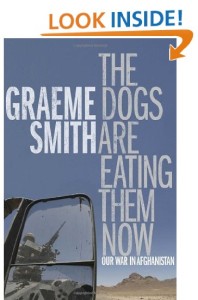
‘A study of how do you know anything in Afghanistan’: An Interview with Weston Prize-winner Graeme Smith

Cultural Intelligence
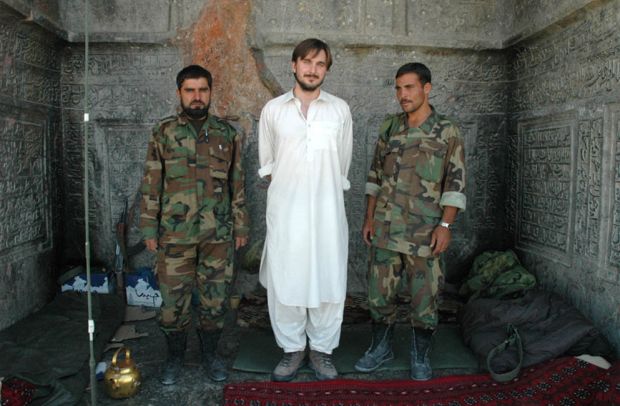
Graeme Smith in Kandahar

‘A study of how do you know anything in Afghanistan’: An Interview with Weston Prize-winner Graeme Smith

Hannah Moscovitch

Random House, October 21, 2013

The author of The Dogs Are Eating Them Now talks with playwright Hannah Moscovitch.

EXTRACTS:

Partly, it’s just that in any war—but especially a place as alien as Afghanistan—you have to be very careful about the conclusions you draw. I’ve been wrong so many times with so many things in Afghanistan. So many foreigners have misjudged the situation that you have to be so, so cautious about how you know anything. It’s almost a kind of interesting epistemological study of how do you know anything in Afghanistan.

. . . . . . .

Amazon Page
Amazon Page

I think we went through a whole transformation in our understanding of who it was we were fighting. Operation Medusa was that moment for me where I started to think, “Oh, okay, maybe we’re not fighting Al-Qaeda in the fields, maybe we’re not fighting people who intend to fly airplanes into buildings in the West. Maybe we’re fighting a bunch of ignorant farmers who have decided to join the Taliban because they’re really pissed off.”

If you look back in the record, especially 2003 to 2006, people would use Al-Qaeda and Taliban in the same breath when talking about our enemies. As things progressed, they started to make the distinction. My friend Alex Strick van Linschoten and Felix Kuehn, two very good academics, wrote an entire book called An Enemy We Created. It’s a fantastic book, I think they’ve only sold fewer than 700 copies which is a terrible shame because it describes the distinction between Al-Qaeda and the Taliban and how they were connected briefly and how they fought each other.

. . . . . . .

I think the task they were given, the tools and the task were never really matched up.

. . . . . . .

Endless books will be written about why this didn’t work. We’re just now reaching a point in the conversation with ourselves where we’re able to reflect on why this didn’t work.

. . . . . . .

It’s a very humbling thing, working in Afghanistan.

Read full interview.

Anthony Judge: Psychosocial Implication of Without Within Enjoying going solar for oneself

Cultural Intelligence
Anthony Judge
Anthony Judge

Psychosocial Implication of Without Within

Enjoying going solar for oneself

Introduction
Going solar as an exercise in technomimicry
Planets “within” as vehicles for significance?
Internalizing alternative modes of transportation
Objects, projects, rejects and subjects
Questionable objectification of the natural environment
Dominion over the world “without” — understood as being “within”
Problems of society as “within” rather than “without”
Transforming awareness framed by stellar evolution
Ignorance “without” as re-cognized “within”
Conclusion
References

Stephen Aftergood: What Is Overclassification?

10 Security, 11 Society, Definitions, Government, Ineptitude, IO Impotency, Military, Officers Call
Steven Aftergood
Steven Aftergood

WHAT IS OVERCLASSIFICATION?

When people criticize overclassification of national security information, what exactly are they talking about?  Is it too much secrecy?  The wrong sort of secrecy?  Classifying something at too high a level?  Oddly, there is no widely-accepted definition of the term.

But since the solution to overclassification, if any, will naturally be shaped by the way the problem is understood, it is important to specify the problem as clearly as possible.

In 2010 Congress passed (and President Obama signed) the Reducing Over-Classification Act, which mandated several steps to improve classification practices in the executive branch.  But in a minor act of legislative malpractice, Congress failed to define the meaning of the term “over-classification” (as it was spelled in the statute).  So it is not entirely clear what the Act was supposed to “reduce.”

Among its provisions, the Act required the Inspectors General of all classifying agencies to perform an evaluation of each agency's compliance with classification rules.

To assist them in their evaluations, the Inspectors General turned to the Information Security Oversight Office (ISOO) for a working definition of overclassification that they could use to perform their task.  ISOO's answer was cited by the Inspector General of the Department of Justice in its new report.  (Audit of DOJ's Implementation of and Compliance with Certain Classification Requirements, Inspector General Audit Report 13-40, September 2013.)

    “Over-classification,” according to ISOO, means “the designation of information as classified when the information does not meet one or more of the standards for classification under section 1.1 of

Executive Order (EO) 13526

    .”  If something is classified in violation of the standards of the executive order– then it is “over-classified.”


So, for example, information that is not owned by the government, such as a newspaper article, cannot be properly classified under the terms of the executive order.  And neither can information that has no bearing on national security, such as an Embassy dinner menu.  And yet information in both categories has been known to be classified, which is indeed a species of overclassification.

Unfortunately, however, this ISOO definition presents the problem so narrowly that it misses whole dimensions of overclassification.


Continue reading “Stephen Aftergood: What Is Overclassification?”

Berto Jongman: John Naugton on Edward Snowden and Public Indifference About Total Surveillance

09 Justice, 11 Society, Cultural Intelligence
Berto Jongman
Berto Jongman

Edward Snowden: public indifference is the real enemy in the NSA affair

Most people don't seem to worry that government agencies are collecting their personal data. Is it ignorance or apathy?

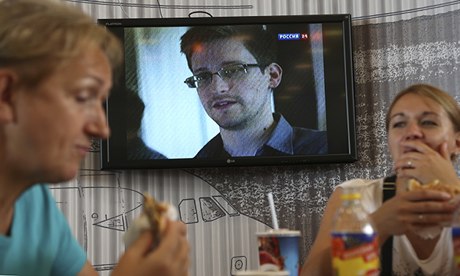
Edward Snowden's revelations exposed a terrifying level of ‘passive acceptance' of surveillance. Photograph: Sergei Grits/AP

One of the most disturbing aspects of the public response to Edward Snowden‘s revelations about the scale of governmental surveillance is how little public disquiet there appears to be about it. A recent YouGov poll, for example, asked respondents whether the British security services have too many or too few powers to carry out surveillance on ordinary people. Forty-two per cent said that they thought the balance was “about right” and a further 22% thought that the security services did not have enough powers. In another question, respondents were asked whether they thought Snowden's revelations were a good or a bad thing; 43% thought they were bad and only 35% thought they were good.

Edward Snowden

Writing in these pages a few weeks ago, Henry Porter expressed his own frustration at this public complacency. “Today, apparently,” he wrote, “we are at ease with a system of near total intrusion that would have horrified every adult Briton 25 years ago. Back then, western spies acknowledged the importance of freedom by honouring the survivors of those networks; now, they spy on their own people. We have changed, that is obvious, and, to be honest, I wonder whether I, and others who care about privacy and freedom, have been left behind by societies that accept surveillance as a part of the sophisticated world we live in.”

I share Henry's bafflement. At one point I thought that the level of public complacency about the revelations was a reflection simply of ignorance. After all, most people who use the internet and mobile phones have no idea about how any of this stuff works and so may be naive about the implications of state agencies being able to scoop up everybody's email metadata, call logs, click streams, friendship networks and so on.

Continue reading “Berto Jongman: John Naugton on Edward Snowden and Public Indifference About Total Surveillance”

4th Media: 4 in 5 in US Face Near-Poverty, No Work

01 Poverty, 03 Economy, 07 Other Atrocities, 11 Society

4th media cropped4 in 5 in US Face Near-Poverty, No Work

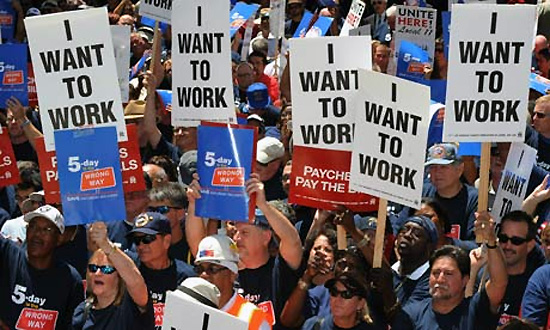
Four out of 5 U.S. adults struggle with joblessness, near-poverty or reliance on welfare for at least parts of their lives, a sign of deteriorating economic security and an elusive American dream.

Click on Image to Enlarge

Survey data exclusive to The Associated Press points to an increasingly globalized U.S. economy, the widening gap between rich and poor, and the loss of good-paying manufacturing jobs as reasons for the trend.

The findings come as President Obama tries to renew his administration’s emphasis on the economy, saying in recent speeches that his highest priority is to “rebuild ladders of opportunity” and reverse income inequality.

As nonwhites approach a numerical majority in the U.S., one question is how public programs to lift the disadvantaged should be best focused — on the affirmative action that historically has tried to eliminate the racial barriers seen as the major impediment to economic equality, or simply on improving socioeconomic status for all, regardless of race.

Read full article with excellent photos and graphics.

Eagle: Charles Hugh Smith on the Poverty of Our Political Theater of the Absurd

Cultural Intelligence
300 Million Talons...
300 Million Talons…

The Poverty of our Political Theater of the Absurd

The public sphere has been effectively stripped of everything but corny, irritatingly hammy political theater.

All we have left in the U.S. is a deeply impoverishing Political Theater of the Absurd. Policy, theory and governance have all been reduced to competing stage performances in the Theater of the Absurd. The actors are transparently given to farcical overacting in exaggerated dramas drained of meaning; they proceed through the cliched motions as if the audience hadn't seen the same charades overplayed dozens of times before.

“Government shutdown” and “debt ceiling” may have engaged audiences starved for entertainment in a bygone age, but now they exemplify a theater that is so impoverished it can only re-stage tired formulaic dramas with a savage appetite for incompetence and buffoonery.

Continue reading “Eagle: Charles Hugh Smith on the Poverty of Our Political Theater of the Absurd”

noble gold