Geek comedian Tom Scott imagines citizen volunteers accessing the real-time data store of spy agencies to help keep the country safe.
Imagine that the NSA and the U.K.'s GCHQ opened their databases and tools to public volunteers to aid them in the search for terrorists. Tom Scott, who is described as a British geek comedian, programmer, and presenter, produced a video, “Oversight: Thank you for volunteering, citizen,” that imagines ordinary citizens accessing the databases of everything about everyone to assist governments in their surveillance activities.
Scott's “Oversight” program lets ordinary citizens click on potential threats as they are logged, such as an e-mail with the words “blowing things up” in it; view the information; and add information to spy agency databases.
Who Are They? What Do They Want? Why Do They Fight?
This paper presents the results of 78 in-depth interviews conducted with self-identified Afghan insurgents. If the interviewees are indeed representative of broader Taliban sentiments, then the future of Afghanistan is grim. It appears that only the return of a ‘pious’ Islamic government will satisfy them.
Maryland may soon join Oregon in exploring solutions to the crisis of student debt and unaffordable education.
Education is supposed to be a human right. But the United States puts people into deep debt to pay for it. Short of taxing billionaires or dismantling bombers (both of which we're all, I hope, working on), what's the solution?
This is not a plan to make education truly free, and that would probably be ideal. But this is not, I think, a step that would move us away from that goal — in the way that strengthening but tweaking the private health insurance system arguably moves us away from a single-payer solution.
This is, however, a plan that makes college tuition at state universities initially free.
Rami G. Khouri is Editor-at-large of The Daily Star, and Director of the Issam Fares Institute for Public Policy and International Affairs at the American University of Beirut, in Beirut, Lebanon. You can follow him @ramikhouri.
BEIRUT — I would love to know who the jerk is who wrote the White House’s press statement on the occasion of the inauguration earlier this week of the new Iranian President, Hassan Rouhani. I say this is the work of a jerk, or a band of war-addicted zealots in Washington, D.C., because it seems designed to totally bury the opportunity that Rouhani represents to improve the wellbeing of Iranians and resolve Western-Iranian and Arab-Iranian tensions on a variety of important issues.
Afghanistan: Afghan Taliban leader, Mullah Muhammad Omar, published his annual Id al-Fitr address, which commemorates the end of Ramadan. The address contained several familiar themes. Most important for NATO forces is that Omar urged the Taliban to continue to attack foreign forces in the name of all Afghans. He said he would support only a fully Islamic government and denounced the current government in Kabul as a bunch of “hirelings” and urged Afghans not to work with them.
“I reiterate once again that we do not think of monopolizing power,” he said in the statement. “Those who truly love Islam and the country and have commitment to both, whoever they may be or whichever ethnicity or geographical location they hail from, this homeland is theirs.” He also denounced democracy as a waste of time.
Western media coverage of the address cherry-picked the headlines. Some interpreted the quote above as an assertion that the Taliban no longer intend to take power after NATO forces depart. That is wishful thinking that takes the comment about monopolizing power out of the context of establishing a fully Islamic state.
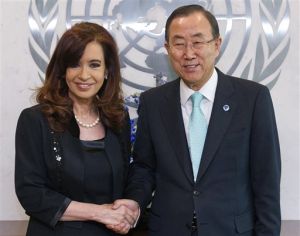
Argentina's President Cristina Fernandez used the opportunity of presiding over the U.N. Security Council for the first time Tuesday to take aim at the veto power of its five permanent members _ the United States, Russia, China, Britain and France.
Fernandez also criticized member states that don't implement U.N. resolutions, citing unheeded demands for a Palestinian state and Britain's refusal to engage in talks about the disputed Falkland Islands, which Argentina calls the Malvinas.
. . . . . . .
Argentine President at UN
She said the veto was a safeguard during the Cold War to prevent “nuclear holocaust” _ but today the United States and Russia sit at the same table “and we can't deal with the problems in this new world with old instruments and old methods.”
Fernandez pointed to two Latin American organizations _ the Community of Latin American and Caribbean States and the Union of South American Nations _ which take decisions on the basis of unanimity when there is a conflict. By contrast, she criticized the use of vetoes by the permanent members of the Security Council.
Russia and China have vetoed three Western-backed resolutions to pressure Syrian President Bashar Assad to end the 2 1/2 year conflict that has killed more than 100,000 people, and the United States, Israel's closest ally, has vetoed numerous resolutions over the years on the Palestinian conflict with Israel.
Fernandez strongly supported the Arab League's U.N. observer Ahmed Fathalla who said all 193 U.N. member states must implement U.N. resolutions
With one-liners like, “We are excellent at launching Tomahawk missiles; we need to get better at launching ideas,” it is not hard to appreciate why The New York Timeslabeled recently retired Admiral James Stavridis a “Renaissance admiral.” Labels like “innovator” and “thought leader” may be overused, but Stavridis lives up to the hype, nudging the U.S. military not only to be more adaptive and less insular, but also to re-examine its role in international conflict resolution in places like Latin America and Afghanistan.
The former Aircraft Carrier Group Commander, TED Talk guest, author and overlord of all NATO missions, including the 2011 NATO-led operation in Libya, champions a revolutionary approach to the most vexing conflicts of our day. Stavridis has challenged the stagnant military culture and pushed for the transformation of organizations like U.S. Southern Command from an old school military planning citadel to an agile organization better able to “plug ‘n play” with non-traditional partners. The admiral believes the U.S. can help partners to end conflict quickly, reconstruct and then develop through the application of “smart power”:the effective combination of soft power (diplomacy and development) and hard power (military might).