Mini-Me: Slow Ideas

Cultural Intelligence
Who?  Mini-Me?
Who? Mini-Me?

Huh?

SLOW IDEAS

Why do some innovations spread so swiftly and others so slowly? Consider the very different trajectories of surgical anesthesia and antiseptics, both of which were discovered in the nineteenth century.

Atul Gawande

New Yorker, 29 July 2013

EXTRACTS:

So what were the key differences? First, one combatted a visible and immediate problem (pain); the other combatted an invisible problem (germs) whose effects wouldn’t be manifest until well after the operation. Second, although both made life better for patients, only one made life better for doctors.

. . . . . . . .

This has been the pattern of many important but stalled ideas. They attack problems that are big but, to most people, invisible; and making them work can be tedious, if not outright painful.


Continue reading “Mini-Me: Slow Ideas”

Owl: US Media Ignores Major Egyptian Protests Focused on Barack Obama & US Ambassador Specifically

Corruption, IO Deeds of War, IO Impotency, Media
Who?  Who?
Who? Who?

Egyptians in the Street Despise Obama and US Diplomat Anne Patterson

Curiously, a massive wave of anti-Obama sentiment in Egypt has been utterly ignored by vintage media, even though the protests may be the largest in all of human history.

15 Photos From the Tahrir Square Protests You'll Never See In Legacy Media. #Egypt #Morsi #Obama

Click on Image to Enlarge

Phi Beta Iota:  The many signs, both hung banners and neatly printed hand posters in perfect English, are clearly “organized” but they are also clearly what the protesters want to say.  As a general statement, the US Government and Obama and the US Ambassador are considered to be severely hypocritical and not at all supportive of any form of democracy.

Anne Wood Patterson
Anne Woods Patterson

Unlike many Ambassadors who bought their position with campaign contributions, Anne Woods Patterson is a professional who took 20 years to go from entry level to Deputy Assistant Secretary of State for Inter-American Affairs and has been an Ambassador to various countries for the past fifteen years.  She is considered by Egyptians to be too close to the Muslim Brotherhood.

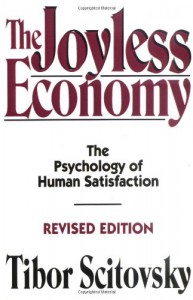
Worth a Look: The Joyless Economy – The Psychology of Human Satisfaction

Worth A Look
Amazon Page
Amazon Page

When this classic work was first published in 1976, its central tenet–more is not necessarily better–placed it in direct conflict with mainstream thought in economics. Within a few years, however, this apparently paradoxical claim was gaining wide acceptance. Scitovsky's ground-breaking book was the first to apply theories of behaviorist psychology to questions of consumer behavior and to do so in clear, non-technical language. Setting out to analyze the failures of our consumerist lifestyle, Scitovsky concluded that people's need for stimulation is so vital that it can lead to violence if not satisfied by novelty–whether in challenging work, art, fashion, gadgets, late-model cars, or scandal.

Though much of the book stands as a record of American post-war prosperity and its accompanying problems, the revised edition also takes into account recent social and economic changes. A new preface and a foreword by economist Robert Frank introduce some of the issues created by those changes and two revised chapters develop them, discussing among others the assimilation of counter-cultural ideas throughout American society, especially ideas concerning quality of life. Scitovsky draws fascinating connections between the new elite of college-educated consumers and the emergence of a growing underclass plagued by drugs and violence, perceptively tracing the reactions of these disparate groups to the problems of leisure and boredom.

In the wake of the so-called “decade of greed” and amidst calls for a “kindler, gentler” society, The Joyless Economy seems more timely than ever.

Eagle: Local Resilience: Software Defined Supply Chain + True Cost Economics?

IO Technologies
300 Million Talons...
300 Million Talons…

Thanks to the growth of 3D printing, intelligent robots, and open-source hardware, tomorrow’s supply chains will be faster, smaller, cheaper, and local.

Nothing exemplifies the exceptional power and scale of today’s highest performing supply chains than the simple phrase: designed in California, assembled In China. Behind that elegant phrase are some of the world’s most sophisticated supply-chain processes, stitching together networks of suppliers, sub-assemblers and logistics companies around the globe.

Supply chains today are big, complex and global. Keeping them humming is an enormous challenge. But does it have to be that way? We think the world is entering the era of small, simple and local supply chains, powered by a new generation of manufacturing technologies such as 3D printing, intelligent assembly robotics and open-source hardware – also known as the Software Defined Supply Chain.

Learn more.

Phi Beta Iota:  When True Cost Economics becomes a mainstream app,  this will change everything as it will gut those who externalize costs of water, fuel, child labor, and tax avoidance.

Stephen E. Arnold: Automated Analytics Ramps Up — Robert Steele Comments

IO Sense-Making
Stephen E. Arnold
Stephen E. Arnold

Big Names Ramping up the Analytics Field

Posted: 22 Jul 2013 11:41 AM PDT

The world of analytics is getting much more competitive. We’ve been seeing some impressive names belly up to the bar or revamp their already available platforms. One such case we discovered in a recent Daily Finance article, “Actuate’s Newest Release of BIRT Analytics Add Key Advanced Predictive Analytics for Business Analysis.”

According to the story:

“Adding to its already rich set of capabilities for business analyst-driven predictive analytics, BIRT Analytics 4.2 sports three new advanced features: Association Rules for detecting purchase patterns over time (for instance in grocery receipts by and across customer segments); Decision Tree, which allows prediction of outcomes based on decision paths; and Campaign Workflow to enable you to effectively execute campaigns based on the analysis, and set up a process to improve them based on analyzing the results.”

While we have extremely high hopes for this new edition of BIRT, we are aware that it’s a long, hard climb to the top of the analytics mountain. Personally, we think organizations like Oracle and Sinequa do a better job. We are patiently waiting to watch BIRT burst to the top of the charts, but know that it might never happen. Such is the world of analytics, be warned.

Patrick Roland, July 23, 2013

Sponsored by ArnoldIT.com, developer of Beyond Search

Continue reading “Stephen E. Arnold: Automated Analytics Ramps Up — Robert Steele Comments”