Global Hawk (Block 30), one of the more obvious vampires sucking money out of the defense budget, has been disinterred from its coffin by corporate go-fers in Congress. The story of this high cost, low performance drone makes obvious that filibuster abuse and political dogmatism are not the only problems in Congress. Two really excellent pieces of work explain the gruesome details.
Aram Roston at the Defense News series of publications published on July 15 an excellent summary of the issues. Find the article and some useful side box material at http://www.airforcetimes.com/article/20130715/NEWS04/307150015/The-battle-over-Global-Hawk. Kudos to the editors at Defense News for allowing their corporate-ad-populated publication to release this excellent example of highly independent journalistic professionalism.
Richard Sia and Alexander Cohen at the Center for Public Integrity released on July 16 their own analysis, also truly excellent, that dives deep into the issues, especially the corruption surrounding Congress' action on Global Hawk/Block 30. Find it, also with important side-material and links, at http://www.publicintegrity.org/2013/07/16/12969/huge-drone-could-not-be-grounded.
As an aside, I note that the CPI piece briefly cites Rep. Roscoe Bartlett (R-MD), my representative in Congress last year, who “played a key role in blocking the retirement of Block 30 [Global Hawk].” Bartlett is also quoted in the CPI piece lecturing Members of Congress for putting pork above the national interest. Bartlett somehow forgot to mention that there is a significant Northrop-Grumman facility in his district, just a few miles from my house in Hagerstown, MD. But surely, that had nothing to do with his support for their product. Right.
An embodiment of all that is wrong with institutions like the House Armed Services Committee, where he presided over a major subcommittee, Bartlett was involuntarily retired in the 2012 elections.

Tell me it’s a sick joke: Former U.S. Treasury Secretary Lawrence Summers, the guy who tops the list of those responsible for sabotaging the world’s economy, is lobbying to be the next chairman of the Federal Reserve. But no, it makes perfect sense, since Summers has long succeeded spectacularly by failing.
Why should his miserable record in the Clinton and Obama administrations hold him back from future disastrous adventures at our expense? With Ben Bernanke set to step down in January, and Obama still in deep denial over the pain and damage his former top economic adviser Summers brought to tens of millions of Americans, this darling of Wall Street has yet another shot to savage the economy.
Stupid, Sexist, Sleazy — What's Not to Like?
Summers was one of the key players during the Clinton years in creating the mortgage derivative bubble that ended up costing tens of millions of Americans their homes and life savings. This is the genius who, as Clinton’s Treasury secretary, supported the banking lobby’s successful effort to make the sale of unregulated bundles of mortgage securities and the phony insurance swaps that backed them perfectly legal and totally unmonitored. Those are the toxic bundles that the Federal Reserve is still unloading from the banks at a cost of trillions of dollars.
But back on July 30, 1998, when he was deputy Treasury secretary, Summers assured the Senate agriculture committee that the “thriving” derivatives market was the driving force of American prosperity and would be fatally hurt by any government regulation of the sort proposed by Brooksley Born, the stunningly prescient chair of the Commodity Futures Trading Commission.
Summers opined that “the parties to these kinds of contracts are largely sophisticated financial institutions that would appear to be eminently capable of protecting themselves from fraud and counterparty insolvencies. … ”
Consider the astounding stupidity of that statement and the utter ignorance upon which it was based. One financial CEO after another has testified to not knowing how the derivatives were created and why their worth evaporated. Think of AIG and the other marketers of these products that were saved from disaster only by the injection of government funds not available to foreclosed homeowners whose mortgages were wrapped into those toxic securities.
Part of the reason nothing is being done about climate change is the naked bias of some of the major corporate media institutions. This story is particularly pernicious, because Reuters is not a single newspaper, or television station but, like the Associated Press, a service used by almost all newspapers.
My sense, for myself, is that we have moved into a new cognitive space in which issues of comprehensibility, credibility and deliverability become fundamental in a context in which attention time is limited.
I no longer think that rational articulations can be either comprehended or delivered — other than use of missiles, if that is to be framed as rational.
Little attention is given to the decision-making dynamics and what to do with those who disagree — other than to design them out
Also of relevance is how to design in that which others perceive as having been designed out.
I think the scope for dialogue on such matters is now very limited. It is interesting to note the messy range of comments on any proposed scheme in a newspaper article. There is no scope or suggestion to map those in any meaningful way. The assumption is that some are “wrong” and some are “right” — with each variously labeling the other. No use is made of argument mapping techniques. Why is the interesting question.
There are many web data extraction programs and some cloud services available and they vary widely in cost and features. In this post, we’ve summarized them below to help you to make your choice. All of these programs have been either tested by us or have been in general use for web ripping. We hope these brief overviews and the following reviews will help you choose a web scraper for your purposes.
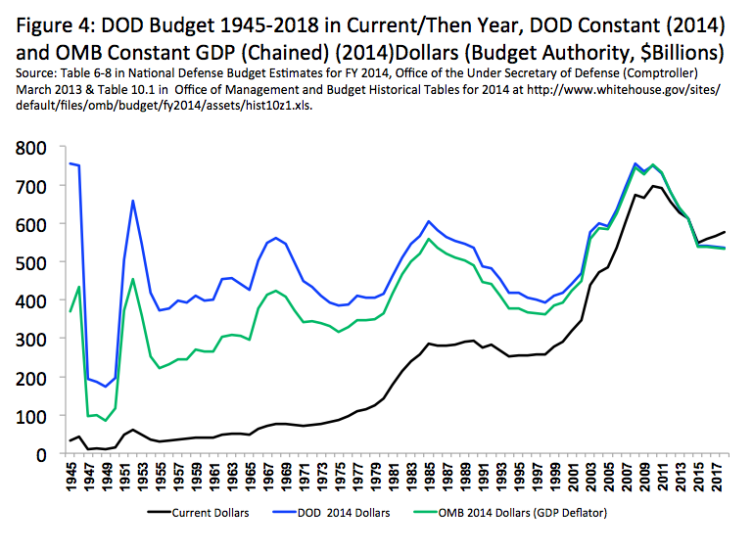
“If Congress goes along [by approving President Obama's 2014 DOD budget request], Pentagon spending levels will exceed any previous high by any other president in any year in peace or in war since the death of President Roosevelt in 1945, except for President George W. Bush from 2006 to 2008.”
“…current military spending is lapping at historic highs, not lows.”
The Defense Budget Is Even Larger Than You Think: part two of two
Given the warped measures that high-spending advocates and the Defense Department use to calibrate past, present and future defense spending (described here Monday), it is important to find an independent, objective yardstick to measure Pentagon spending trends accurately.
Unfortunately, there isn't one.
If there were, this debate would be over, and I could retire.
Click on Image to Enlarge
The Bureau of Economic Analysis in the Commerce Department might be tasked with the job of finding one, but it actually plays a major role in devising the Pentagon's self-serving measures of inflation. The Office of Management and Budget has its own deflators that are only slightly different.
Both embrace the proposition that a large portion of cost growth in Pentagon spending should be counted as inflation: the Pentagon experiences more inflation than other agencies and should get more money-the argument goes.
In the 1980s, the Congressional Military Reform Caucus argued that the Pentagon should be held to an independent but analogous measure of inflation, and identified the Producer Price Index as most appropriate. Others, especially the Defense Department, disagreed.
The differences will not be resolved here, but the question remains: what would the Pentagon's budget history look like if it lived by the rules followed by most everyone else – especially the rest of the federal government, and the American economy?
A new study of global wealth says prosperity peaked around 1978, and we’ve been heading downhill ever since. New Scientist reports.
Governments have tended to build economic policies around gross domestic product (GDP), the sum of all monetary transactions in an economy. GDP has risen fairly steadily — and often dramatically — since the second world war, implying the world has become more prosperous. Critics point out, however, that GDP only tells part of the story.
For a more comprehensive measure — one that accounts for social factors and environmental costs — economists started using the Genuine Progress Indicator (GPI). It adjusts expenditure in 26 ways to account for costs like pollution, crime and inequality, and for beneficial activities where no money changes hands, such as housework and volunteering.